⚔ Brawlhalla Elo Calculator
Estimate ranked 1v1 or 2v2 Elo change, projected rating, rank band, team average, and placement-match volatility before the next set.
| Band | Elo range | What it means |
|---|---|---|
| Tin | 200 to 909 | Starter ladder and early placement fallout. |
| Bronze | 910 to 1129 | Basic punish windows and movement habits form. |
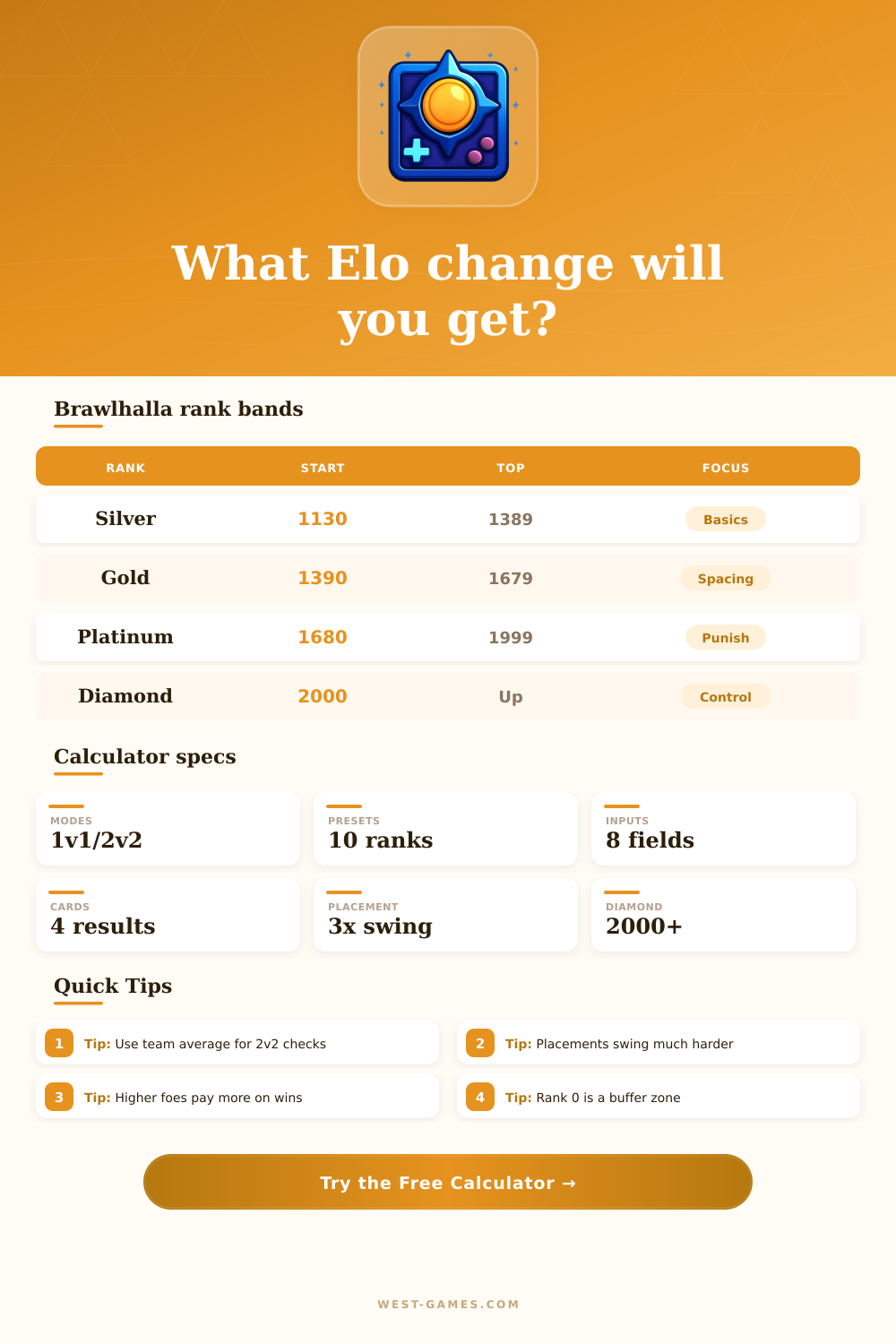
| Silver | 1130 to 1389 | Most players learn stable neutral and recovery routes. |
| Gold | 1390 to 1679 | Spacing, dodge reads, and weapon comfort matter. |
| Platinum | 1680 to 1999 | Consistent punishes and matchup knowledge decide sets. |
| Diamond | 2000 and higher | No standard tier split; high ladder starts here. |
| Tier | Low | High | Next jump |
|---|---|---|---|
| Bronze 5 | 1086 | 1129 | Silver at 1130 |
| Silver 5 | 1338 | 1389 | Gold at 1390 |
| Gold 5 | 1622 | 1679 | Plat at 1680 |
| Platinum 5 | 1936 | 1999 | Diamond at 2000 |
| Diamond | 2000 | Open | Leaderboard race |
| Gap | Favored win | Underdog win | Planning note |
|---|---|---|---|
| 0 Elo | 50% | 50% | Even set; normal swing. |
| +100 Elo | 64% | 36% | Favorite loses more on upset. |
| +200 Elo | 76% | 24% | Underdog win pays strongly. |
| +300 Elo | 85% | 15% | Loss is expected for the lower side. |
| +400 Elo | 91% | 9% | Huge mismatch in standard Elo math. |
| Setting | Factor | Use case |
|---|---|---|
| 1v1 ranked | 32 base | Personal ladder planning. |
| 2v2 ranked | 28 base | Team average estimate. |
| Placement | 3.00x | First 10 ranked matches of a season. |
| Early season | 1.35x | Soft reset and unsettled ladder feel. |
| Stable veteran | 0.85x | Lower movement after many games. |
| Scenario | Input to use | Result to watch | Why it matters |
|---|---|---|---|
| One more game before Gold | Your current Elo and likely opponent Elo | Elo to next band | Shows whether a normal win reaches the cutoff. |
| 2v2 with a lower teammate | Your Elo, teammate Elo, enemy average | Team average and win chance | The same enemy team can be easier or harder depending on partner rating. |
| Placement match gamble | Placement uncertainty and expected enemy Elo | Adjusted Elo factor | A close match can move like several normal games. |
| Diamond gate check | Platinum 5 or high Platinum rating | Projected Elo and rank band | Tests whether the next result crosses 2000. |
| Upset hunting | Opponent much higher than your rating | Expected win chance and change | Low probability wins are the biggest positive swings. |
Rank 0 buffer zones can appear after deranking; this calculator reports the visible threshold band from the projected Elo.
Brawlhalla ranked is based off a formula that determines how much a players rating change after every game that they play. Although a player may experience losing game that feel like bad luck, that loss can still move their rating below a specific threshold. To understand how much a player’s rating will change after any game, a variety of factors must be consider.
Factors include the player’s current rating, the average rating of the opponents that they play, and whether they are playing matches against another teammate or playing placement matches alone. When players competes against others of similar rating, there will be small changes to the players’ ratings. However, if a player of a higher ranking defeats a player of a lower ranking, the rating change will be more significant.
What Affects Your Brawlhalla Rank
If the players are even matched up in a ranked match, but the higher-ranked player loses the match, the penalty for that loss will be significant to there rating. The Brawlhalla ranked calculator allow players to determine the change in a players rating after each game. However, the player must accurately enter the details into this calculator to receive an accurate result.
The player must determine which rating is the most important to use within a specific queue. In 2v2 games, the player should compare the average of the player’s rating and their teammate’s rating to the average rating of the opponent team. Using just the player’s rating or the rating of only one opponent will produce inaccurate results.
Additionally, a players projected rating gain will impact how much the rating changes when moving ranks as opposed to when not moving ranks. Placement matches will impact a player’s rating more significantly than normal games. The reason for this is that the system must find their rating quick for the placement matches queue.
Thus, a win or loss in a placement match will drastically impact the players rating. Using the calculator, players can test the rating changes for a win or loss before placement matches is completed. Rating changes for early season volatility also impact a player’s rating, although with a smaller multiplier than placement matches.
Additionally, players who has more experience with Brawlhalla, known as veteran accounts, will have their ratings change more slow than newer players. This is due to the systems confidence in the rating of a veteran account. Form adjustments are small rating changes for the player.
However, they are still important to consider when planning which games to play. When a player win a series of games in a row, that is referred to as a hot streak. A hot streak will impact the players next game as the rating system will suggest that the player is performing better than their current ranking.
Other form adjustments, such as a cold streak or the use of a new legend, will dampen the impact of a players rating. However, these are not official rules within Brawlhalla. The reference tables included in the article are designed to assist players in transforming the rating calculation into decisions.
The tables will help a player to determine how far they are from the next sub-tier. Additionally, the reference tables can help a player understand how a 200-point rating gap can change a player’s chance of winning a game. Knowing the rating gap between players will allow a player to determine which games are worth playing and which are best for practicing skills.
The information will also allow players to understand the varied experience of players ranked within the same division. One player may be the favorite in all of their games, while the other may always be the underdog. However, the calculator will not eliminate the variance in a players games.
The system does not display all of the confidence and season adjustment for each player. Thus, the calculator provides estimates only. By entering all of the necessary data for the games that a player will play prior to entering into their game session, the player can transform their vague feelings about their performance into accurate expectations.
This will allow the player to no longer feel as if every loss is the same. Additionally, they can better understand when the loss of games was costly as opposed to cheap. Although the goal is not to achieve perfect accuracy in a players rating, there should be no surprise when the player reviews their rating after they have completed their gaming session.