🎲 Pathfinder Character Planner
Build a tabletop Pathfinder 1e character plan with point buy, racial modifiers, class progression, feats, skill ranks, spell slots, favored class bonuses, and combat math.
| Score | Cost | Modifier | Planning note |
|---|---|---|---|
| 7 | -4 | -2 | Severe dump stat |
| 8 | -2 | -1 | Common weakness |
| 10 | 0 | +0 | Baseline score |
| 14 | 5 | +2 | Efficient strong score |
| 16 | 10 | +3 | Specialist start |
| 18 | 17 | +4 | Very expensive before race |
The calculator applies this cost table to the six base scores before racial modifiers.
| Progression | Level 5 | Level 10 | Level 15 | Level 20 |
|---|---|---|---|---|
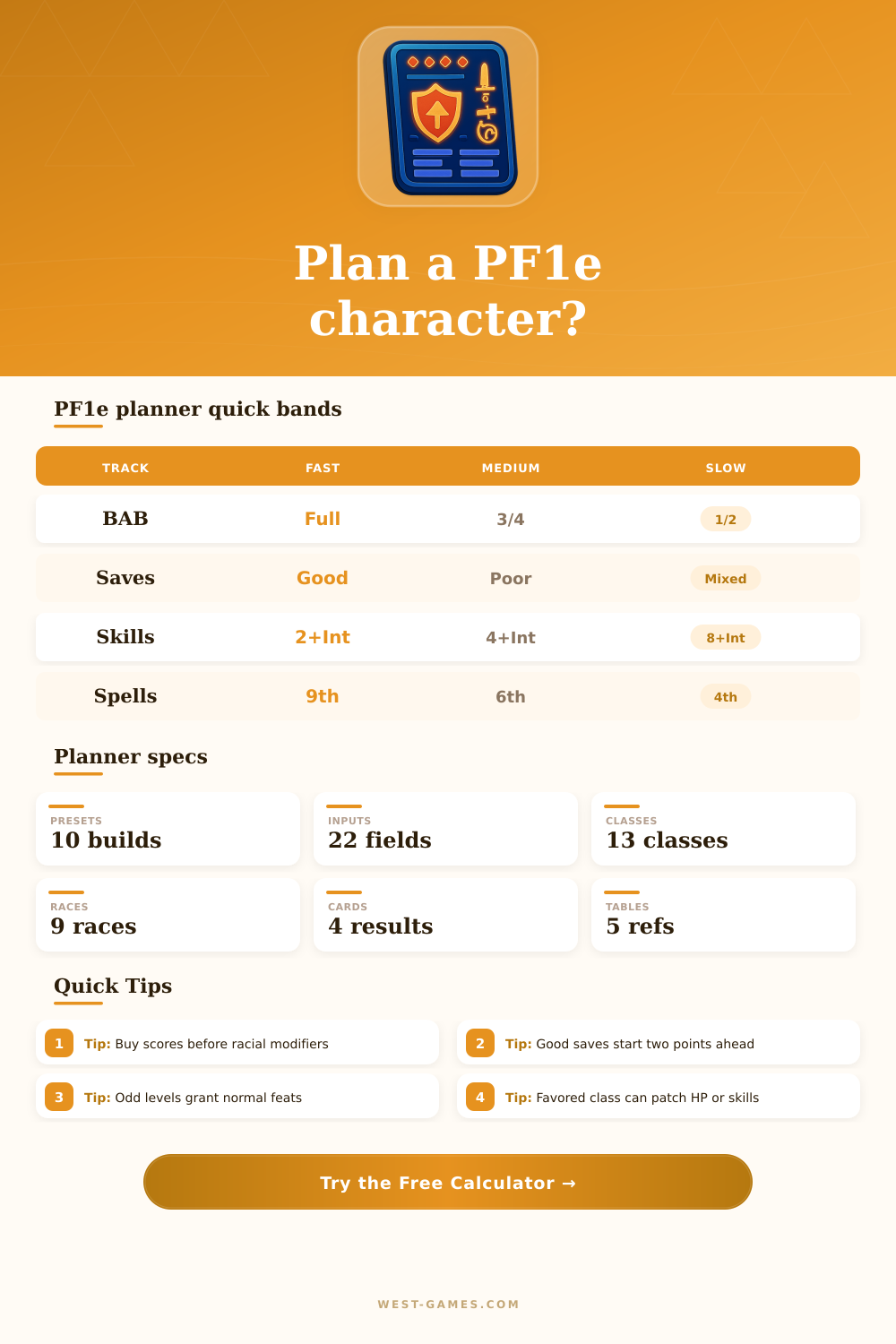
| Full BAB | +5 | +10 | +15 | +20 |
| 3/4 BAB | +3 | +7 | +11 | +15 |
| 1/2 BAB | +2 | +5 | +7 | +10 |
| Good save | +4 | +7 | +9 | +12 |
| Poor save | +1 | +3 | +5 | +6 |
Good saves use 2 plus half level. Poor saves use one-third level, rounded down.
| Race | Ability modifiers | Size | Planner effect |
|---|---|---|---|
| Human | Flexible +2 | Medium | Bonus feat and skill |
| Dwarf | +2 Con/Wis, -2 Cha | Medium | Strong Fort and Will |
| Elf | +2 Dex/Int, -2 Con | Medium | Caster and finesse lean |
| Halfling | -2 Str, +2 Dex/Cha | Small | AC and attack size bonus |
| Gnome | -2 Str, +2 Con/Cha | Small | Durable Cha caster |
| Tiefling | +2 Dex/Int, -2 Cha | Medium | Dex or Int build lean |
Flexible races use the selected racial +2 ability field in the form.
| Class | BAB | Good saves | Skills | Spells |
|---|---|---|---|---|
| Fighter | Full | Fort | 2+Int | None |
| Rogue | 3/4 | Ref | 8+Int | None |
| Cleric | 3/4 | Fort/Will | 2+Int | 9th divine |
| Wizard | 1/2 | Will | 2+Int | 9th arcane |
| Bard | 3/4 | Ref/Will | 6+Int | 6th arcane |
| Ranger | Full | Fort/Ref | 6+Int | 4th divine |
The JS data includes all selectable classes, including monk, magus, alchemist, sorcerer, paladin, druid, and barbarian.
| Caster track | Example classes | First spells | Mid-game ceiling | Level 20 ceiling |
|---|---|---|---|---|
| Prepared 9-level | Wizard, Cleric, Druid | Level 1 | 5th at level 9 | 9th-level spells |
| Spontaneous 9-level | Sorcerer | Level 1 | 4th at level 8 | 9th-level spells |
| Six-level hybrid | Bard, Magus, Alchemist | Level 1 | 3rd at level 7 | 6th-level spells |
| Four-level martial | Paladin, Ranger | Level 4 | 2nd at level 7 | 4th-level spells |
| No slots | Fighter, Rogue, Monk | None | Class features | Class features |
Spell slot totals are planning estimates, with bonus slots and save DCs derived from the selected casting ability.
Building a Pathfinder character involve a variety of decisions. Two of these decisions involve the choice of class and the assignment of ability score to the character. A planning tool is useful for playing Pathfinder because a planning tool performs the mathematical calculations for the player.
Furthermore, a planning tool ensures that the mathematics of the game character are accurate. A planning tool dont replaces the player’s decision in building the character. Instead, a planning tool allow the player to focus on the story and the decisions regarding the character when the mathematics of the game have already been calculated.
Why use a Pathfinder character planner
The first step in building a Pathfinder character is known as the point buy process. This process involve the player purchasing six different ability score within a fixed budget of game points. The player purchases the bonuses from a chosen race and character level after the point buy process.
A character calculator can handle the mathematics of the point buy process because the cost of each ability score is not linear. The cost of purchasing an ability score from 16 to 18 is not the same than the cost of purchasing an ability score from 14 to 16. Furthermore, not all abilities score can be purchased with the point budget.
For example, a character may overspend on one ability score such that there are not enough points to purchase either the Wisdom or Charisma ability score. Such a character will likely be weak in relation to magic or stealth ability. A character calculator allows the player to view the remaining game points in real time to ensure that the player does not create a weak character.
Each race for the Pathfinder character provide bonuses to the character’s abilities. For example, halflings have bonuses to their Dexterity score. However, the bonuses to Dexterity are given to characters who use Dexterity in their character build.
Similarly, dwarves have bonuses to both their Constitution and Wisdom score. The bonuses to these abilities shift the character’s role within the game. A planning tool can automatically incorporate these racial bonuses into the character and show the character how their abilities will change with the selection of a race.
Some races, such as halflings, have flexibility in the bonuses that they may provide to the player. For example, halflings can place their bonus of plus two into any ability score that they choose. This flexibility allow for a halfling to have the characteristics of either a strength based fighter or a dexterity based rogue.
A character’s class determines the role that the character will play within the game. Characters of each class possess different bonus to their abilities. For example, fighters have different bonus abilities than wizards of the same level.
As a result of these differences in bonus scores, fighters and wizards have different capabilities in their use of attack and saving throw. The character planner allows a player to see which saving throws are strong for a chosen class and which saving throws are weak for that same class. The character planner can see the weaknesses in a character’s saving throws.
Recognizing these weaknesses allow a player to select the proper feats to maximize the character’s abilities. Furthermore, the character planner estimates the number of spell slots that a player will have based off their class and bonus spell slot that result from having a high score in the ability that determines the number of spell slots. Each character has a limited number of skill rank and feats.
Classes provide a certain number of skill ranks with every level that the character reaches. However, the player can limit those skill ranks if the player chooses to focus on a few skills rather than providing skill ranks to all available skills. The character planner displays the number of skill ranks that a player will have after selecting a few skills.
This skill rank system is helpful because it is easy for a player to forget the limited number of skill ranks that a player earns with every level. The same is true for feats. A player can only select a limited number of feats for their character.
Martial classes receive bonus feats. However, players may only select bonus feats after meeting certain requirements. A character planner helps a player to track the number of feats that a player can select and whether or not a feat chain will fit within the available slots.
The mathematics of combat for a Pathfinder character result from all of the previous decisions that the player has made for the character. The combat mathematics for the character include the attack bonus for the character, the damage that the character deals with each attack, the armor class of the character, and the saving throws that the character can make. All of these value are determined by the ability scores, the racial bonuses to those scores, the class of the character, and the gear that the character purchases.
A character planner can calculate these statistics for a player. The combat statistics are especially useful in that they allow a player to compare the effectiveness of a dexterity based build to a strength based build for the same character. Every time a character levels up in Pathfinder, a small bonus is provided to the player; this bonus is known as the favored class bonus.
The favored class bonus change the character over a period of twenty or more levels. A favored class bonus can be spent on hit point or it can be spent on skill ranks. A character planner will allow a player to toggle between hit points and skill ranks to reflect the favored class bonus to the character.
Although small, the favored class bonus is important for players who are building two similar characters and wishing to provide one a slight bonus over the other. A character planner will not determine if the character that is constructed will be fun to play. Instead, the character planner will determine if the numbers that are constructed for the character are functional.
The planner will show a player if the character’s numbers are tight or if one area of the character is stronger than another. While a player’s enjoyment in playing the character will depend upon the story and the people that the player is playing with, a character planner will only take care of the mathematical aspect of the character that is built. Youll see that the planner helps you find the best way to build your character.
It isnt hard to use even if you are a beginner. If you want to make a strong character, you should of used a tool like this from the start. One thing is certain, the planning tool makes things more comfortabley.
It actually helps alot more than you think. Realistically, its the best way to manage all the moddern math involved.