🚀 Outer Worlds 2 Character Planner
Test a colony-ready build plan across aptitude, attributes, skill groups, flaws, perks, companions, weapons, science, stealth, dialogue, armor, and quest-role readiness.
Formula Breakdown
| System | Assumption | Formula use | Swap later |
|---|---|---|---|
| Aptitude | Small starting lean | 4 to 10 bonus points | Use final background perks |
| Attributes | Six classic RPG stats | Weighted by solve lane | Map to final attribute names |
| Skills | Grouped to 0-100 | Average plus lane multipliers | Replace with final skills |
| Flaws | Trade flaw for perk | Perk bonus plus penalty | Use confirmed flaw effects |
| Skill group | Helps most | Secondary use | Weak if ignored |
|---|---|---|---|
| Ranged | Open fights | Crit pressure | Boss damage |
| Science / tech | Weird weapons | Hack, heal, repair | Route options |
| Stealth | Bypass routes | Lockpick, theft | Pacifist plans |
| Dialogue | Faction checks | Companion morale | Quest flexibility |
| Defense | Survival | Recovery timing | Hard modes |
| Preset | Primary solve style | Armor plan | Companion logic |
|---|---|---|---|
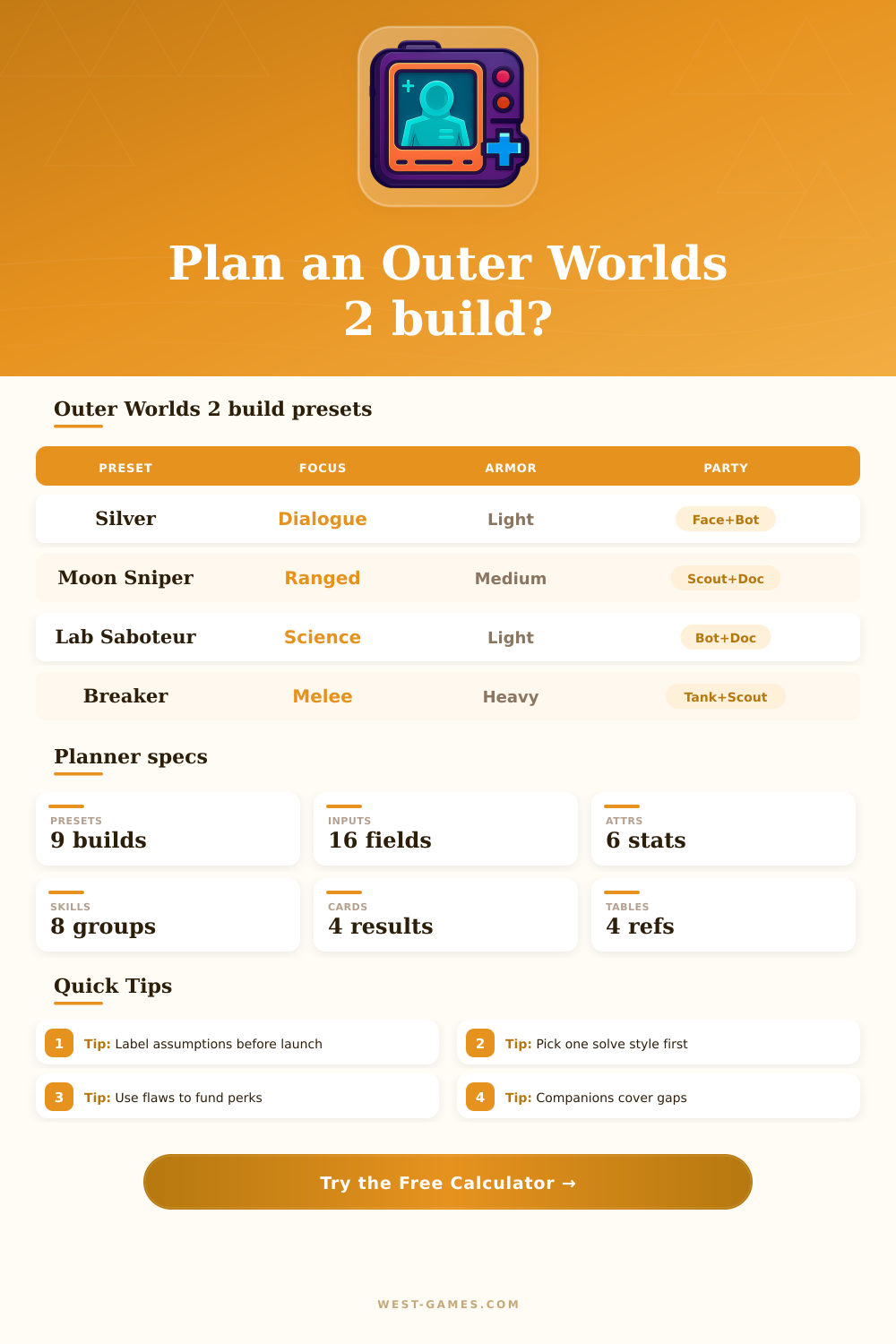
| Silver Tongue Corporate Defector | Dialogue, reputation, light sidearm | Clothing or light armor | Face specialist covers checks while bot guards forced fights. |
| Moon Rim Precision Sniper | Ranged damage and scouting | Medium armor | Scout extends stealth routes while doctor stabilizes long fights. |
| Lab Saboteur Science Ghost | Science tools, hacking, quiet entry | Light armor | Bot handles danger while doctor improves recovery math. |
| Board Breaker Heavy Vanguard | Heavy weapons and intimidation | Heavy armor | Tank and scout keep pressure high without losing route awareness. |
| Wildcard Captain Skill Generalist | Balanced exploration | Medium armor | Wildcard crew gives smaller bonuses across every lane. |
| Result card | Core formula | Main inputs | How to improve |
|---|---|---|---|
| Build Fit | Role lane + attribute fit + skill fit + perk fit + companion match | Role, aptitude, attributes, skills, perks | Focus one route and pick matching perks. |
| Combat Survival | Defense skill + armor + temperament + companion sustain - difficulty tax | Armor, defense, difficulty, companions | Add defense investment or safer companions. |
| Quest Readiness | Dialogue + stealth + science routes weighted by quest complexity | Talk, stealth, science, complexity | Raise the lane matching your quest target. |
| Resource Strain | Weapon strain + armor tax + flaw penalty - perk relief - science relief | Weapon, armor, flaw, science, perks | Reduce heavy gear tax or add utility perks. |
The character planner is an tool that will help you to understand the choice you are making within Outer Worlds 2. Outer Worlds 2 present players with many choices throughout the game. However, Outer Worlds 2 does not present players with many choice regarding the way in which those choices will impact one another.
For instance, players can choose to create a character that uses dialogue to pass checkpoint or a character that utilizes long-range weapons to avoid combat entirely. Both of these character types will use the same attribute point and skills. However, the quests that the player face can make a player’s weakness manifest itself only after they enter the difficult area of a game.
Plan Your Outer Worlds 2 Character
Thus, players need to use the character planner prior to creating there characters to weigh the pros and cons of these choices. The character planner treats the aptitudes as the starting point for the characters rather than their classes. It do this because the game mechanics allow for such flexibility.
For instance, players that create a corporate defector will start with more dialogue and systems knowledge. However, they can also purchase points to increase their investment in heavy weapons later in the game. The character planner will record their early choice and illustrate mathematically whether their later investments is in support of or in conflict with their early choices.
The same logic can be applied to the six stats that each character possess and the skill groups that is related to those stats. Each stat affects certain aspects of gameplay more than other stats. The character planner applies a weighting system to the stats so that players can see which aspect of gameplay is the most strongest for their character build.
For instance, a gunslinger will require a higher score for the Perception stat than a diplomat. This same logic can be applied to the skill group that is connected to each of the attribute of the characters. The character planner does not create any new system within the game.
However, it does make the existing systems easy for players to understand what each stat and skill group do. The flaws for each character are important because they create an imbalance to the character. For instance, if a player selects a flaw such as creature phobia or consumable habit, they will gain more perk point.
However, they will also lose some of their skills in checks for survival or for conversation. The character planner allows players to see these flaws in advance so that they are not surprised by them while battling boss or on reputation missions. The same logic applies to armor choice.
For instance, heavy armor will provide players with more strength in combat but will reduce their stealth and dialogue skills. The character planner allows players to see these two sets of value for each type of armor so that they can make an informed decision with regard to the characters armor. Another component of the character planner that is important is the companions system for the player to create.
Players must name the two companions that they will be journeying with. The character planner will calculate which skill each companion will have, their strength and their weakness. For instance, if the two companions that are selected are a face specialist and a security bot, the character will have strength in dialogue but will have a weakness in skills like science and healing.
If the companions are a scout and a doctor, these skills will be covered but the other skill like science or stealth will be weaker. Thus, players can use this system to decide which skill they must develop themselves within the game. The complexity of the quests that the players must undertake is another component of the character planner.
Players can set the complexity for the quests that they want to pursue for their characters. The character planner will allow players to see if their characters meets the requirements for those types of quests. A player may create an excellent character for a general type of quest but create a weak character if they choose to avoid combat and killing of enemy.
This feature allows for real planning by the player of their characters. Finally, the character planner includes reference table for the different choices within the game. These tables allow players to review the assumptions that the developers placed into the game.
Players can use these tables to determine if the mathematics of the game match their intentions for that aspect of their character. For instance, if the reference table indicate that science weapons are of high strain, players may decide whether this is an appropriate skill for their character or whether they need to make a change to the attribute allocations for their character. The main purpose of the character planner is not to create the perfect character for players.
However, its purpose is to allow players to create and test the different type of character builds that they have already considered. Many character planners do a poor job of illustrating the relationship between each stat within the game. This character planner maintains each of these skill and the relative strength of each so that players understand the weak aspect of their build prior to creating their characters.
Thus, this character planner allows for players to make small adjustment to their characters to ensure that they will become successful in the more complicated portion of the game.