✨ Genshin Summon Calculator
Plan Primogems, Fates, pity, guarantee state, target constellation or refinement, expected pulls, chance, resource gap, and leftover wishes without using pack or money inputs.
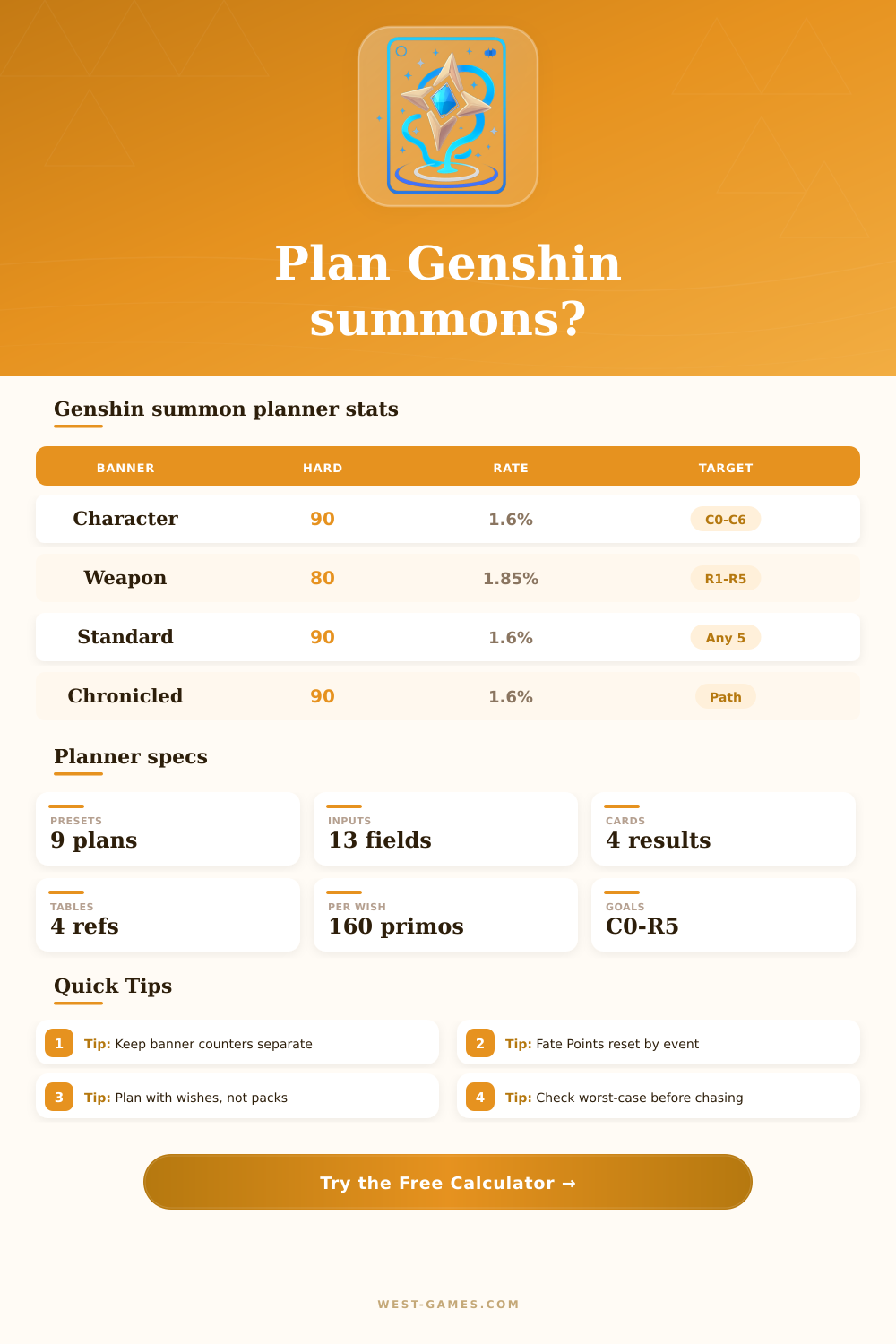
| Banner | Hard pity | Target rule | Carry note |
|---|---|---|---|
| Character Event | 90 | 50/50 then guarantee | Pity and guarantee carry |
| Weapon Event | 80 | 75/25 promo, path target | Fate Points reset |
| Standard Wish | 90 | Any 5-star milestone | Standard only |
| Chronicled Wish | 90 | Path target after miss | Fate Points reset |
This planner keeps banner families separate so a character pity plan does not accidentally absorb weapon or standard resources.
| Goal | Total copies | Use case | Planner input |
|---|---|---|---|
| C0 or R1 | 1 | First unlock | Target 1 |
| C1 or R2 | 2 | One upgrade | Target 2 |
| C2 or R3 | 3 | Early breakpoint | Target 3 |
| C6 or R5 | 7 or 5 | Max chase | Target 7 or 5 |
For weapons, the calculator caps the goal at R5 even if a higher character-style target is selected.
| Resource | Wish value | Where entered | Planning note |
|---|---|---|---|
| Primogems | 160 = 1 wish | Primogems field | Remainder is kept |
| Owned Fates | 1 wish each | Owned Fates | Match banner type |
| Shop Fates | 1 wish each | Shop field | Only planned use |
| Daily saving | Floor converted | Days and daily | Pack-free forecast |
The calculator avoids pack inputs and uses in-game resources only: Primogems, Fates, planned exchanges, and future free income.
| Scenario | Main risk | Key field | Watch result |
|---|---|---|---|
| Fresh C0 | Losing first check | No guarantee | Worst-case pulls |
| Guaranteed C0 | Only pull timing | Target guarantee | Leftover wishes |
| Weapon R1 | Wrong promo weapon | Fate Point | Chance in plan |
| C2 stretch | Multiple cycles | Owned copies | Expected gap |
Use expected pulls for normal planning and worst-case pulls when deciding whether a chase is worth committing every saved wish.
Genshin Impact planning involves a lot of math and some hope, to. Most players looks at their total primogem stash and assume it translates directly into a specific character guarantee. But in reality, there’s a very clear disconnect between how many primogems you actualy have and what you’re realistically capable of obtaining during the event.
This means you watch timer tick down and do math based off your current supply of primogems. Then, you has to decide whether it makes sense to grind those daily commission over the next three weeks or just wait until regular old wish comes around.
How to Plan Your Genshin Impact Pulls
Of course, it’s not always as simple as plugging into those equations. Each wish take a different amount of pity, and you need to factor in your existing pity counter and whether you’re recovering from a 50/50 or starting from scratch. Once you input your resources, however, the calculator do all the calculations for you, you don’t have to remember several values with each type of banner family.
To begin with, pity doesn’t “reset” between pulls. For instance, if you failed to get anything after pulling 90 times on the previous character event wish, your very first five-star pull on a new limited banner will feature highlighted character. This will continue for any number of pulls until you use it.
The only reason people seem to forget about this, and spend real money as a result, is because they assume that their pity count reset to zero each time a new banner goes live. They don’t. You can make sure the number of expected pulls reflect your actual situation different than the worst case scenario by entering your current pity count and guarantee status into the tool.
The Fate Point mechanic adds further complexity, particularly because weapon banners has a rate-up system unlike character events that give you the featured unit on the second five-star if you lose the first check. With weapons, you only have a 25 percent chance of getting your desired weapon even after you lose initial roll. To be certain of getting the sword or bow you want, you’ll need Fate Points; however, those points don’t carry over from event to event.
When the banner rotates out, it resets and you won’t have any way of saving up momentum from one event to help you snag your target in the next. Unless you’re already sitting at one Fate Point heading into the new event, you’ll need to approach every weapon banner as its own cycle.
People tend to underestimate their daily savings when making long term plans. Saving 60 primogems per day might seem like nothing, but after a month, that’s almost a dozen wishes saved. Add that to login event rewards and exploration rewards, and that amount go up even more. The tool allows you to account for this anticipated income on top of what you already have, which will help determine whether or not you’ll be able to afford upgrading a constellation.
That’s where budgets gets blown out the most, as it’s much more cost effective to go from no copies to one copy compared to going from five copies to six. After all, each copy beyond the first will need its own pity cycle and their own guarantee check; the cost isn’t linear, but rather exponential.
Remember, too, that these standard and chronicled wishes operate independently of your limited banner pity. Even though those resources can be tied together into one big ball of fate they remain separate in practice. You’ll still need to convert them before using them on the standard wish. This tends to make little strategic sense unless you’re actively seeking a character you don’t have.
Maintaining separate buckets for your resources will help avoid accidentally watering down your spending power where it matters most: on priority targets. For this reason, the page’s reference tables makes clear differences between banner types’ hard pity limits and their own target rules. Weapon events max out at eighty pulls, with character events capping at ninety. Standard wishes comes back to ninety again, but without the featured character guarantee mechanism.
That knowledge will allow you to manage your expectations, as well. Use the math to see that you are only one constellation away from getting a second one, so aim for that. Great! But realize that the number’s too large, so save up for following limited banner instead of bleeding yourself dry over something improbable.
At the end of the day, the point of summoning is managing your own risk. The odds aren’t changeable; they’re given to you. But your exposure isn’t. Understanding exactly how much you have and what those pulls should realisticly purchase removes the nail-biting from pressing that pull button. It removes the guesswork and replaces it with following a plan. This transforms a roll of the dice into a calculated investment of your time and effort. You could of planned better.