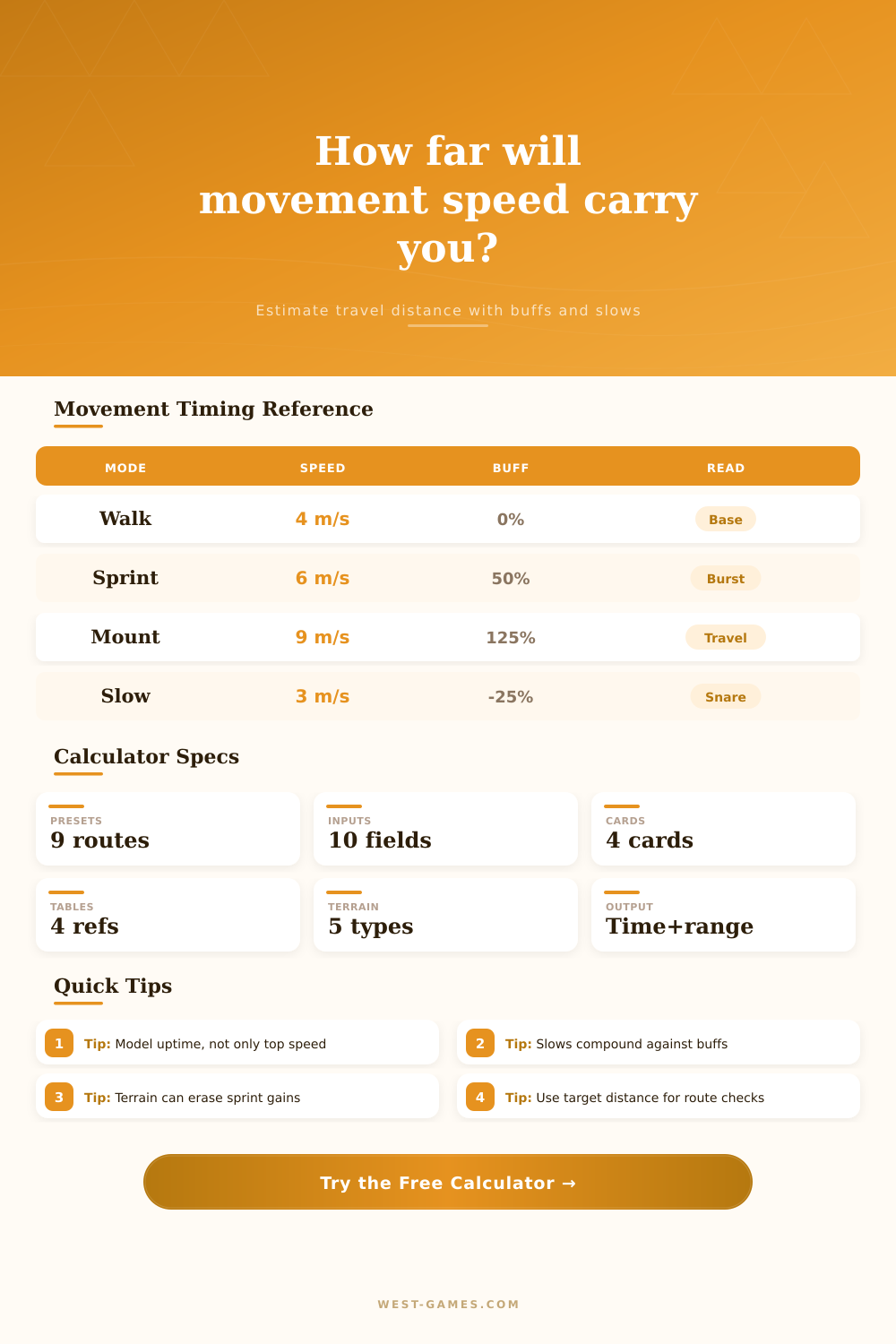
Movement Speed to Distance Calculator
Estimate how far a character, vehicle, or mount travels after sprint buffs, mount bonuses, slows, terrain loss, and real uptime are applied.
Calculation breakdown
| Movement mode | Typical base | Common buff | Best use |
|---|---|---|---|
| Careful stealth | 2.0 to 3.5 m/s | 0% to 20% | Noise-limited routes, patrol gaps, or stealth games |
| Humanoid run | 4.5 to 6.5 m/s | 20% to 60% | Dungeon movement, objective swaps, and short PvP resets |
| Combat sprint | 5.5 to 8.0 m/s | 40% to 100% | Burst dodges, kiting windows, or boss mechanic moves |
| Ground mount | 7.5 to 12.0 m/s | 60% to 160% | Overland routes, gathering loops, and town-to-field travel |
| Vehicle or boost | 10.0 to 22.0 m/s | 100% to 300% | Racing segments, boost pads, and timed traversal missions |
| Condition | Suggested input | What it represents | Distance effect |
|---|---|---|---|
| Light clip or body block | 5% to 12% slow | Small combat pathing loss | Usually visible only on longer routes |
| Snare debuff | 25% to 60% slow | Skill, trap, frost, web, or suppression effect | Can erase sprint value if uptime is high |
| Rough terrain | 86% terrain | Rocks, brush, ramps, stairs, or heavy turns | Multiplies the final buffed speed |
| Water or mud | 76% terrain | Deep ground penalty or swim-adjacent travel | Often worse than a moderate snare |
| Speed lane | 108% terrain | Downhill lane, rail, wind path, or clean racing line | Can turn small buffs into meaningful seconds |
| Effective speed | 30 seconds | 2 minutes | 500 m route |
|---|---|---|---|
| 3.0 m/s | 90 m | 360 m | 2 min 47 sec |
| 5.0 m/s | 150 m | 600 m | 1 min 40 sec |
| 7.5 m/s | 225 m | 900 m | 1 min 7 sec |
| 10.0 m/s | 300 m | 1200 m | 50 sec |
| 15.0 m/s | 450 m | 1800 m | 33 sec |
| Preset | Baseline | Main modifier | Route note |
|---|---|---|---|
| Dungeon Pull | 5.5 m/s | 35% sprint at 35% | Short route with small combat drag |
| Arena Kite | 5.8 m/s | 55% sprint at 45% | Strong slow pressure and clean ground |
| Open World Mount | 5.2 m/s | 120% mount at 85% | Long travel with light terrain loss |
| Raid Reposition | 5.0 m/s | 40% sprint at 22% | Movement is broken by casts and mechanics |
| Boost Pad Lap | 12.0 m/s | 180% boost at 30% | Fast segment with speed-lane terrain |
That feeling of “I should’ve made it”, you know that one? That’s when you think there was just enough time to run around and reposition again, but then suddenlly your character fails to reach safety by even an inch. Most of the time, this isn’t due to lack of reflexes. In fact, it’s because you don’t realy understand how speed works over time. You look at stat on your screen, and you assume that it applies consistently. That’s not typically true.
Most player fall behind due to difference between their theoretical maximum speed and the space they cover. Most movement models don’t work because they assume that speed has one fixed value. But actualy traveling around is a mix of weighted values. You sprint for ten seconds, then walk for thirty, get slowed by a debuff for five, and stop to click an objective. These all slow average differently.
Why Speed Is More Than Just a Number
Plug in your base speed, along with these other changes, and the calculator on this page does the math for you. It saves you having to do that mentally (averaging out how much combat slows things).
But here’s the catch: we’re measuring something that isn’t necessarily what people think they are measuring. When I say a buff with 50% haste, it sounds great… until you consider it only applies to one-fifth of entire length of your travel path. Sure, that burst may be awesome, but when normalized by walking speed, it makes very little difference to how far you end up going. People like to look at high number and think, “That sounds good.” But that high number doesn’t last long enough to make much of a dent in the overall distance you’ll cover.
Uptime is what matters for movement efficiency. Every time your feet touch down on the ground, it becomes a tax against your speed. It’s easy to model: running over flat stone is nothing compared to running through shallow water, climbing steep stairs, or through dense brush. There’s some amount of friction you need to account for that most game engine don’t really deal with beyond simple speed multipliers.
That’s laid out on the page as a reference table, and there are coefficients for all sorts of obstacles and rough ground, but the idea extends everywhere. Just because a path may be short on a map doesn’t mean that it won’t take you twice as long to get across due to having to climb ledges or go in and out of shallow water while zig-zagging around pillars. Messy paths like this count as much as straight movement speed.
Penalties stack on top of one another. They stack especially harshly when effects are slow. A slow effect doesn’t work linear with a snare effect. Two multipliers don’t just add up together. They multiply one another into something rather severe. You might lose thirty percent of your speed to a root or frost spell. And then you trip over a root that slows you down by 30% too. The thing most folks don’t catch: They’re taking the slow percentage off your base speed and forgetting about mud. Your total effective speed becomes much lower than both numbers alone would suggest.
Another variable not usually mentioned is route uptime: what percentage of your total time are you actualy spent moving? You might think you’re spending 10 minutes fighting enemies and casting spells, but if you stop to rest, wait at a gate, or loot corpses, you’ve covered no meters whatsoever. A mere fraction increase in travel time can have a dramatic impact on total range. Spending just ten percent of your movement standing still increases required speed by almost eleven percent, a trivial math problem that’s also easy to forget when things get hot.
This shift in thought pattern will cause you to rethink both what you carry and your routes. It may no longer make sense to focus only on speed; instead, it could of been better to prioritize something that makes your path clearer and something that helps you stop moving more quickly. Sometimes you go around something because it is faster then punching through the middle when your speed stat is higher. This tool allows you to play out various scenarios based off realistic inputs which help quantify those decisions.
Distance isn’t about raw velocity at a point-in-time. It’s about effective time spent moving. If you can learn to treat movement speed as a changing rate determined by context instead of a number, you’ll start seeing the game board differently. You’ll come to respect the world around your character and its friction. That’s worth more than any temporary sprint buff.