ESO Armor Calculator
Estimate Elder Scrolls Online physical and spell resistance after armor weight, traits, enchants, set bonuses, Resolve buffs, and enemy penetration.
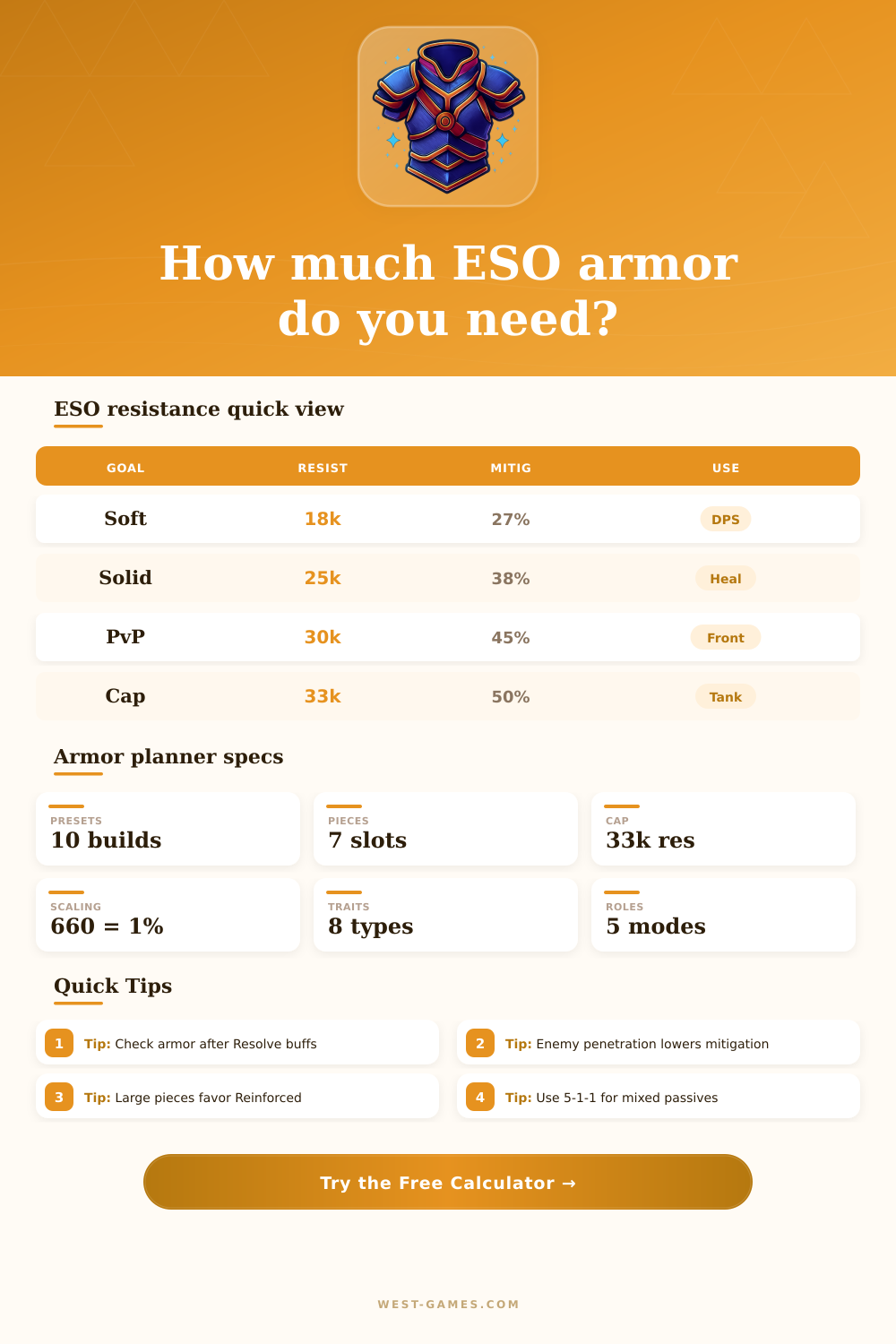
| Resistance | Mitigation | Typical use | Notes |
|---|---|---|---|
| 18,200 | 27.6% | DPS baseline | Comfortable for many PvE damage builds |
| 25,000 | 37.9% | Solo or healer | Good cushion before burst windows |
| 30,000 | 45.5% | PvP or dungeon tank | Strong after penetration is considered |
| 33,000 | 50.0% | Resistance cap | Extra resistance protects against debuffs |
| Split | Identity | Defense feel | Best fit |
|---|---|---|---|
| 5 Heavy / 1 Medium / 1 Light | Tank staple | High armor | Trials, dungeons, bruisers |
| 5 Medium / 1 Heavy / 1 Light | Stamina lean | Moderate | Stam DPS, brawler pressure |
| 5 Light / 1 Medium / 1 Heavy | Magicka lean | Lower armor | Mag DPS and support |
| 3 Heavy / 2 Medium / 2 Light | Hybrid mix | Balanced | Solo arenas and leveling |
| Modifier | Planner effect | Defense value | Use case |
|---|---|---|---|
| Reinforced | +8% gear armor | High | Large tank pieces |
| Nirnhoned | +900 resistance | Medium | Flat resist tuning |
| Infused | +25% enchant effect | Variable | Glyph-heavy setups |
| Impenetrable | +1650 crit resist | PvP | Critical burst protection |
| Set style | Planner add | Mitigation type | Best role |
|---|---|---|---|
| Fortified tank lines | +3460 resist | Raw resistance | Main tank |
| PvP defensive lines | +2974 resist | Pen cushion | Frontline |
| Minor Aegis style | 5% PvE layer | Separate layer | Trial defense |
| Monster resist set | +2064 resist | Raw resistance | Flexible slots |
Building a strong defensive profile in the game Elder Scrolls Online depend upon an understanding of how resistance works. The resistance value of a player can make them feel like either a fragile character or a sturdy character, and the difference between those two values can range from 18,000 to 30,000 resistance. Resistance impact a player in that there resistance will impact the amount of healing they require, the level of aggression with which they can play, and if they will survive the damage that is directed at them in player vs. Player (PvP) situation.
The calculator included on this page will calculate the resistance of a character once the player input their armor weight, their traits, and their buffs. Each of these variable is required because the armor weight of a character will impact their resistance. For instance, heavy armor piece provide the most armor for each slot.
How to Build Armor Resistance in Elder Scrolls Online
As such, many tank will choose to wear five or more heavy armor pieces. Light armor pieces provide less armor, but offer bonus to magicka recovery and spell resistance. Medium armor pieces fall somewhere in the middle in regard to the amount of armor that they provide, but offer bonuses to mobility skill.
Thus, the weight distribution of an armor build will have an impact upon other aspect of the character, as well. Beyond armor pieces, traits can also impact resistance value. For instance, the Reinforced trait will increase the armor value of each large piece of armor that the character wears; thus, the Reinforced trait is most useful for characters with several heavy armor slots.
The Nirnhoned trait will provide flat resistance to the character, rather than increasing their armor value; thus, the Nirnhoned trait is provided to characters who require an increase in resistance without increasing their armor weight. Finally, the Impenetrable trait will reduce the damage that a player takes if they are critically hit; thus, the Impenetrable trait is provided to armor builds that will face opponent with high penetration value. Each of these traits can be chosen based off the type of damage that a player will take.
Beyond the traits that a player wears, the resolve buffs that are active will impact the resistance of the player. For instance, Major Resolve will add nearly 6,000 resistance to a character while active, and Minor Resolve will add almost 3,000 resistance while active. These value are significant, but dissapears once the buffs are removed.
Thus, characters may calculate their resistance while buffed, but feel fragile when the buffs are removed. The included calculator can be used to toggle these buffs on and off, thus allowing characters to view the difference between their buffed and unbuffed resistance. Similar to how enemy penetration will reduce the resistance of a player, each point of penetration that an enemy has will reduce the resistance that a player has before any mitigation are applied to that incoming damage.
Thus, penetration should of been treated as if it is real damage that the player is taking; otherwise, players may believe that they have sufficient resistance to survive enemy penetration. In the tables provided on this page are common resistance values and the role that characters have when they possess those amounts of resistance. For example, 18,000 resistance is considered to be a comfortable value for those who deal damage with their characters, especially those who rely upon positioning to avoid damage.
Characters with 25,000 resistance are able to provide a cushion for solo players and healers; those who have 30,000 resistance can be targeted as a player who wish to survive penetration, as well. Additionally, there is a hard cap for resistance at 33,000; beyond this value, any resistance that is gained will only help to prevent debuffs from stripping armor from a player. Beyond the resistance value of the armor pieces that a character wears, the weight distribution of that armor will also impact other element of the player.
For instance, a character who wears five heavy armor pieces, one medium armor piece, and one light armor piece is generally considered to have an effective weight distribution for those who play as tanks; the medium armor piece can provide benefits to stamina return. Using more medium armor will lower the cost of rolling and sprinting, but will also lower the resistance against sustained physical damage. Thus, the calculator can indicate how resistance will be distributed based upon armor weight, allowing players to understand the tradeoffs between these two element of character control.
Beyond the base resistance that can be gained from armor alone, other factor will impact the total resistance of a player. For instance, gold armor pieces contain a small resistance multiplier for their contribution to a player’s total resistance; each of the seven armor slots will have these multipliers applied to their resistance. Additionally, some armor set will provide flat resistance bonuses to the players who wear those sets, or provide mitigation layer that work in addition to the armor values.
For instance, some set bonuses will reduce the damage that a player takes from area of effect (AoE) abilities without impacting their total resistance. These bonuses are mainly important for characters who are close to their resistance target. Planning their armor pieces allows players to decide which problem that their armor is attempting to solve.
For instance, if a player dies to burst damage, increasing the number of heavy armor pieces and utilizing the Reinforced trait will help to solve that problem. If, however, a player has issue with resources when blocking enemies, medium weight armor pieces and the use of sturdy traits will solve that players problem. Thus, the armor calculator can remove guesswork from the process of building armor, and ensure that the player’s decisions are based upon important information.
Once a player knows how their armor compares to their target, the armor pieces can be adjusted one variable at a time. For instance, the weight distribution of the armor can be adjusted, traits can be swapped, or the penetration that enemies can have can be accounted for. Each of these adjustment can help to reveal whether a player has come closer to their target resistance value, and if any problem have been introduced in adjusting for that target.
By understanding each of the factor that impact the resistance of a character, a player can begin to build armor that is balanced in regard to their desired role within the game. Additionally, such understanding will allow for adjustments to that armor to be made one variable at a time to solve the problems that is experienced by that player with their characters.