🎯 Elo Win Rate Calculator
Convert rating gaps into expected score, draw-adjusted game odds, best-of match chances, required climb score, and games needed to reach a target Elo.
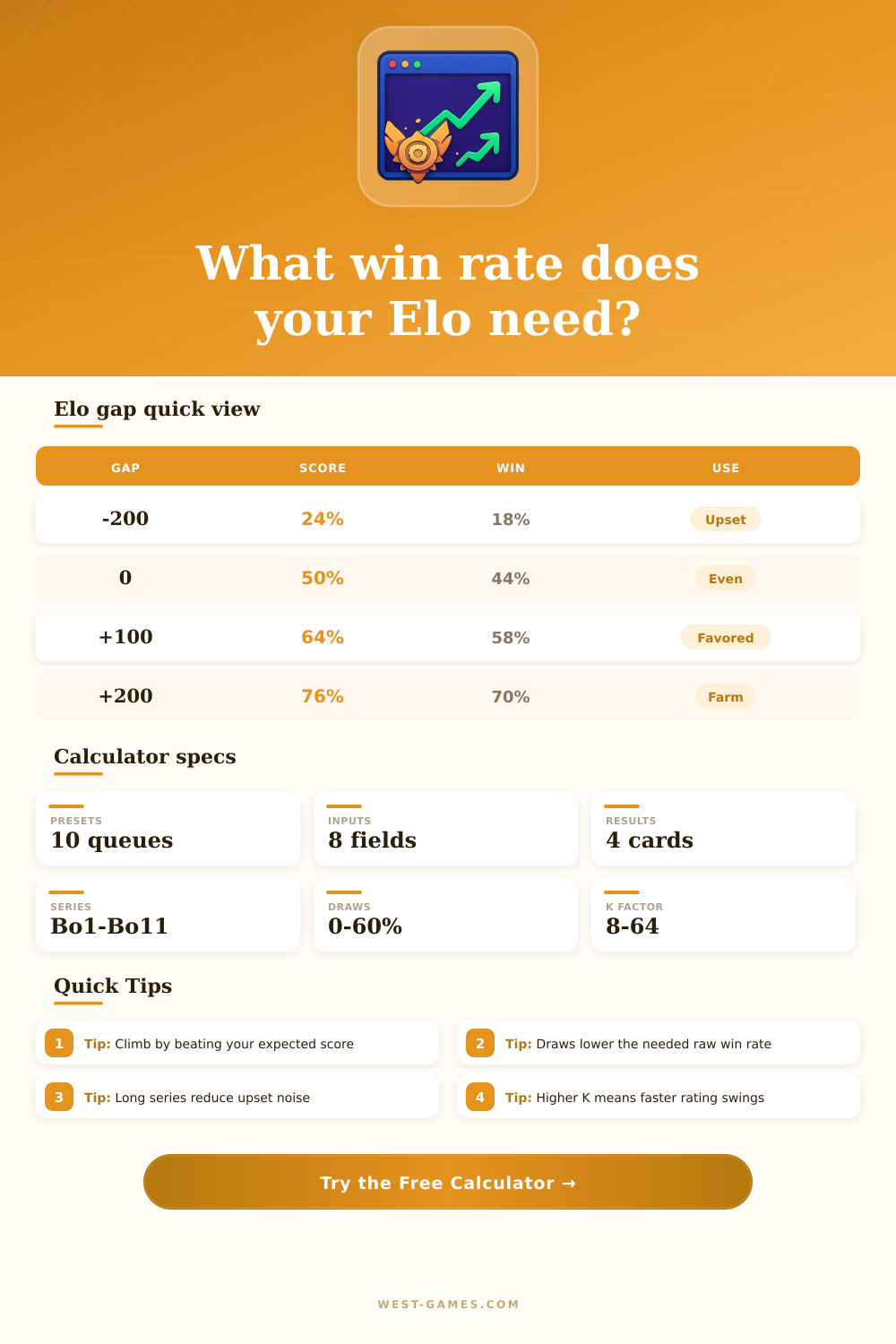
| Player Gap | Expected Score | Draw-Adjusted Win | Match Read |
|---|---|---|---|
| -400 Elo | 9.1% | 3.1% with 12% draws | major upset route |
| -200 Elo | 24.0% | 18.0% with 12% draws | underdog but live |
| 0 Elo | 50.0% | 44.0% with 12% draws | even pairing |
| +200 Elo | 76.0% | 70.0% with 12% draws | clear favorite |
| +400 Elo | 90.9% | 84.9% with 12% draws | must convert cleanly |
Expected score is wins plus half of draws, using 1 / (1 + 10^(-gap / 400)).
| K-Factor | Common Use | Even Win | Even Loss |
|---|---|---|---|
| 8 | very stable pool | +4.0 | -4.0 |
| 16 | established ladder | +8.0 | -8.0 |
| 24 | active ranked climb | +12.0 | -12.0 |
| 32 | volatile placement | +16.0 | -16.0 |
| 64 | fast calibration | +32.0 | -32.0 |
Actual systems may cap gains, apply uncertainty, or use team adjustments, but K-factor is the core Elo multiplier.
| Format | Good For | Noise Level | Draw Handling |
|---|---|---|---|
| Best of 1 | ranked queue snapshot | high | draw can split score |
| Best of 3 | short set check | medium-high | tie still possible |
| Best of 5 | standard match block | medium | half-point majority |
| Best of 7 | long set pressure | medium-low | draws soften swings |
| Best of 11 | training validation | low | skill edge shows more |
The calculator counts each win as 1 point, draw as 0.5, and loss as 0, then compares total match points.
| Actual Score | Expected Score | K 24 Pace | Climb Signal |
|---|---|---|---|
| 50% | 50% | 0.0/game | rating holds steady |
| 55% | 50% | +1.2/game | slow but real gain |
| 60% | 52% | +1.9/game | strong session trend |
| 62% | 57% | +1.2/game | favored but needs volume |
| 48% | 40% | +1.9/game | losing record can climb up-pairing |
Rating gain depends on actual score minus expected score, so opponent strength matters as much as raw win rate.
| Preset | Player | Pool | Draws | K | Use Case |
|---|---|---|---|---|---|
| Rapid Chess 1500 Push | 1500 | 1450 | 12% | 24 | steady plus-score climb |
| Blitz Arena Grinder | 1850 | 1800 | 7% | 16 | large sample queue block |
| Bullet Tilt Repair | 1720 | 1680 | 2% | 20 | low draw, high swing games |
| Fighting Game FT5 Set | 1350 | 1375 | 0% | 32 | set-play improvement check |
| Rocket League Duo Queue | 1620 | 1600 | 3% | 24 | team queue session target |
| Valorant Ranked Block | 1550 | 1580 | 4% | 18 | longer match rhythm |
| StarCraft Ladder Sprint | 2100 | 2050 | 0% | 24 | decisive ladder games |
| AoE Empire Series | 1280 | 1300 | 1% | 28 | best-of match planning |
| Tournament Underdog Run | 1900 | 2050 | 6% | 32 | upset bracket scenario |
| Master Queue Hold | 2400 | 2350 | 10% | 12 | rating protection block |
An Elo rating systems provides a numerical value for a player’s skill level. However, the Elo rating system can be difficult to use to formulate a specific plan of action from the rating difference between two player; for example, a player with a higher Elo rating will usualy have a higher rating then there opponent; however, the result of the game can still even out the win totals between both players. The difference in Elo ratings between two players can be influenced by a variety of factor, such as the number of draws between players, the length of a series of games between two players, and the rate of speed at which the Elo rating system react to the results between two players.
By using a calculator that includes these three variables, a player can determine if they are a favored player in the series of games. Under the Elo rating system, it is important for a player to understand what the rating gap measure. More specifically, players should be aware that the Elo rating system doesnt count wins.
How to Use a Calculator to Check Your Elo Rating
Instead, it count the expected score for a player. For expected score, draws are counted as half points. Draws can be common among a pool of players of all skill levels.
Therefore, if a players win rate is below 50%, it is still possible for that player to have a positive score for their games played. A calculator allows a player to account for this math. By inputting their current Elo rating, the average rating of their opponents, and the expected rate at which draws will occur in their games, the calculator display the percentage of wins that the player must achieve to maintain a positive score after accounting for the draws.
Another factor to consider in the Elo rating system is the length of a series of games between two players. For instance, a series of games with high variance, such as a single game between two players, has a higher chance of resulting in a winning score for one player and losing games for the other player. However, a series of games that includes many games, such as a best of seven or best of eleven series of games, will have fewer variance between the results of each players games.
Therefore, a longer series of games will not change the skill of the players, but it will ensure that unlucky results do not impact the outcome of the games. A higher number of players also feel more confidently in the outcome of longer series of games, which a calculator can account for. The Elo rating system also include the K-factor as a variable in the system.
The K-factor influences the number of games and how much each player’s rating change within the system. Using a high K-factor will cause the Elo rating for each player to change more after each game. This factor can be helpful for altering a players Elo rating.
Using a low K-factor will protect the Elo ratings of players that have already be established. A low K-factor is helpful for players who would like to have a steady value for their Elo rating. Neither a high K-factor nor a low K-factor is the best factor for all players; the best K-factor for a player will depend upon the player’s desire to either change or hold their Elo rating.
The same variables that can be used to calculate the rating gap between two players can also be used to calculate how many games it will take for a player to reach a target Elo rating. By entering a target Elo rating and the number of games that a player plan to play in a session, a calculator can provide an estimate for the total number of games and the number of gaming session that will be required for that player to reach there target Elo rating. This estimate, however, will only be accurate if a players actual score is above their expected score within each session of games played.
If the player’s actual score is below their expected score, their Elo rating will not change, no matter how many games they play. The parameters of a calculator are helpful for providing a baseline for a player’s Elo rating system, but no calculator can account for every factor that can exist within the real world and the real game environment. Variables such as the strength of opponents, tilt scores, and adjustments on specific gaming platforms can all have an impact on a players Elo rating.
By comparing the Elo rating system to the actual games played, it is possible to determine whether there is indeed a difference between a player’s performance or the skill of the players within the player pool. It is a useful habit for a player to check their expected score prior to the start of a gaming session using a calculator. It is actualy more useful to check this prior to a gaming session than after a player has completed their games for that session.
For example, by using a calculator, a player and their opponent may determine that the player has a slight advantage in their score. Yet, if the player desire to have a high increase in their Elo rating, they may determine that they will need a higher win rate for that session of games. By determining this in advance, they can make a deliberate choice about either the length of their gaming session or the skill level of their opponent.
By using these calculations, a player can steer the movement of their Elo rating.