🎮 Elo Win Probability Calculator
Estimate a single match probability, upset odds, draw-adjusted result, best-of series edge, and uncertainty range from two Elo ratings.
| View | Player A | Draw | Player B | Read |
|---|---|---|---|---|
| Single match | 38.9% | 31.0% | 30.1% | A slight edge |
| Decisive only | 56.4% | 0% | 43.6% | Close pairing |
| Best of 1 | 56.4% | n/a | 43.6% | Volatile |
| Low estimate | 34.4% | 31.0% | 34.6% | Within uncertainty |
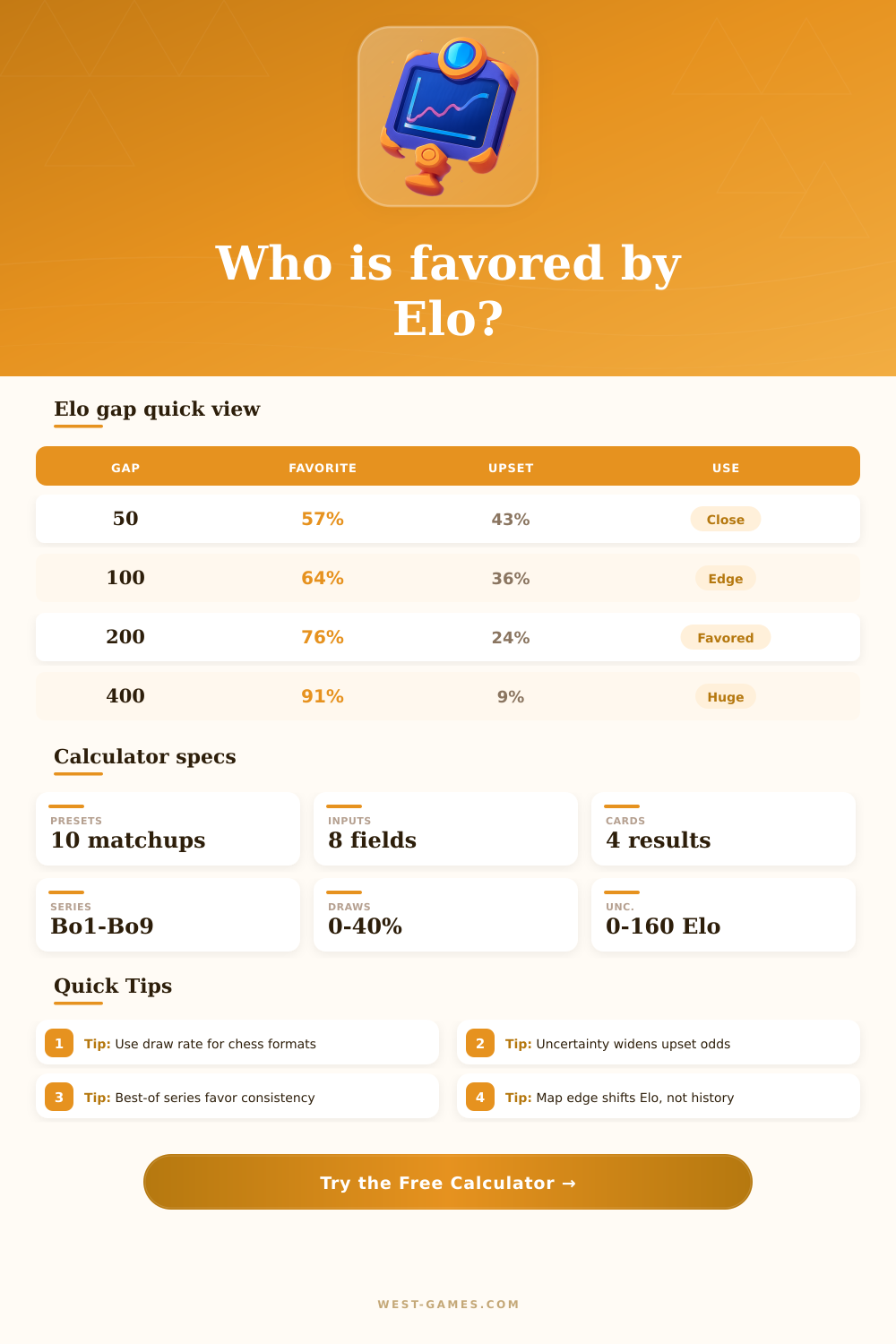
| Gap | Favorite | Underdog | Match feel |
|---|---|---|---|
| 0 Elo | 50.0% | 50.0% | Even |
| 50 Elo | 57.1% | 42.9% | Slight edge |
| 100 Elo | 64.0% | 36.0% | Clear edge |
| 200 Elo | 76.0% | 24.0% | Strong favorite |
| 400 Elo | 90.9% | 9.1% | Huge mismatch |
These values are decisive-game expectations before adding draws, side advantage, or uncertainty.
| Format | Draw rate | Use case | Effect |
|---|---|---|---|
| Arcade or FPS | 0% | No draws | Pure win/loss |
| Card ladder | 1-3% | Rare ties | Tiny dilution |
| Soccer style | 18-28% | League match | Upsets compress |
| Rapid chess | 20-35% | Strong players | Win share shrinks |
| Classical chess | 30-40% | Elite play | Draws dominate |
| Single | Bo3 | Bo5 | Bo7 |
|---|---|---|---|
| 52% | 53.0% | 53.7% | 54.4% |
| 55% | 57.5% | 59.3% | 60.8% |
| 60% | 64.8% | 68.3% | 71.0% |
| 65% | 71.8% | 76.5% | 80.0% |
| 70% | 78.4% | 83.7% | 87.4% |
Series math assumes independent decisive games with the same per-game edge.
| Uncertainty | Meaning | Use | Risk |
|---|---|---|---|
| 0-20 Elo | Stable | Known pool | Narrow |
| 25-50 Elo | Normal | Active ladder | Moderate |
| 60-90 Elo | Shaky | New roster | Wide |
| 100-130 Elo | Volatile | Few games | High |
| 140+ Elo | Unknown | Showmatch | Very high |
An Elo system use a mathematical formula based off the past performance of a competitor to create a single number that represent that competitor. That Elo rating help to determine the probability that one competitor will defeat another competitors. An Elo system does not just measure the performance of a competitor by a feeling but calculates a number based on the competitor’s past games.
Given an Elo system, peoples can determine the future outcomes of the competitors based on there past performance. A competitor can experience various factor that may contribute to they rating prior to the start of the games between the competitors. Such factors include the advantage of one side of the game, software patch, or the advantage of the home crowd.
How the Elo System Works and What Changes Ratings
The Elo system can be adjusted to account for these factors that impact a competitor’s actual strength. Draw rates between games also impacts the Elo system. For games that make draws unlikely to happen, there is less chance of a draw between the competitors.
For game formats that make draws likely between the players, that outcome is more likely then a win for either competitor. Another factor that impacts the Elo system is the length of series between competitors. For instance, a best-of-seven series will smooth the outcome of a series compared to a best-of-three series.
The longer series between two competitors allow for the stronger competitor more opportunities to play and to exhibit their strength compared to a best-of-three series. Additionally, the difference between the two series are smaller for ratings that are closer than for a best-of-three series, but the difference is more considerable for ratings that are further apart. An Elo calculator can estimate this for a series of games between two competitors.
Uncertainty is one more factor that can be included in the Elo system. A rating based on twenty games will contain more noise in its rating than a competitor with a rating based on two hundred games. The more uncertainty between the outcome of the games between the competitors, the wider the win range will be for Elo rating.
The wider range in win projections can help a competitor determine whether an underdog is a viable competitor to the favorite for the tournaments or games compared. If there is limited information for the games between the competitors, the uncertainty will be higher and a wider win range will be indicated to show the potential outcome of their games. Reference tables can be used to determine the outcome of games between competitors.
These tables can help people determine if a twenty-point difference in ratings is significant or not. Additionally, the reference tables can help humans determine if a forty percent chance for draws between the team is normal between games in a specific format or not. Without these tables, people would likely misinterpret the percentage outcome of games between two teams with different rating.
Ratings are not a number that is fixed for each competitor but change based on new information. For instance, if a competitor changes their environment in which they play their games, their rating will change even if the number in the Elo rating system is the same. The strength in effect are changing because the environment they are playing in has changed.
This factor should of been adjusted for within the Elo system to account for the change in their actual strength as a competitor. The context of the environment can also be factored into the Elo system. For example, a hundred-point Elo gap can mean a different outcome in an environment that make draws unlikely compared to an environment where draws between competitors are likely.
The Elo system does not change based on the games or the surface being used for the games, but these factors must be provided to the Elo system to create an outcome based on those parameters. The Elo system also calculates the distance between the performance that is expected by the competitor and the performance that would be required for another outcome for the games between the competitors. If the distance between those two performances is small, small change in the skills of the competitors or the conditions in which they play the games can make a great deal of difference in the outcome of the games between the competitors.
However, if the distance between those performances is large, small changes to the games will have little effect on the outcome between those two competitors. Knowing the distance between expected and required performance is more important to the Elo system than knowing the outcome of the games between two competitors.