🗡 Diablo 4 Rogue Skill Tree Calculator
Plan Rogue points, spender cadence, imbuement uptime, key passive synergy, and defensive coverage in one compact build model.
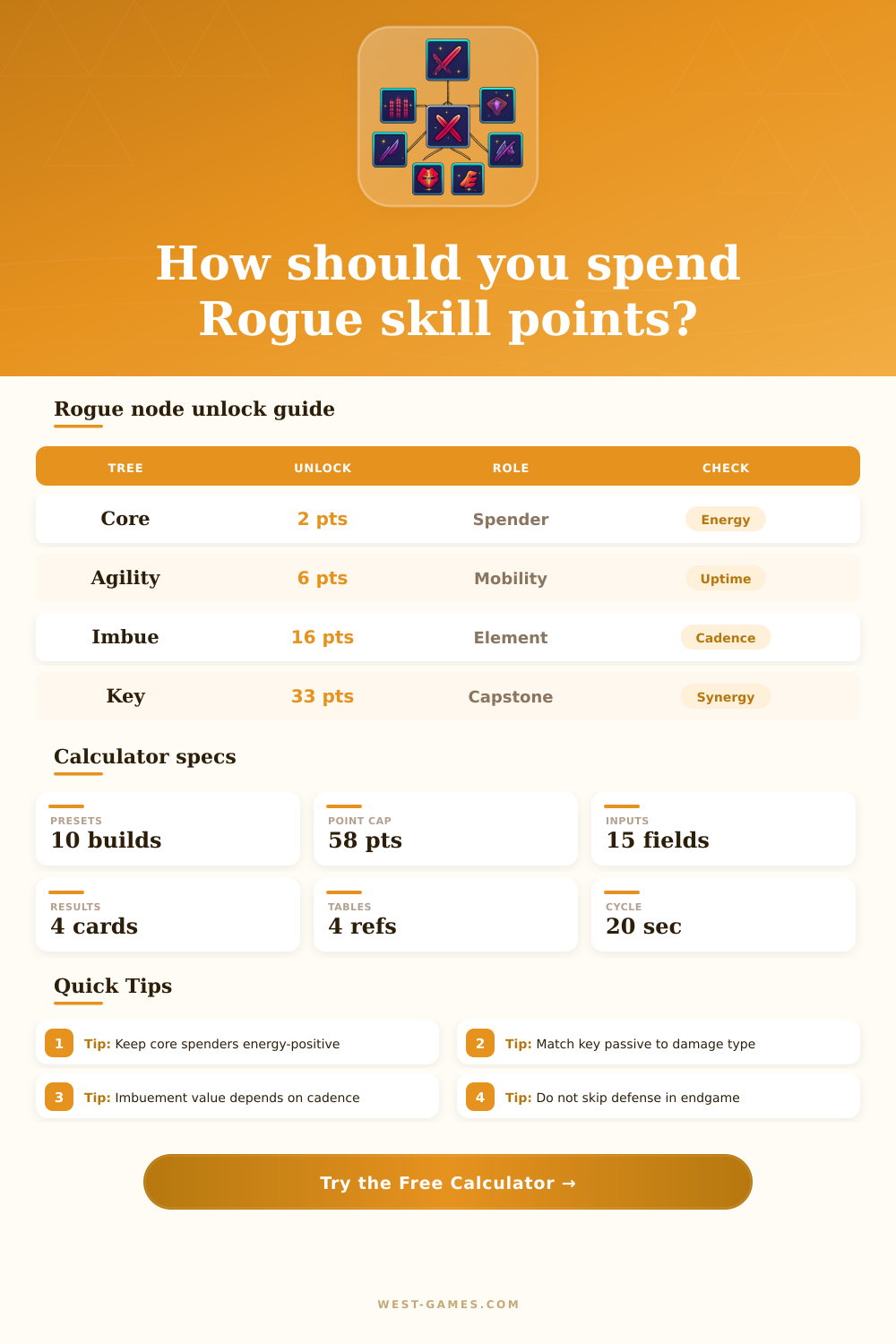
| Cluster | Points | Primary use | Calculator check |
|---|---|---|---|
| Basic | 0 | Generator and opener | Basic attacks per cycle |
| Core | 2 | Main spender damage | Core ranks and upgrades |
| Agility | 6 | Movement and repositioning | Mobility score |
| Subterfuge | 11 | Defense, stealth, control | Survival score |
| Imbuement | 16 | Shadow, Poison, Cold scaling | Imbued cast ratio |
| Ultimate | 23 | High-impact cooldowns | Ultimate investment |
| Key passive | 33 | Final build identity | Passive synergy |
Thresholds are used as planning gates; the calculator also checks whether your total spend exceeds your selected point budget.
| Skill | Cost | Profile | Model power |
|---|---|---|---|
| Twisting Blades | 30 | Melee burst return | 1.22 |
| Barrage | 30 | Close or mid-range cone | 1.05 |
| Rapid Fire | 25 | Single-target marksman | 1.16 |
| Penetrating Shot | 35 | Line cleave marksman | 1.34 |
| Flurry | 25 | Melee area sustain | 0.98 |
| Heartseeker Basic | 0 | Basic attack scaling | 0.82 |
Model power is a normalized planning value. Ranks, crit, Vulnerable uptime, and imbuement cadence modify it.
| Spec | Best fit | Damage mod | Energy value |
|---|---|---|---|
| Combo Points | Burst spenders | 1.18x | Builder cadence |
| Inner Sight | Fast spend loops | 1.08x | +30 per cycle |
| Preparation | Ultimate resets | 1.05x | +10 per cycle |
Combo Points rewards Basic attacks, Inner Sight helps heavy spenders, and Preparation improves Ultimate-heavy rotations.
| Package | Role | Damage amp | Control value |
|---|---|---|---|
| Shadow | Clear and explosions | 12% | Medium |
| Poison | Boss and elites | 16% | Low |
| Cold | Freeze and setup | 10% | High |
| Dual Imbuement | Hybrid coverage | 18% | High |
| No Imbuement | Trap or pure physical | 0% | Build-specific |
The imbuement multiplier only applies to the portion of main-skill casts entered as imbued in the form.
| Key passive | Best material | Formula effect | Watch-out |
|---|---|---|---|
| Momentum | Cutthroat melee | +8% damage, +18 defense | Needs close uptime |
| Close Quarters Combat | Mixed marksman and melee | +12% damage, +8 defense | Requires alternating ranges |
| Precision | Marksman crit | +15% damage | Crit chance dependent |
| Victimize | Vulnerable basic scaling | +10% damage, +10 control | Needs Vulnerable uptime |
| Exposure | Trap reset package | +7% damage, +12 reset | Low value without traps |
| Alchemical Admixture | Imbuement hybrid | +9% damage, +8 control | Needs varied damage types |
Use this grid to compare the tree material that supports your chosen spender: melee, marksman, trap, imbuement, Vulnerable, or hybrid crit.
To build a Rogue in Diablo 4, one must has an understanding of the energy system of the game. The energy system is important to the game because it dictates every decision that a player make within the game. By selecting a spender skill that one can afford, a player avoids the situation in which they can quickly deplete the resources that their Rogue character has.
The calculator that is provide allows a player to input the number of times that they wish to use the player’s chosen spender skill within a twenty-second window. By using this calculator, a Rogue warrior can avoid the guesswork that they would have to make in order to determine whether their skill rotation would be able to continue into a fight with a group of enemies or a boss. Before one chooses a spender skill, it is necessary to determine the cost of the primary damage skill of the Rogue warrior, as well as to determine how that cost can change with the addition of ranks and upgrades to that primary skill.
Rogue Build Guide and Energy Calculator
For instance, both the skills Twisting Blades and Penetrating Shot are high damage skill, but Twisting Blades returns energy with the return of the blade, while Penetrating Shot require the Warrior to continually position themselfs as a marksman. Energy starvation is a common reason that Rogue Warriors fail during gameplay, and it is more detrimental to a Warrior than low damage output from their spells. Once a player has chosen a spender skill, they must also choose a specialization for their character.
Specializations such as Combo Points provides rewards for utilizing basic attacks before using spender skills, Inner Sight provides resource relief for longer games, and Preparation provides assists for the Warriors Ultimate skill. Each of these can be compared using the calculator, based off the type of activity that the Warrior desires to focus on their gameplay. Many players make the mistake of underinvesting in the Agility and Subterfuge clusters for their warrior early in the game, as they are often trying to reach the Imbuement skill and the Ultimates nodes for their character.
This shortcut may work during the campaign stage of the game, but causes problems for players when they encounter situations that require repositioning, or when battling group of enemies. This tool allows players to track how many points they have invested in the Agility and Subterfuge skills. Additionally, the tool will inform the player if they are attempting to select the Imbuement skill without investing in sufficient points into these skill clusters.
The total number of points that a player selects for their warrior should not exceed the fifty-eight point planning cap for the game, as most players who use these builds in the endgame stages of Diablo 4 will spend their points within this cap prior to the application of their seasonal bonus points. There are three main Imbuement skills to consider for warriors. Shadow Imbuement is effective at clearing groups of enemies, as the explosions from the Imbuement will continue to attack additional enemies.
Poison Imbuement is more effective in utilize pressure on bosses and elites enemies. Additionally, Cold Imbuement will provide control over the game, allowing the warrior to freeze their elite enemy before it can attack them. These imbued skills require the player to enter the number of casts of each skill per cycle.
The Imbuement skills will only apply to the main skill casts that is marked as imbued. If players enter an incorrect number of imbued casts for their player characters, their damage score will appear higher than their actual damage score that will be dealt to enemies. Energy balance is a crucial component of the warrior and her spells.
Yet, most players will ignore this component after a glance at the energy score. The energy balance calculator will determine a net energy value and a sustainability score for the player’s character. If the net energy value for each cycle is a negative number, it would not be beneficial to invest any additional points into damage nodes for the Warrior’s spells.
Instead, investing into basic attacks, Inner Sight, or cost reduction passives will provide more benefit to players during gameplay. Additionally, there are reference tables that list the thresholds that will allow players to unlock each of these skills clusters. These tables will remind players of which nodes will generate or refund energy for their characters.
For players who move past the campaign of Diablo 4, defense scores become more important to the Warrior and her survival within the game. Subterfuge skills will increase the uptime of skills such as Dark Shroud and Concealment. Agility skills will increase the character’s ability to dodge enemy attacks.
The readiness score for the character will provide a weight to each of these defense stats based upon the type of activity that the warrior chooses to perform. For example, the weight of each of these stats will change based upon whether the player is pushing the Pit boss or performing speed content in the game. The selection of the key passive skill will dictate the rest of the character’s points investment into the game.
The momentum passive will reward the Warrior for staying within melee range of their enemies. The precision passive will reward the Warrior for move towards their enemies to take advantage of the critical strike chance that marksman players can score. Lastly, the exposure passive will only provide benefit to players who are investing points into the creation of traps.
These calculations will include the damage and defense scores of the game, weighted according to the selected key passive. Additionally, players can select a different key passive at a later stage of the game. The calculator will help to determine the impact of such a change, as it will allow players to move points out of the early skill clusters for which the new key passive has higher requirements.
As players begin to build their characters, they tend to make common mistakes with each of the skills. For instance, many players will max out the ranks for their Core skill, but then find themselfs in a situation where their energy is negative. Additionally, players will often forget that the ratio of their imbued casts impacts their imbuement multipliers.
For instance, should a player enter zero as the number of imbued casts yet select one of the Imbuement skills will create misleading results in the damage score that is provided by the calculator. Thus, this tool will not judge the mistake of players, but will make clear the impact that they will have upon the characters if those mistakes are made. While the calculator is a helpful tool to determine the effectiveness of a Warrior and her skills, it cannot provide an understanding of the way that the build may feel while the player is actively playing the game.
For instance, some players may enjoy the Combo Points, as they are used to the bursts of damage from utilizing their abilities in such a manner. Others may find the use of Inner Sight to be more comfortable during their fights with the bosses in the game. These preferences can only be understood after the player begins to use the skills in the game.
Use the calculator to identify two or three different point spreads for the player to test in the game. While the calculator will allow players to create a functional skill tree for their characters, the player will have to make a decision based upon the way that the rotation may feel during gameplay.