🏰 Chambers of Xeric Loot Calculator
Estimate CoX loot value from team points, personal points, death and supply penalties, Challenge Mode settings, purple split rules, and expected common loot.
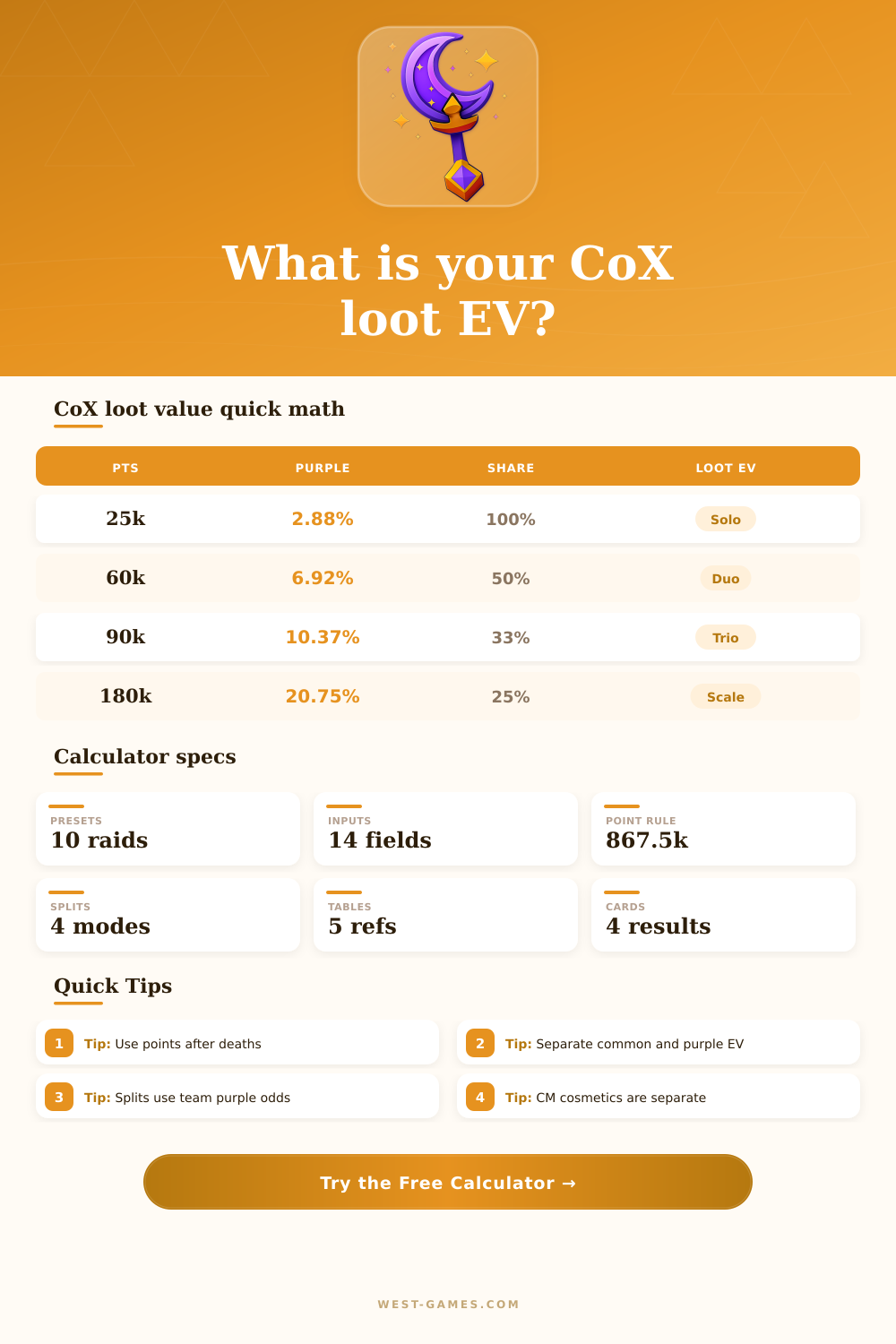
| Effective team points | Any purple chance | Common loot role | Typical use |
|---|---|---|---|
| 25,000 | 2.88% | Solo baseline | Learner or iron chest |
| 32,000 | 3.69% | Strong solo share | Clean no-death solo |
| 65,000 | 7.49% | Duo-level chest | Equal split duo |
| 95,000 | 10.95% | Trio split chest | Stable team raid |
| 180,000 | 20.75% | Scaled team chest | High purple frequency |
This calculator uses effective team points divided by 867,500 for the raid-wide purple chance.
| Loot rule | Purple EV formula | Common loot formula | Best when |
|---|---|---|---|
| FFA | personal unique chance x purple value | personal points x common GP rate | Everyone keeps own drops |
| Equal split | team purple chance x purple value / splitters | personal common loot | Trusted team shares purples |
| Weighted split | team purple chance x purple value x point share | personal common loot | Points decide payout share |
| Iron keep | personal unique chance x purple value | personal common loot | Bank value, not trade split |
Common loot is modeled separately because it generally follows your personal contribution rather than team split rules.
| Penalty | Input | Calculator treatment | Loot effect |
|---|---|---|---|
| Your death | Death count | Personal points x 0.60 per death | Lowers personal share and common loot |
| Supply drain | Personal supply points | Subtracts from personal points | Lowers personal and team points |
| Team penalty | Other team point penalties | Subtracts from team points only | Lowers team purple chance |
| Outside supplies | GP per raid | Subtracts from GP value | Lowers net EV and EV/hr |
If your team records exact point loss, enter the exact values rather than relying only on the death multiplier estimate.
| Common GP per 1k points | 25k personal | 32k personal | Use case |
|---|---|---|---|
| 3,500 GP | 87,500 | 112,000 | Conservative chest |
| 5,200 GP | 130,000 | 166,400 | Balanced default |
| 7,500 GP | 187,500 | 240,000 | High-value commons |
| 10,000 GP | 250,000 | 320,000 | Optimistic loot log |
Update this input with your own RuneLite loot tracker average for the cleanest common-loot EV.
| CM factor | How this calculator handles it | Value implication | Comparison cue |
|---|---|---|---|
| Point-based unique | Uses the same team point denominator | Purple EV still depends on points | Compare effective points per hour |
| Longer completion | Cycle minutes lower raids per hour | Can reduce EV/hr despite higher points | Enter full reset and scouting time |
| Cosmetic rolls | Shown as a planning note, not added by default | Dust and kits can add subjective value | Use CM focus view for reminder text |
| Supply intensity | Supply points and GP costs are separate | Bad deaths can erase the point gain | Watch net EV after penalties |
| Team split | Uses selected purple payout rule | Equal split smooths CM variance | Compare team EV to FFA EV |
Challenge Mode has separate cosmetic motivations, so this calculator keeps the main GP model focused on common loot, purples, penalties, and time.
When you begin the raid, you’re thinking about your prayer pots and Olm’s phase transitions. Three hours later, when the loot window pops up, all that math about how much gold per hour come to mind.
Time is the true currency here so most players end up losing “money”. Which is to say, they waste time, during this gap between expectation and reality.
How to Calculate Your Raid Profit
Once you input your team’s performance into the calculator above, it do the raw arithmetic for you. It spares you the guesswork of wondering whether you had an entertaining but ultimately costly run or one so chaotic it result in actual profit.
This comes back to the point system and its role in dictating value. Namely, what your team’s proximity to eighty-sixty-seven-thousand-five-hundred is on any given unique roll. Players knows that higher means more chance at loot. What many don’t realize is how fast their points will be lost under penalty.
Taking a death doesn’t only subtract what you contributed; it multiplies into a massive cut in your portion. The tool models it as 40% cut per death. It is a cruel multiplier that can make even a good run into a net negative experience when trying to go it alone or guide an uncoordinated party.
This is where many fail to see the logic. They forget that whole reason to survive Olm is precisely the economic plan. There’s one more wrinkle that simple average can’t convey: splitting up the catch.
Equal-split mode means that as a player, your individual points counts less. What matters now is the combined power of the squad. That changes everything in terms off risk profile. Maybe you’re hauling gear, and not putting down as many points. Or maybe something is going wonky and it’s just not your day. Regardless, you’ll get a little bit of whatever a team bag drops. And the calculator accounts for the number of players taking a cut out of the bag.
So, for example, a steady trio run tend to be far more efficient (in terms of expected value) compared to a high variance solo run. Even though the total possible payout may appear smaller in theory. Grinding is about dependable income (and stability trumps spikes).
The reason we don’t talk about common loot as much is that it’s boring, especially when compared to the glitz and glamor of purples. Common stuff like herbs, ore, runes, and seeds accumulate over time. They’ll pad your wallet ever-so-slowly, but no one cares until they gets the next rare item.
The page has a reference table that shows how many points are worth how much gold if you change the number of gold/point to reflect your own personal experience. Why? Two people can have the same amount of points but end up with very different results at the end of the day. That depends on selling/banking strategy, inventory management, etc. No one knows your numbers as well than you do, so use that instead of some general guess.
In Challenge Mode, however, time becomes the main cost. While points is still linked to their special rolls, the reset time extends and the challenge itself grows more difficult. That’s why the calculator also considers how long your raid will take. That has a direct effect on “earnings per hour” number.
If you’re getting lots of points from a slower run, then you may see some big numbers in terms of total gold. However, those numbers will often fall flat compared to amount of hours required. The loss in productivity is a real measurement that must be weighed against how much people value kits and other dusted out cosmetic items. It’s up to each individual player to decide what they find valuable enough to invest their time in. No spreadsheet will ever completly solve that for you.
The last variable between theoretical profit and money in the bank? It is prep cost. Scouting supplies, food, and potions are up-front expenses which reduces the value of what you find on the table. Forgetting about those costs would of made everything appear more luxurius than it actualy is. Outside costs and supply drain fields let you input those expenses so you can view the true net impact once all bills are paid.
That helps prevent one of the most common mistakes: congratulating yourself on a high raw loot number while forgetting about the price tag you’re paying to earn it.
Nothing more than manage expectations, understand how groups work, and make decisions about which path to take, difficulty, time, and group makeup is not mutually exclusive. You input some stuff. You get some numbers. You change your plan accordingly. And then you return to the Chambers with a calmer mind.
Sometimes the loot window will still shock you. But now you’ll have some idea if you had a good night or simply made some loud noise.