📦 Repo Loot Calculator
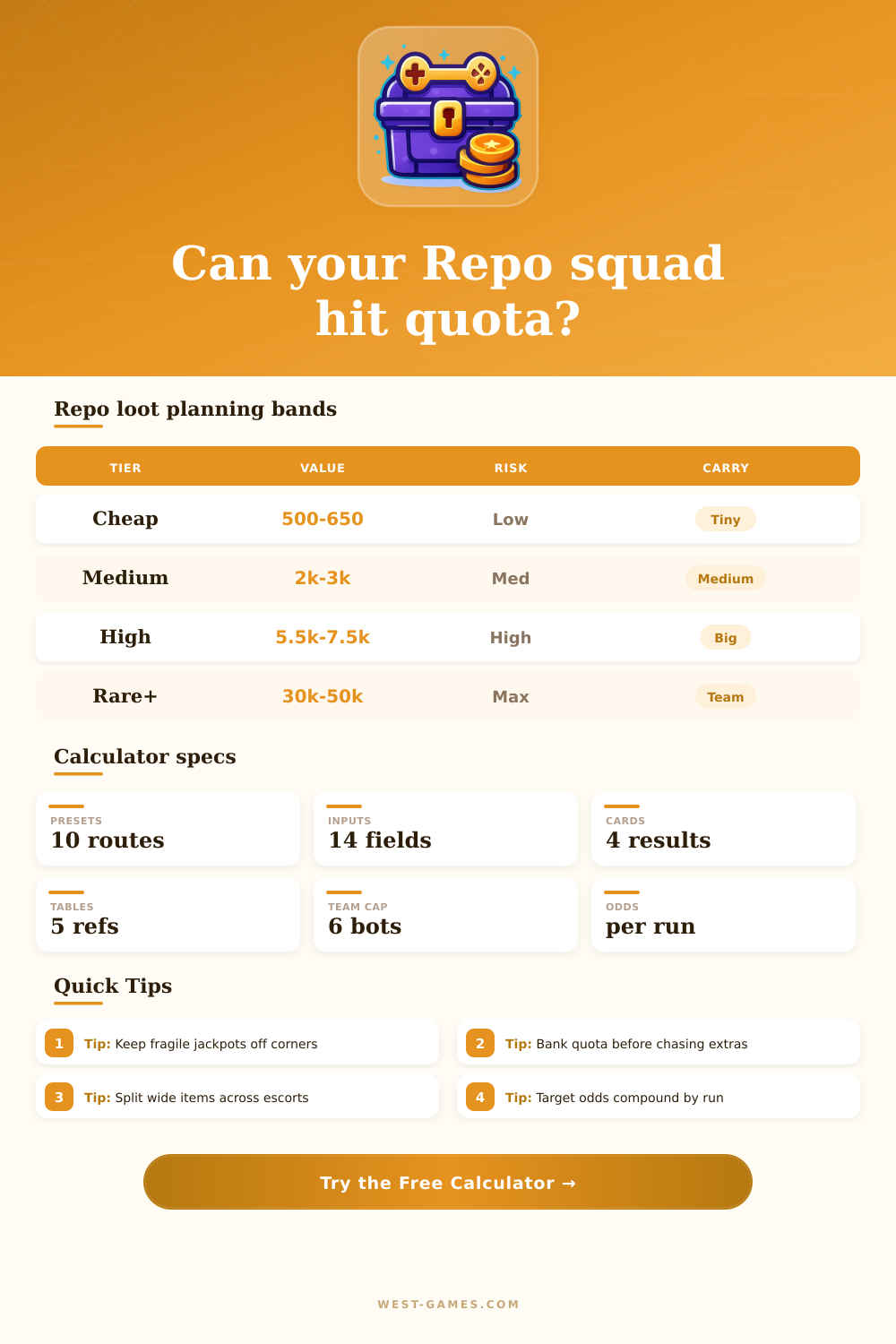
Plan R.E.P.O. quota runs from location, moon pressure, item value tiers, C.A.R.T. handling, extraction success, team share, fragile loss risk, and target valuable odds.
| Value tier | Typical range | Calculator focus | Quota behavior |
|---|---|---|---|
| Very Cheap / Cheap | 250 to 650 | Tiny and small stack routes | Safe but needs many pieces |
| Cheap+ / Cheap++ | 850 to 2,000 | Fast early quota filler | Good for first extraction |
| Medium / Medium+ | 2,000 to 4,500 | Reliable C.A.R.T. value | Strong balance of value and risk |
| Medium++ / High | 4,500 to 7,500 | Room sweep priority | Worth escorting through danger |
| High+ / Expensive | 9,500 to 25,000 | Showpiece hunt | Can swing a quota alone |
| Expensive+ / Expensive++ | 30,000 to 50,000 | Jackpot route | Huge value with severe loss risk |
R.E.P.O. values are rounded and generated per valuable, so use these as planning bands rather than guaranteed item rolls.
| Location | Loot feel | Multiplier | Target note |
|---|---|---|---|
| Headman Manor | Mixed valuables and fragile decor | 1.00x | Good baseline route |
| McJannek Station | Tighter industrial movement | 0.96x | Reduce carry efficiency |
| Swiftbroom Academy | Many small pulls and classrooms | 1.04x | Strong tiny-stack route |
| Museum of Human Art | Showpieces and awkward hauling | 1.18x | Best for heavy jackpots |
| Disposal Arena | Cleanup and recovery pressure | 0.92x | Use safer buffers |
| Random chain | Mixed module route | 1.00x | Edit target odds manually |
Location multipliers describe practical route value, not hidden spawn code. Tune them after a few squad runs.
| Pressure | Value factor | Risk factor | Planning note |
|---|---|---|---|
| Early level | 0.90x | 0.85x | Lower value, safer carry |
| Crescent Moon | 1.00x | 1.00x | Baseline quota planning |
| Half Moon | 1.15x | 1.14x | Bank before chasing extras |
| Full Moon | 1.32x | 1.30x | Expect more run disruption |
| Super Moon | 1.55x | 1.55x | High value, brutal losses |
The calculator applies pressure to both expected value and exposed loss risk so late routes can look profitable but dangerous.
| Largest size | Handling factor | Escort need | Failure mode |
|---|---|---|---|
| Tiny / Small | 1.06x | Low | Low total value |
| Medium | 1.00x | Medium | Door panic drops |
| Big | 0.92x | Medium high | C.A.R.T. crowding |
| Wide | 0.84x | High | Rotation and corners |
| Tall / Very Tall | 0.78x | High | Doorframes and tipping |
Lower handling reduces banked value after breakage and success checks, making heavy items need better escorts.
| Target route | Base odds | Value style | Calculator use |
|---|---|---|---|
| Emerald Bracelet / Goblet | 18% | Tiny stack | Common filler target |
| Cube of Knowledge | 12% | Medium high | Efficient shelf pull |
| Dumgolf Staff | 8% | High | Escort priority |
| Museum Boombox | 7% | Trap sound risk | Risk-adjusted target |
| Uranium Mug | 6% | High value small | Secure carry route |
| Dinosaur | 3% | Jackpot fragile | High variance hunt |
| Propane Tank | 5% | Trap valuable | Recovery model |
Odds compound by run with 1 - (1 - single-run chance)^planned runs.
| Metric | Formula | Inputs | Interpretation |
|---|---|---|---|
| Quota target | quota x (1 + buffer) | Quota and buffer fields | Amount to bank before leaving |
| Raw run value | quota x clear x map x moon x tier | Route, pressure, rooms, tier | Expected value seen before losses |
| Handling value | raw x C.A.R.T. x size factor | Carry efficiency and size | Value that can reasonably move |
| Banked haul | handling x success x (1 - breakage) | Success and fragile loss | Expected extracted SURPLUS per run |
| Loss risk | handling - banked haul | All risk settings | Value exposed to failure per run |
| Expected runs | target / banked haul | Quota target and banked haul | Average runs needed for quota |
| Target odds | 1 - (1 - odds)^runs | Target odds and planned runs | Chance to see chosen loot |
Randomized modules can beat or miss the forecast; use the breakdown to tune assumptions after each squad session.
Every run of a R.E.P.O. Exists to meet its quota. It’s about banking enough surplus before time runs out. If you can spend the night hunting for rare items but don’t have at least three grand surplus in your truck when the clock ticks down to zero, then you’ve failed this run. That kind of pressure drives the game’s economy: there are high-risk targets and low-value filler loot and the challenge lie in finding the right combination. This is done not just through instinct but with precise knowledge of how many points each run bring back after subtracting for team splits, monster attacks, and broken equipment.
And instead of having to guess at compounding probabilities, all we have to do is enter our target odds, target pressure on the route, and carry efficiency, and the calculator up top does the rest. So instead of treating your squad’s plan as a series of lucky rolls it models it as a system of inputs.
How to Plan Your Repo Run
If you pick a spot with low difficulty moving around and high loot density (like McJannek Station or Headman Manor), the tool will apply a multiplier to that. A museum run feels different because the showpieces themselves are larger and harder to move, so they lowers your effective carry efficiency. The model accounts for this by decreasing handling factor if you’re going for wide or tall items, essentially mimicking the friction of dragging bulky objects through narrow door frames. This physical constraint matter because every single drop create zero surplus.
Then there’s moon pressure. Moon changes math completely. Early levels have predictable spawns on relatively calm corridors, but money-per-run isn’t high. Then as it grows towards the full/super phase, monster aggression go up while loot value skyrockets. Your haul prediction might look like it’s higher, but then you’ll notice that loss risk column shows how much of that theoretical gain is now vulnerable to being lost. Many teams gets caught here, chasing big-moon runs without even noticing that their breakage rate just doubled. By showing both expected haul and unbanked value-at-risk, the tool allow you to see whether the extra surplus is worth the additional probability of a wipe.
These factors are also affected subtly but critically by your team size. While R.E.P.O. Can support as many as six semibots, the more bots you add the smaller each bot’s share of whatever you extract. If there’s a lot of loot, it doesn’t matter so much, you just need to remember your own slice gets cut down further for every additional teammate. Efficiency matters here; a well-coordinated trio is generally going to be faster than an unruly six-bot team who can barely get their heads around synchronizing extractions. Keep in mind your team composition when setting your runs per quota goal. Adjust to match how fast your particular squad can clean rooms and fill up the C.A.R.T. Before anything slips through a narrow stairwell.
Patience pays off here: because target odds compound across multiple runs. You may feel like the chance of snagging that Dinosaur fossil, or Cube of Knowledge, on any given trip is slim. But if you’re planning an extraction loop four or five times, those odds add up a lot. That’s how the tool calculates cumulative chance, to help you determine whether it’s time to cash out with what you’ve got, or stick around hoping for a jackpot. Better to go home with something guaranteed than come back with nothing, just hoping you’ll get lucky next time.
Even safe extraction means thinning profits from fragile losses. Broken decor and chipped wares diminishes resale values for your loot, which means you need to set a reasonable breakage percentage and avoid predicting an over-optimistic number. Players consistantly undervalue the frequency of accidents caused by corners and clutter. By prompting you to enter this risk explicitly, the calculator forces you to acknowledge that not all picked-up goods arrives at the truck unscathed. While shaving this number downward may appear positive on paper, it rarely reflects the chaos of an under-pressure live run.
Repo runs are won with discipline more so than dumb luck. Consider bonus loot separately from quota loot. First bank the target at the extraction point which is the only thing required to win. Then evaluate if the group can safely move the extras for some extra profit. Thinking in these two steps allows the team to avoid the greedy mistake of putting survival second.
The prediction tools also helps frame the decision making process, offering clear lines of both risk and reward. Once you know what makes the numbers tick, it’s no longer about taking chances on hope. It becomes about managing resources. That shift in mentality transforms a frantic scramble into a well-managed operation, where everything you pull has a purpose.