✨ Magic XP Calculator
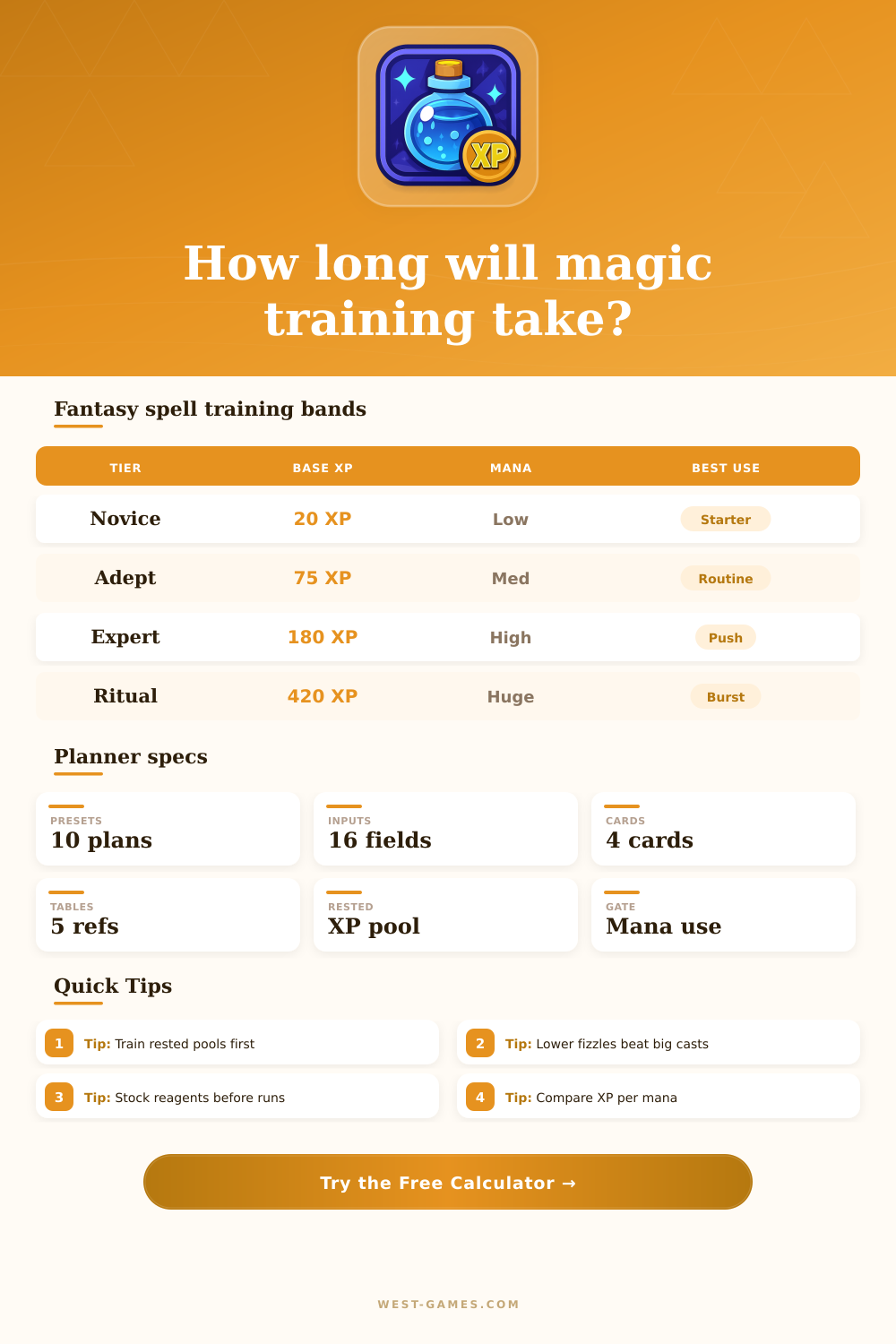
Plan fantasy spell training with spell tier, school specialization, mana cost, cast time, success rate, rested XP, reagents, and target level in one session model.
1. XP To Target
target curve - current progressUses a generic fantasy level curve, then subtracts progress inside the current magic level.
2. Cast XP
base XP x tier x school x bonusApplies spell tier, school specialization, global XP bonuses, and a fizzle learning credit.
3. Real Cast Rate
cast time + mana recoveryConverts mana cost, regen, and recovery downtime into practical casts per hour.
4. Resource Limit
casts x reagent profileChecks whether stocked reagents cover the target plan and the selected session length.
Tier Payoff
Rates whether the chosen tier produces enough XP to justify its risk and cast time.
Mana Efficiency
Compares expected XP against mana cost and recovery delay.
Reagent Readiness
Checks whether inventory stock supports the target and session plan.
Session Fit
Shows whether this route produces visible progress in the planned session.
| Spell tier | Typical base XP | Mana pressure | Training note |
|---|---|---|---|
| Cantrip practice | 8 to 18 XP | Very low | Good for first levels or no-reagent drills |
| Novice spell | 18 to 40 XP | Low | Reliable when success rate is not capped |
| Apprentice spell | 40 to 90 XP | Moderate | Best general training band for early builds |
| Adept spell | 90 to 180 XP | High | Good once fizzles stay under control |
| Expert spell | 180 to 340 XP | Very high | Works with strong regen and bonus XP |
| Master spell | 340 to 650 XP | Extreme | Few casts, high downtime, high payoff |
| Ritual spell | 650+ XP | Ritual gate | Best modeled as planned bursts, not spam |
Values are descriptive fantasy/RPG planning bands. Enter your actual spell XP when your game, campaign, or mod exposes exact numbers.
| School | XP style | Mana behavior | Reagent behavior |
|---|---|---|---|
| Evocation | Direct damage casts | Higher bursts | Often common catalysts |
| Restoration | Steady repeat casts | Efficient loops | Usually light reagent use |
| Illusion | Control and veil practice | Low to moderate | Focus crystal friendly |
| Conjuration | Summons and pacts | Front-loaded | Consumes bindings or sigils |
| Enchantment | Glyph and item training | Moderate | Bench reagent pressure |
| Necromancy | Rites and sacrifices | Uneven bursts | Rare component pressure |
| Transmutation | Utility transformations | Efficient practice | Low consumable pressure |
| Elementalism | Area rotations | Expensive channels | Crystals and essences |
| Profile | Multiplier | Best spell type | Planner warning |
|---|---|---|---|
| No reagent | 0x | Cantrips and pure mana spells | Mana is the main limiter |
| Common catalyst | 1x | Routine training spells | Watch large cast counts |
| Focus crystal charge | 0.5x | Channels and control spells | Charges may refill out of combat |
| Rare ritual component | 2.5x | Master and ritual spells | Target route may exceed stock |
| Consumed scroll or rune | 3x | Prepared burst sessions | Session length can be resource gated |
| Training feel | Cast time | Mana cost | Efficiency cue |
|---|---|---|---|
| Fast cantrip loop | 0.8 to 1.5 sec | 0 to 8 mana | Low XP, excellent uptime |
| Apprentice rotation | 1.5 to 3 sec | 8 to 24 mana | Often best XP per hour |
| Adept channel | 3 to 5 sec | 24 to 55 mana | Needs success rate and regen |
| Expert burst | 4 to 8 sec | 55 to 120 mana | Great with rested XP pools |
| Ritual sequence | 8+ sec | 120+ mana | Plan as limited high-XP casts |
| Route type | Strength | Weakness | Best result signal |
|---|---|---|---|
| Reliable novice spam | High uptime and low fizzle rate | Many casts to target | Strong XP/hour and mana score |
| Adept specialization drill | Good XP per success | Can require more regen | Balanced tier and session score |
| Rested expert burst | Uses bonus XP quickly | Short until rested pool drains | High early session progress |
| Reagent ritual route | Huge XP chunks | Inventory and component gated | Resource gate card decides viability |
| School bench practice | Predictable glyph or ward loops | Often lower action pace | Good reagent readiness score |
This is a fantasy/RPG training planner, not an OSRS Magic XP formula. Use the exposed fields to match a custom game, private server, tabletop campaign, or modded RPG economy.
Don’t fall into the trap of thinking that casting the most powerful spell you’re able to learn will result in the most efficient magical training. Even if it might seem like a bigger number on paper, its typically an error. High level spells takes longer to cast and cost more mana. They are also often made of rarer reagents that deplete your pack faster then they give you XP.
The secret sauce of magical training is finding the balance between resources and throughput. The calculator up top do this for you when you specify your own parameters for a given play session.
How to Train Magic Efficiently
Mana is not only a cost; it’s also a temporal restriction. You have to spend your mana to cast a spell and then sit there until it replenishes. Casting a huge fireball (which requires 80 mana points) might take you longer to “recover” than it does to actualy make the incantation. While this high-powered spell yields more XP per cast, an easier apprentice spell may yield less XP individually, but at least you can shoot it off three times while the other one recharges only once. Because you’re being consistent instead of intense over time you’ll probably get more experience-per-hour using the lower-mana spell.
The table on the page spells all this out in terms of how much “mana pressure” each tier of spell put on you. For example: Grinding out levels means that raw power isn’t as important as success rates. If I have a spell which deals two-hundred experience points per cast but fails forty percent of the time, it’s going to bog me down. It will give less experience and my failed spells still cost me time (and usually mana) on most systems. To accommodate this, the calculator lets you plug in your real-world success chance. In other words, it can tells you if the risk of using a high-tier spell is worth potential reward, or if you should just stick to an adept-level routine that has proven reliable over time.
Managing resources and trying spells take up time, and most people greatly underestimate how much downtime this causes. It also adds rested experience bonuses that completely change how things go. You will spend your rested experience points where they are most effective. (where they multiply the greatest amount). The smallest gains don’t justify burning through your rested bonus by hitting cantrips; the absolute gain isn’t worth it. You hold onto your rested bonus until you push into master/expert levels during a concentrated burst session. This means you may train in a slightly different way based off whether you’re actively playing or not.
Before the session begins, reagents are often the deciding factor between success and failure. Sure you can figure out how many casts will take you to level twenty-five, but what happens when every cast costs one rare crystal and you only carry two hundred of them? No matter your mana regen rate, you is finished. This inventory check works on the fly, showing the resource gate for your session. And yes, it saves you from being stuck midway through a two-hour session with no more materials because you got too excited about casting.
Specializing in the correct school helps too. Illusion and restoration are generally smoother, low-reagent, and mana-efficient schools that work well if you’re looking to do a lot of straight-up grinding. In contrast, something like evocation or necromancy may be more peaky (i.e., give bigger rewards per cast) but more costly to set up. Consider which combination of these things is most valuable to you: your existing supply pile and how much you can spare from that for getting supplies rather than just casting spells.
At the end of the day, magic levelling up is all about using resources well. It is not an uncontrolled power fantasy. It is about using the spell that gives you the most experience per real-world minute, while accounting for every second wasted on failed casts, waiting for mana to regenerate, or managing your inventory. Magic should just be a continuous stream of successful spells; getting in the groove and sustaining the flow of spellcasting without running out of materials or exhausting your furnitures. It is not necessarily the one with the biggest explosion, but it’s the one that lets you keep a consistent pace for however long you play.