Herblore XP Calculator
Pick a potion, enter your XP goal, add bonus XP and market values, then estimate potions, supplies, training time, and loss or profit.
Potion training presets
XP target and potion setup
Supply values and stock
Supply count from last calculation
Supply values are planning estimates. Current Grand Exchange prices, tax treatment, buy limits, and finished potion dose conventions can change the final result.
Training method comparison grid
OSRS starter and mid-level XP per potion
| Potion | Level | XP per potion | Unfinished potion | Secondary ingredient |
|---|---|---|---|---|
| Attack potion | 3 | 25 | Guam potion (unf) | Eye of newt |
| Strength potion | 12 | 50 | Tarromin potion (unf) | Limpwurt root |
| Energy potion | 26 | 67.5 | Harralander potion (unf) | Chocolate dust |
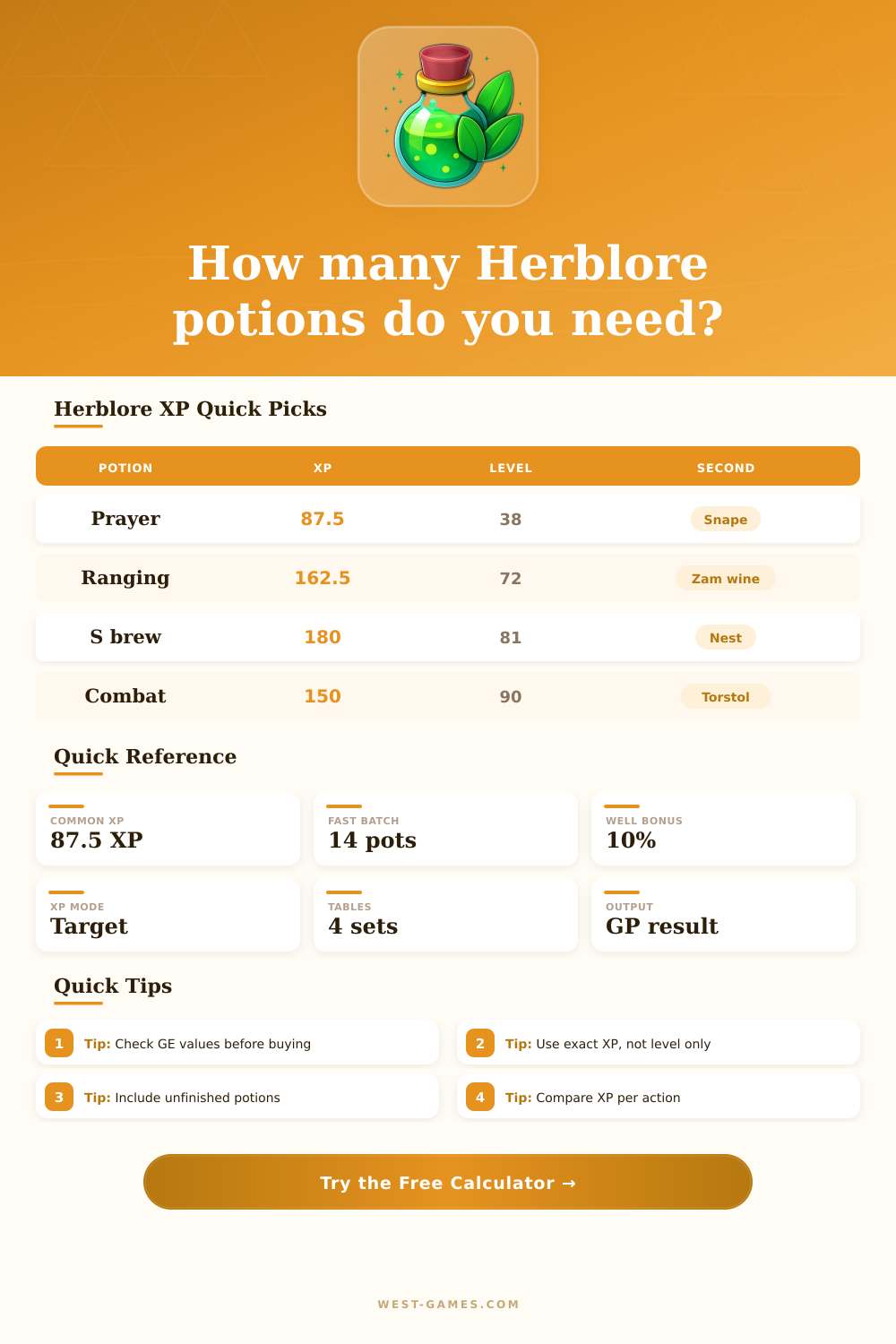
| Prayer potion | 38 | 87.5 | Ranarr potion (unf) | Snape grass |
OSRS combat potion XP per potion
| Potion | Level | XP per potion | Unfinished potion | Secondary ingredient |
|---|---|---|---|---|
| Super attack potion | 45 | 100 | Irit potion (unf) | Eye of newt |
| Super strength potion | 55 | 125 | Kwuarm potion (unf) | Limpwurt root |
| Ranging potion | 72 | 162.5 | Dwarf weed potion (unf) | Wine of Zamorak |
| Super combat potion | 90 | 150 | Super set plus torstol | Torstol |
OSRS utility and bossing potion XP per potion
| Potion | Level | XP per potion | Base potion | Secondary or extra item |
|---|---|---|---|---|
| Stamina potion | 77 | 102 | Super energy potion | Amylase crystal |
| Saradomin brew | 81 | 180 | Toadflax potion (unf) | Crushed nest |
| Extended antifire | 84 | 110 | Antifire potion | Lava scale shard |
| Anti-venom+ | 94 | 125 | Anti-venom potion | Torstol |
RuneScape bonus XP planning table
| Planning mode | XP modifier | Use when | Calculator field | Supply effect |
|---|---|---|---|---|
| Standard OSRS | 0% | Normal potion training | Game mode: OSRS | Base potion count |
| Portable well | 10% | RuneScape portable training | Portable well checkbox | Fewer potions needed |
| Bonus XP event | Custom | Account-specific modifiers | Other bonus XP percent | Lower supply target |
| Make unfinished | 0 XP | Planning vial plus herb actions | Make unfinished checkbox | More actions counted |
Herblore planning tips
Your wallet clenches as you view prices in the Grand Exchange. Reaching level ninety Herblore require a certain amount of experience that you’re aware of, yet it seems so far away. Two million experience isn’t just a string of numbers on the screen. That’s thousands upon thousands of repeated clicks spent hovering over a well. Hours accumulated while hoping for the best.
This gold could purchase a respectabel home if you do not handle it with care. This is where planning comes into play. What was once an option becomes a necessity. It is what separates frustration from fun.
Plan Your Herblore Training To Save Money
At this point, most players simply begin mindlessly clicking. They’ll purchase low-level items and cross their fingers they’ll win out in the end. The calculator above do all this work for you after inputting your goals. It spares you from having to guess whether your next batch of prayer potions will aid your progress or drain you of gold without you knowing it.
Most users fail to understand that there are two different metrics: total XP/hour AND money spent per hour. Your total XP/hour look good because you’re doing tons of things which takes time. However, if each action costs more gold than it returns in value, you is essentially paying to train. In other words, you’re spending gold to gain XP. So if you have plenty of ingredients, a slower XP potion might end up being much cheaper per thousand XP. The point is you want your final product to retain its value.
How much profit/loss do you get from each potion? Don’t focus solely on the filling-up-bar-speed. Use this tool (which will require you to input the current Grand Exchange value of both inputs and outputs). That means herbs, vials, and any secondary ingredients such as torstol or snape grass. Failure to account for this could result in ending up with a negative balance. The sense of pride might not be worth the expense.
The other thing about training is what exactly you’re doing while you train. I’d recommend that you make some unfinished potions too. This provides another layer to making potions. It gives you experience from act of mixing itself. You will get less experience per act than if you finish one. However, this allows you to reach the same total amount with fewer acts of brewing.
It sounds easy, right? But it completely alters your shopping list. You’ll want more roots or dust and vials than you expected. Each unfinished potion take up a whole new set of materials. Checking the box on the calculator recalculate everything. This ensures you don’t run out halfway through your session by failing to plan for all those extra steps.
The XP modifiers make things even more complex. For example, you get a ten percent bonus to experience for each brewing action when using a portable well while playing RuneScape 3. That cuts down the overall number of potions needed by almost an eighth. Again, that’s tiny in absolute terms, but it adds up across thousands of potion use. Even in Old School RuneScape, account bonuses or special events can change the base number. The point here is that entering a custom percentage lets you adjust for reality versus the default base.
Otherwise, you could easily end up over-buying your supplies by quite a lot. Then you’re left with gold you’ve already spent, and a stash of potions you don’t actualy need. That’s where the reference tables came into play. It helped me select the potion that made sense given my current level.
Regardless of how much I’d like to rush it, there’s no way to make a ranging potion until you’re level twenty. Every potion comes with its own market changes and ingredient profile. High XP potions are pricey (Saradomin brew). Low XP potions are cheap (attack potions) but you need buckets of them. Which one do you go with? That will come down to both your patience and your wallet.
While some players gravitate towards the lower level pots as they’re easier to acquire in bulk, others skip ahead to whatever the highest tier is they can pay for. Spending more money upfront gets you to your goal faster. To put it simply, herblore is more about logistics than skill. It’s about making sure you’re tracking the right things, buying at the best times, and keeping inventory in check, all while maximizing your time versus cost.
By providing specific time numbers and supplies costs, the calculator takes the worry out of the equation. You don’t have to wonder whether to buy 5k or 10k vials; you know exactly what size stack to get and exactly how long to spend doing it. The math tells you exactly where to go from here. There’s no doubt, there’s no guesswork, there’s only the click-click-clicking itself.
Start with an end-game in mind and then create the steps to get there. Anything after that is merely repeating yourself, but at least you should of planned for that repetition.