Ball Tower Defense Trade Calculator
Compare offered units against requested units with assumption-based rarity, trait, demand, age, evolution, dupe, and fairness scoring.
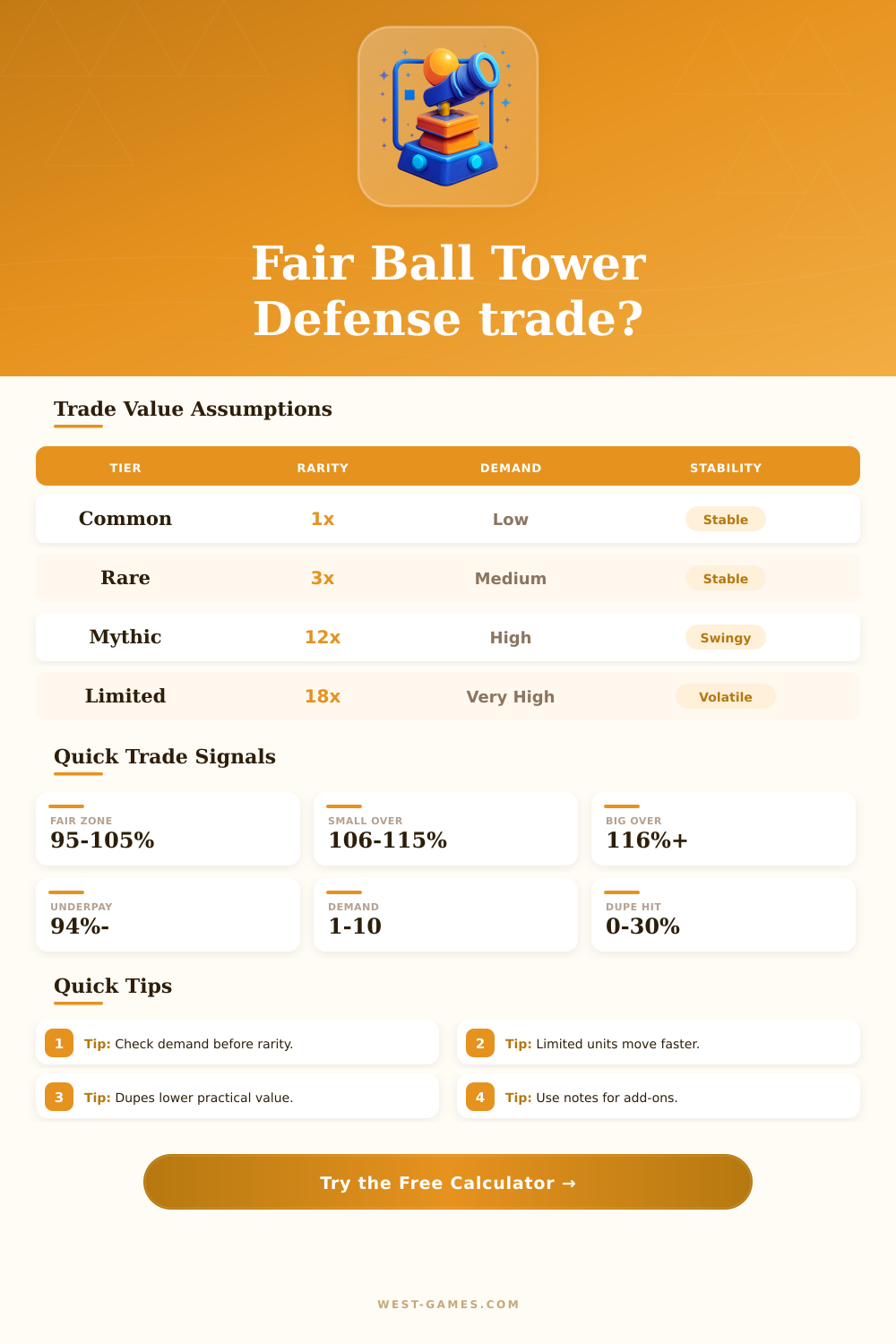
Underpay Zone
Below 95% means the offer is usually light under these assumptions. Add value, improve trait quality, or ask for a smaller requested unit.
Fair Zone
95% to 105% is close enough that demand preference, dupes, and trust can decide the trade without a major value gap.
Overpay Zone
Above 105% means the offer is richer than the request. This can be intentional for high-demand or hard-to-find units.
| Rarity | Base Points | Use Case | Trade Stability |
|---|---|---|---|
| Common / Early | 15 | Filler, starter adds | Very stable, low leverage |
| Rare | 35 | Early roster upgrades | Stable if demand is active |
| Epic | 70 | Mid-game swaps | Moderate stability |
| Legendary | 140 | Core trade unit | Demand-sensitive |
| Mythic | 300 | High-value target | Demand can swing quickly |
| Secret | 520 | Premium collector unit | Volatile, scarcity-driven |
| Limited / Event | 680 | Event scarcity or flex trade | Highest volatility |
| Modifier | Low Impact | Medium Impact | High Impact |
|---|---|---|---|
| Trait | Range / utility 1.06x | Damage or speed 1.14x | Perfect roll 1.35x |
| Evolution | Base 1.00x | Ascended 1.10x | Maxed evolution 1.32x |
| Level | Level 1-25 adds up to 5% | Level 26-70 adds up to 14% | Level 71-100 adds up to 20% |
| Availability | Current 0.96x | Older 1.08x | Vaulted 1.26x |
| Signal | Input | Adjustment | Reason |
|---|---|---|---|
| Demand 1-3 | Low | 0.90x to 0.98x | Harder to move in trades |
| Demand 4-7 | Normal | 1.00x to 1.12x | Usable demand without hype |
| Demand 8-10 | High | 1.16x to 1.28x | More traders compete for it |
| Dupes | 0-20 copies | 0% to 30% drag | Extra copies are less useful to you |
| Ratio | Label | Meaning | Possible Action |
|---|---|---|---|
| Below 85% | Heavy underpay | Offer is far below request | Add units or lower ask |
| 85% to 94% | Light underpay | Close, but request side leads | Add a small sweetener |
| 95% to 105% | Fair | Comparable assumption value | Use demand preference |
| 106% to 115% | Light overpay | Offer side leads slightly | Accept if chasing demand |
| 116% and up | Heavy overpay | Offer side gives much more | Recheck scarcity assumptions |
Trading in Ball Tower Defense require players to evaluate the value of each unit in a trade. Trading in Ball Tower Defense are also difficult to perform due to the number of factors that impact the value of each unit within the game. Many players will attempt to trade with others by guessing the value of each unit that is being traded.
Guessing the value of each unit often result in trades that is unfair to one or both of the players involved in the trade. In order to trade units fairly with others, each player must understand that the value of a unit is not a fixed value but change based on a variety of different factors. The rarity of the unit impacts the value of each unit but is not limited to the rarity of the unit.
How to Make Fair Trades in Ball Tower Defense
For example, Limited units tend to have high scarcity, which often increases their value compared to units that are more easy obtained. Units with high rarity such as Mythic units may be of more value if they are not available for purchase but may have a lower value than Limited units if they is available for purchase by all players. In addition to rarity, the demand for a unit will impact its value; the more higher the demand for a unit, the higher its value.
The calculator within the guide allows for players to input variables related to the demand for a unit to see how the value of that unit change. Other factors related to the unit that impact its value include the quality of its traits. Units with high quality traits have higher value compared to units with low quality traits.
For example, a Legendary unit with high damage traits could have more value than a Mythic unit with low damage traits. The evolution of a unit is another factor in its value; a unit that has reached its maximum evolution will have more value than units at a lower evolution stage because the player will save time when the unit reach its maximum evolution stage. The calculator include a multiplier to account for the value of the evolution stage of the unit.
Other factors related to the unit include the availability of the unit. Units that is no longer available for purchase (often referred to as vaulted units) will have high value due to their scarcity. Current banner units are available for purchase and have lower value due to their availability.
Finally, the number of duplicates of a unit will change the value of the unit trade. Duplicates of a unit tend to have less value due to the fact that they contribute to the utility of a player only if they are perform a fusion of that unit. The calculator will automatically reduce the value of the trade if a large number of duplicates is selected.
It is impossible for the trades between players to be exact according to the calculations of each player. A cushion must be provided for each trade to account for the preferences of each player. For example, one player may accept a lower value of a unit due to their desire to make a trade with another player.
Another player, however, may demand a higher value for a unit as the demand for that unit is rising. The calculator allow for adjustments for these preferences between the two players. Based off the value of each unit, the calculator can output for each trade whether it is fair, a light overpay for one of the players, or a significant overpay for one player.
If the value of each unit is near 100%, the trade is considered to be fair and the decision of each player to trade will depend on the needs of each player. If the trade ratio is significantly away from 100%, the calculator will output the factor related to the unit that creates that imbalance. While the calculator cannot make decisions for the players, the calculator does provide rules for each player to follow when making their trading decision.
Common mistake that may be made when trading in Ball Tower Defense is treating the value of the unit as if it is a fixed value. Many players dont understand the value of demand for a unit and the value of duplicate of a unit. To avoid these common mistakes, the same trade can be entered into the calculator a variety of times with different scores for the demand for a unit.
By entering the same trade into the calculator a variety of times, each player will be able to understand if the trade is worth perform. In addition, the calculator will aid each player in understanding what they are giving up and what they are gain in the trade with another player.