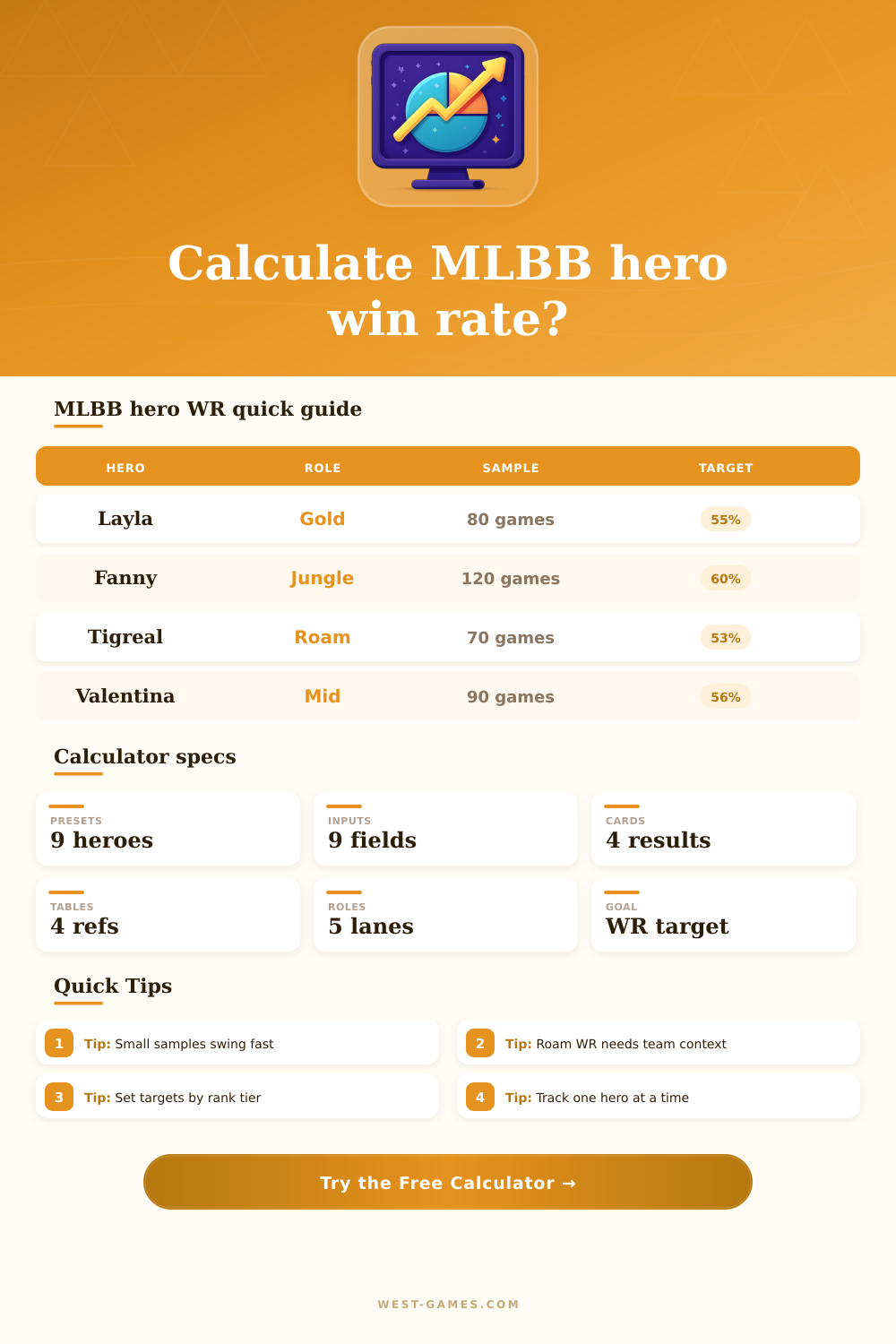
🎮 MLBB Hero Win Rate Calculator
Calculate current hero win rate, target win-rate games needed, role pressure, MVP or medal consistency, lane matchup risk, rank tier expectations, and projected hero record.
| Hero | Main role | Difficulty | Stable target |
|---|---|---|---|
| Layla | Gold | Low | 54-57% |
| Miya | Gold | Low | 55-58% |
| Fanny | Jungle | Very high | 58-62% |
| Ling | Jungle | High | 57-61% |
| Esmeralda | EXP | Medium | 55-59% |
| Valentina | Mid | High | 56-60% |
| Tigreal | Roam | Medium | 52-56% |
| Estes | Roam | Medium | 53-57% |
| Beatrix | Gold | High | 56-60% |
Targets are planning bands for hero-specific records. They are not official leaderboard requirements.
| Matches | One win adds | One loss drops | Readout |
|---|---|---|---|
| 20 | Large | Large | Very noisy |
| 50 | Medium | Medium | Settling |
| 100 | Small | Small | Useful signal |
| 250 | Tiny | Tiny | Long grind |
| 500+ | Very tiny | Very tiny | Slow change |
The larger the match count, the more future games are needed to visibly move hero win rate.
| Rank tier | Good hero WR | Medal need | Planning note |
|---|---|---|---|
| Grandmaster | 54%+ | Low | Basics decide |
| Epic | 55%+ | Moderate | Draft matters |
| Legend | 56%+ | Moderate | Role clarity |
| Mythic | 57%+ | High | Macro checks |
| Honor | 58%+ | High | Fewer freebies |
| Glory+ | 59%+ | High | Draft punishes |
Higher tiers usually demand cleaner role execution and fewer hero experiments.
| Signal | WR effect | Confidence | Calculator use |
|---|---|---|---|
| Favored lane | Raises pace | Medium | Target can be bold |
| Even lane | Baseline | Good | Normal planning |
| Hard lane | Lowers pace | Lower | Expect more games |
| Draft mismatch | Large drag | Low | Target needs caution |
| High medals | Raises trust | Good | Strong process |
| Low medals | Risk flag | Low | Review role fit |
Medal rate is used as an impact signal, while the target-games math comes from wins, matches, and future win pace.
Counter picks against your hero can often make you feel like you are swimming upstream. If you don’t really understand how well you’re actualy performing with certain heroes then climbing the ranks will be difficult, as knowing your general win rate isn’t the whole story. An even 50% for example means little if you played half of them on a hero you’re unfamiliar with, you need more detailed information to truly move forward.
Stop manually calculating probabilities to see if one more game will change your win rate to a more reasonable level. Instead, plug in your existing record and desired targets into the calculator above and let it do the work for you. In turn it tell you exactly how many additional games you must play before your perceived win-rate shifts into a healthier range.
How to Improve Your Win Rate in Mobile Legends
Mobile Legends players often think their stats will stabilize faster then they actually do after a losing run. This tool is handy because it factors in sample size volatility. It remind you that your percentage swings more with each loss while your total match count is still low.
What matters beyond just the bare numbers though, is an understanding of the pressure put on that role. A marksman like Miya or Layla in gold lane has different expectations than a roamer like Estes or Tigreal. A marksman can carries games with their late-game damage output, while a roamer can win games by setting up early-game engagements and vision for his team.
This is why the page lays out the baseline expectation for each type of role on the reference table. Depending on what kind of team coordination you can expect, modify your target win rate accordingly. Without luck on the draft phase or superhuman mechanical skill, you aren’t going to get a perfect sixty percent win rate every game in solo queue. Solo queue is chaos by nature.
The other aspect where win rates fail is consistency in medals. Maybe you’re getting silver medal often because your playstyle is passive and avoids making mistakes, but your win rate isn’t too bad. Or maybe you’re getting high MVPs on losses since you’re trying hard but there’s no one else to support you.
Since medals serve as a sign for confidence, the calculator includes it to tell you: If you’re winning but not seeing any impact awards, your process may not be right despite the outcome appearing positive. That differentiation will help you determine if you should of double down on that hero or not, or pivot to one more suited to your current team composition.
The other part of this equation comes down to lane matchups too. If you are in a favorable matchup, you can afford to take bigger risks, as they’re mechanically disadvantaged versus you. But conversely, if it’s a difficult counter pick situation, you need to pace yourself conservatively and be more cautious. No amount of willpower can make up for a bad draft. Understanding that helps you avoid frustration when things go wrong despite playing well.
Instead of dwelling on personal failure, it changes the conversation to whether you even had a chance to win from the start. Each rank tier also carries a different level of pressure. Lower ranks is more forgiving of bad positioning and experimental plays, but in Mythic or Glory, even the slightest mistake is punished. It recognize that, as you move up the ladder, macro checks get tighter and that you need to execute cleaner at a higher level, meaning there’s less room for freebies to bail you out in the rough spots.
Don’t change too much after 10 games; small samples can swing wildly. Instead, look for trends across 50+ matches. To eliminate factors, track a single hero at a time, jumping from five different heroes will just give you noise, not signal. If you play with consistent hero pools, you’ll be able to find the specific areas where you’re weak and get better at those things one step at a time.
Good mechanics are only part of climbing well; managing expectations is just as important. It’s never going to be perfect, and you’ll have some bad drafts and some bad days. The idea isn’t to get better at everything. It’s to keep getting a little bit better while staying realistic. Ground your decisions with data instead of emotion. Use the tools at your disposal. Heed what the numbers say when they suggest resting up or swapping out for a hero. This discipline makes all the difference between being a casual player and someone that reliably rises through the ranks.