Dice Roll Probability Calculator
Calculate tabletop and game dice odds for exact totals, at least targets, target ranges, modifiers, advantage, disadvantage, expected value, and the live roll distribution.
Model: normal mode rolls the dice once. Advantage rolls the full total twice and keeps the higher total; disadvantage keeps the lower total. Modifiers shift the final total after dice are rolled.
Probability Breakdown
Curve Read
Normal
Same dice, modifier, and target using one ordinary roll.
Advantage
Roll the full pool twice and keep the higher total.
Disadvantage
Roll the full pool twice and keep the lower total.
Plus One
Same roll style with one extra modifier point.
| Total | Exact chance | At least | At most | Bar |
|---|
The table shows the active roll style. Advantage and disadvantage reshape cumulative odds, not just the target row.
| Target | Normal | Advantage | Disadvantage |
|---|
| Dice | Range | Average | Peak |
|---|---|---|---|
| 1d20 | 1 to 20 | 10.5 | Every total ties |
| 2d6 | 2 to 12 | 7.0 | 7 is most common |
| 3d6 | 3 to 18 | 10.5 | 10 and 11 peak |
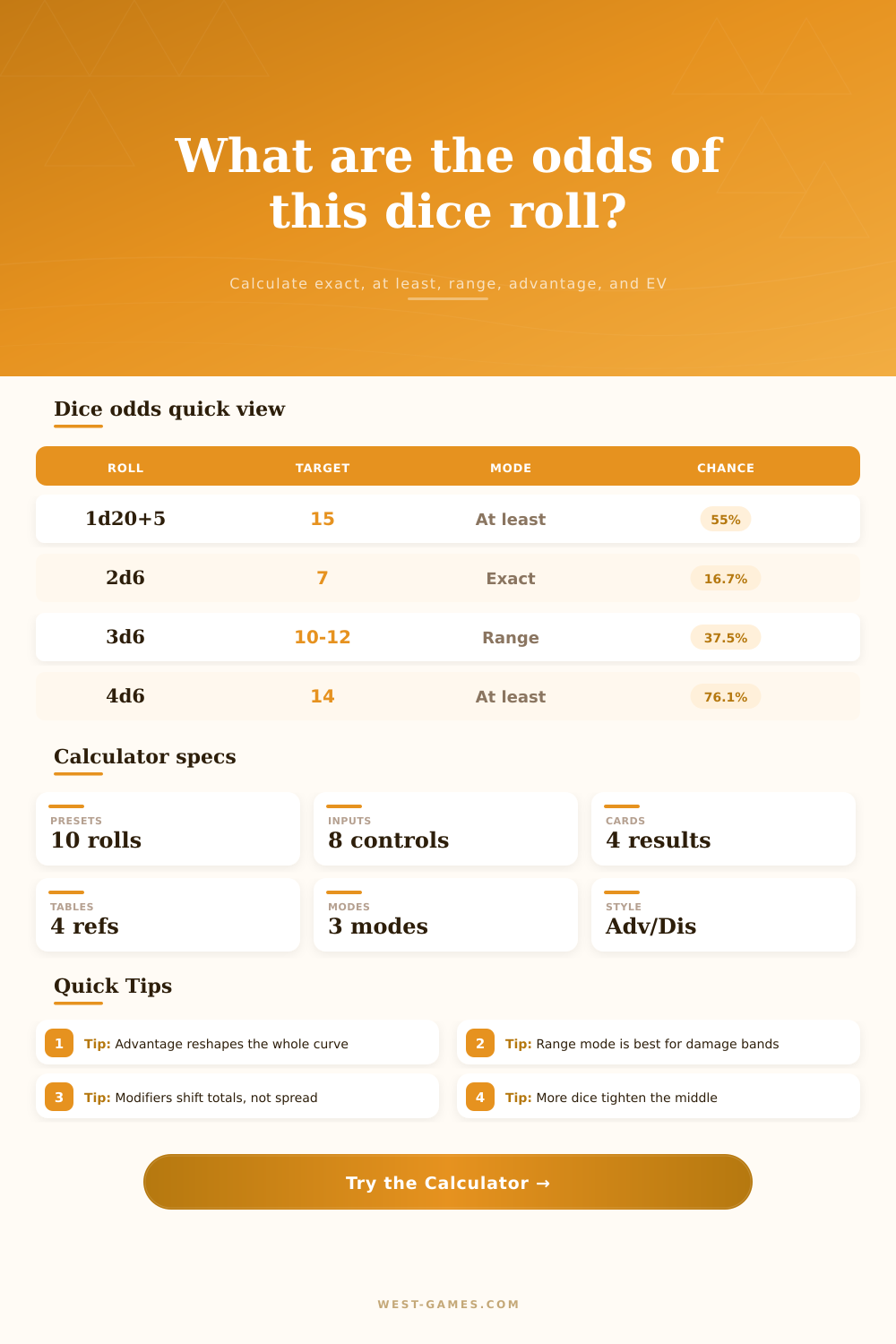
| 4d6 | 4 to 24 | 14.0 | 14 is central |
| 8d6 | 8 to 48 | 28.0 | 28 is central |
| Preset | Dice | Mode | Use case |
|---|---|---|---|
| D20 Skill Check | 1d20+5 | At least 15 | Tabletop ability checks |
| 2d6 Settler Roll | 2d6 | Exact 7 | Bell-curve board games |
| 3d6 Stat Curve | 3d6 | Range 10-12 | Classic character stats |
| 8d6 Fireball | 8d6 | At least 28 | Damage spell planning |
| d100 Loot Table | 1d100 | Range 76-100 | Percentile reward bands |
| Mode | Question answered | Example | Best for |
|---|---|---|---|
| Exact | Will I roll one total? | Exactly 7 on 2d6 | Board triggers and doubles-like events |
| At least | Will I meet or beat it? | 15+ on 1d20+5 | Checks, saves, attack rolls, target numbers |
| Range | Will I land inside a band? | 10 to 12 on 3d6 | Damage bands and percentile loot brackets |
The sound of plastic against wood means it is left to chance. You hold a twenty-sided die between your fingers. What happens over the next half-minute will determine whether your character climbs the cliff or plummets into the abyss below. It’s exhilarating: there’s no way to know what’ll happen. But for all its randomness, there’s a silent math at work underneath each and every roll. Players who’ve been around awhile recognize that and bend the probabilities just enough in their direction.
Knowing what dice can does transforms blind hope into strategic knowledge. Luck doesn’t require mathematical brains. You only need an awareness of what makes luck better. The addition of modifiers alters the distribution but not its width, something most folks don’t notice. Having +5 to your d20 check doesn’t cause it to roll any higher than before. It moves the whole set of possible outcomes five spaces up the number line. The distribution hasn’t changed, just where target sits on that distribution.
Understanding Dice Probability in Games
That’s why raw ability scores is important when stakes are high. A tiny bonus can make difference between a fifty-fifty shot and an almost certain success. That’s why learning specific skills makes sense. It helps turn a fifty-fifty shot into a comfortabley majority.
Rolling a d20 give a flat distribution. Each number on the face of the d20 have an equal possibility. No number gets special treatment, so there’s no middle-of-the-road bias. Two six-sided dice produce different results. Because more combinations add up to a “7” than anything else, most rolls tend to cluster around it. Introducing a third die narrow the cluster even more. Extreme highs and lows gets rarer and rarer.
As a result, dice converge on what mathematicians calls the “mean”, making it easier for game designers to predict averages. Players seeking criticals finds this annoying. For a given notation, a probability calculator do the math. When considering whether or not to invest in a weapon upgrade, using the probability calculator spares you guesswork and helps you decide if the upgrade is worth the slot.
The curve shifts a lot when you consider advantage/disadvantage. Getting two rolls and taking the best doesn’t simply apply an unchanging bonus. It slants the curve upwards by reducing the chances of a bad roll and increasing the chance of a good one much more different than a straightforward bonus would do. Disadvantage has the opposite effect. These rules don’t merely adjust numbers up or down, they reshape the curve. They alter probabilities. This makes them stronger then simple math bonuses.
Most players think that advantage can be approximated by adding a +5 modifier to checks. While this holds up in a conversational setting, truth is more strict: advantage defends you from bad luck, but won’t necessarily grant success. More importantly, it’s better to think in terms of ranges for looting and damage calculations rather than obsessing about specific amounts. Twenty-eight points of damage from a fireball isn’t as relevant as knowing if that number land in a lethal range. Ranges make it easier to visualize bands of effectiveness instead of thinking in terms of individual points of failure.
On the page, I’ve included a reference table which display this nicely. It shows how increasing your threshold add up with cumulative probability so you can easily spot where your odds go south fast.
That doesn’t take away the excitement of the roll. It just alters the type of suspense it creates. Instead of questioning whether the game’s rigged, you enjoy its razor-thin edges between success and failure. The random throws of dice remain unchanged; but now you’ll know exactly what their chances are as soon as they leave your grip. And it isn’t that knowledge that kills the magic. It’s that knowledge that brings the game back down to Earth. Every fortunate turn becomes a hard-earned result instead of an unexpected stroke of luck.
Roll again. But this time, you would of known what is on the line.