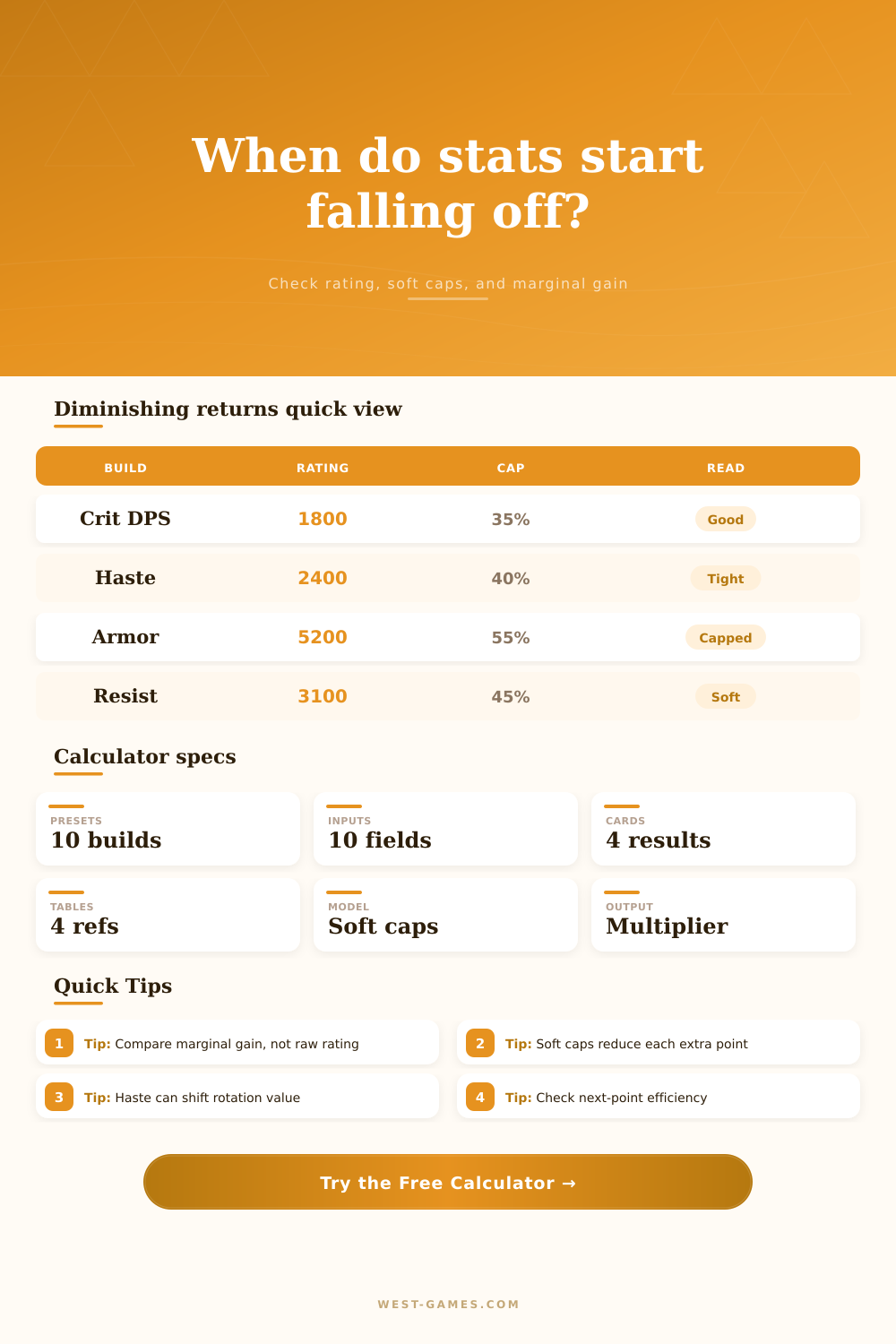
Diminishing Returns Calculator
Convert raw combat rating into effective stat gain with soft caps, hard caps, marginal value, next-point efficiency, total multiplier, and upgrade comparison.
Diminishing returns model: rating converts into raw percent, then gains above each soft cap are reduced by slope. The result is capped, compared against the next upgrade, and converted into a practical combat multiplier.
Calculation Breakdown
Efficiency Read
Ready: choose a preset or edit the stat curve to see where the next point lands.
Raw Value
Base stat plus converted rating before any diminishing returns or cap penalties are applied.
At First Cap
Effective value if the same build stopped exactly at the first soft-cap threshold.
After Upgrade
Projected effective stat after adding the next item, socket, node, or buff amount.
Efficiency Score
Build-weighted upgrade score from next-point gain, marginal value, and payoff multiplier.
| Zone | What It Means | Typical Value Kept | Gaming Read |
|---|---|---|---|
| Below cap | Raw rating converts normally | 100% | Strong upgrade zone |
| First cap | Each point is partially reduced | 45% to 70% | Still often useful |
| Second cap | Heavy diminishing returns apply | 12% to 35% | Compare alternatives |
| Hard cap | Extra stat gives no effective gain | 0% | Reforge or swap stats |
| Stat | Common Cap Pattern | Why It Diminishes | Watch For |
|---|---|---|---|
| Crit chance | Soft cap near combo windows | Chance cannot exceed certainty | Crit damage pairing |
| Haste | Breakpoints plus taper | Rotation gaps disappear | Global cooldown floor |
| Armor | Rating curve plus hard limit | Mitigation approaches a ceiling | Penetration effects |
| Cooldown | Strong early, weak late | Cooldowns approach uptime caps | Buff overlap waste |
| Scenario | Raw Rating Focus | Soft-Cap Risk | Alternative To Test |
|---|---|---|---|
| Raid crit DPS | Crit chance rating | Medium after 30% | Flat damage |
| PvP resistance | Resist rating | High after 55% | Health pool |
| Tank armor | Armor rating | High near 70% | Block or guard |
| Magic find | Loot bonus rating | High after 85% | Clear speed |
| Efficiency | Marginal Value Kept | Upgrade Read | Action |
|---|---|---|---|
| Excellent | 80% to 100% | Point is still premium | Stack freely |
| Good | 55% to 79% | Worth comparing | Check multiplier |
| Thin | 25% to 54% | Returns are fading | Test off-stat |
| Poor | 0% to 24% | Near cap or wasted | Move rating elsewhere |
| Stat Type | Multiplier Formula | Useful When | Diminishes Hard When |
|---|---|---|---|
| Critical chance | 1 + stat x crit payoff | Crit damage is high | Chance approaches cap |
| Haste or speed | 1 / (1 - stat) | Rotation gains actions | Global cooldown is reached |
| Armor or resist | 1 / (1 - reduction) | Incoming damage is steady | Penetration or true damage dominates |
| Cooldown recovery | 1 + stat x uptime payoff | Skills are used on cooldown | Buff uptime overlaps |
| Magic find | 1 + stat x loot payoff | Clear speed is unchanged | Extra rating slows farming |
These are practical comparison models, not a replacement for a specific game's hidden formulas. Use the custom caps to mirror your game, patch, or server rules.
It’s similar to when you’re looking at two items which, on paper, appear identical. One has more haste; the other has a greater critical strike rating. Which do you choose? Chances are you’ll be tempted to grab the one with bigger number, but it’s rarely that easy in gaming math. Will additional points help you play better or they are simply going to yield less value? For first-time character optimizers, this is an all-too-common blunder.
This isn’t meant to be a “memorize this formula” type thing. It also takes care of your marginal value (and soft cap). This calculator does all that hard stuff for you. Simply input your existing stats, set your breakpoint(s), and see whether or not upgrading is worthwhile.
Why Stats Get Less Useful
Bottom line: Raw rating diminishes in value the more you has of it. Character building are limited by soft caps, they’re like invisible walls. For each point of rating up to some cap value, you might get exactly one percent of an effective stat. Past that cap, though, game engine penalizes you. The same cost may yield half a percent or even less. This is how devs prevent any particular stat from hogging all the glory. Instead, it force you to mix and match various attributes.
Let’s take critical chance as an example. The further along your base chance is the less additional rating will improve your actual output. Eventually you’ll put hundreds of points into it and end up with just a single percentage point of actual crit chance. Players often fail to notice this. They see the raw stat increase and don’t realize they’ve lost efficiency, other stats are providing greater value per point spent.
Similar constraints apply to haste. You’ll see major reductions in cooldowns and unlocks for new hits early on. Past that point, however, additional haste is useless because it has nowhere to go (there’s no more room between your hit). To figure out where those regions exist, i.e., where less value is gained for each extra bit, use the calculator and compare the payoff multiplier with marginal gain. Even if your crit damage bonus is high enough, a tiny extra crit chance may still offer value.
These concepts are broken down into concise bands and illustrated on page with their own reference tables. These charts tells you precisely which zones hold value and which ones have reached hard caps or fallen into upgrade territory. This graphical overview saves you the effort of hunting for diminishing returns, so you know where to spend your time and when it’s best to pivot away from one stat toward another.
If your armor is reaching its real-world limits, for instance, an additional point won’t do much to increase your survivability. You may want to shift focus to health or block chance instead. Numbers don’t tell everything; you also have to examine what content you’re doing and how you like to play. In certain situations, such as raid tanking with a lot of burst damage, you may find yourself needing to push the mitigation hard cap. Other times, like when running low-pressure dailies, you’ll rarely see the benefit from going all out trying to get perfect caps because it would of been wasted potential elsewhere. The numbers gives you the information, now use that in context to make the choice.
But these efficiency scores come as part of the output, so you can see what upgrades to focus on immediately. You’re already in the sweet spot if you have a high score (meaning you get huge bang-for-the-buck from an upgrade). If it’s low, you know it’s time to stop stacking and start exploring something else. It is a simple feedback loop that ensures you keep your build optimized, and no fancy spreadsheet skills is needed.
Respecting your limits is all part of mastering diminishing returns. Once that curve has flattened, you can’t get any additional performance from a stat. Great players recognize those boundaries and adjust their strategy as needed. They know when to push hard caps for safety and when to take a step back to stay versatile. Knowing this helps make good gear choices turn into great ones.