Gacha Budget Calculator
Plan a banner pull budget from saved currency, pity progress, guarantee status, login income, event rewards, shop tickets, and the target number of featured copies.
Budget model: this calculator converts every source into pulls, accounts for pity and guarantees, reserves part of your stash, then compares your usable pulls against the selected banner target.
Calculation Breakdown
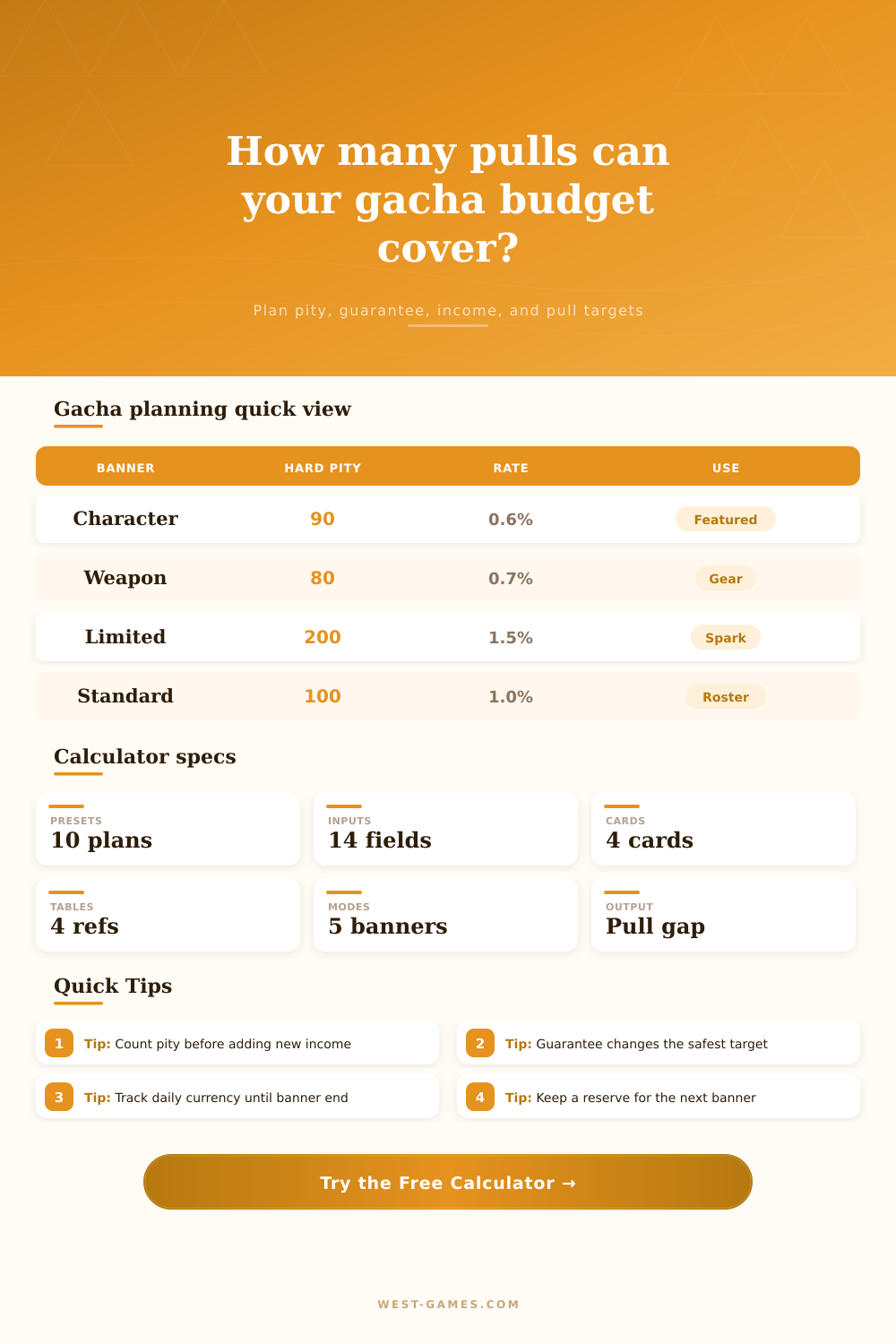
| Banner model | Typical hard pity | Common featured rule | Planning note |
|---|---|---|---|
| Limited character 50/50 | 80 to 90 pulls | First top rarity may be coin flip | Without guarantee, safest single-copy target is close to two pities. |
| Weapon or gear path | 70 to 80 pulls | Path points or fate counter | Plan for the path ceiling if the weapon is required for the build. |
| Spark banner | Often 150 to 300 pulls | Selector after fixed pull count | The budget target is the spark count, not the average hit rate. |
| Standard banner | 80 to 100 pulls | Featured unit usually absent | Use spare tickets only when no limited banner needs them. |
| Starter discount | Varies by account | Discounted ten-pulls or beginner guarantee | Adjust currency per pull if the banner has discounted batches. |
| Goal | Low-risk pull target | When it fits | Watch point |
|---|---|---|---|
| One featured copy, guarantee active | Hard pity minus current pity | You lost the previous 50/50 or have a featured guarantee | Leave enough reserve for the next banner cycle. |
| One featured copy, no guarantee | Up to two hard pities | The unit is high priority and missing is costly | Average luck is not the same as safe planning. |
| Weapon or signature gear | Path ceiling if available | The item materially changes performance or rotation | Check if pity carries to future gear banners. |
| Duplicate or constellation chase | One safe cycle per copy | Copies unlock a key breakpoint | Stop at the breakpoint instead of chasing every copy. |
| Spark target | Exact spark count | Banner offers a guaranteed selector | Only count pulls that award spark currency. |
| Source | How to enter it | Reliability | Budget impact |
|---|---|---|---|
| Daily missions | Daily currency income times banner days | High if you log in every day | Small per day, large over long banners. |
| Event rewards | Event and quest currency | Medium until event shop is confirmed | Can close a pull gap late in the banner. |
| Shop reset tickets | Shop reset tickets field | High after monthly or patch reset | Tickets bypass currency conversion. |
| Mail and compensation | Add only confirmed currency | Low before announcements | Treat as bonus, not baseline. |
| Planned extra pack currency | Extra pack currency field | High once already committed | Use this to model planned top-ups without changing saved stash. |
Average Luck
Best for curiosity. It estimates chance across usable pulls, but it should not replace pity-aware planning.
Soft Pity Plan
Useful when your current pity is near the ramp and you only need one top-rarity result.
Guarantee Plan
Counts only the pulls needed to force the featured result when the next top rarity is locked in.
Spark Plan
Uses the selector count as the target because the banner has a deterministic ceiling.
| Player plan | Recommended reserve | Pull target style | Best use case |
|---|---|---|---|
| Collector | 10% to 20% | Guarantee-safe for one copy | Limited characters that may not rerun soon. |
| Meta optimizer | 15% to 30% | Stop at key copy breakpoint | High-impact duplicate, weapon, or passive unlock. |
| Free-to-play saver | 35% to 60% | Only pull near guarantee | Long-term roster planning across multiple patches. |
| Event sprinter | 10% to 25% | Use confirmed event income | Short banners with heavy reward front-loading. |
| Standard ticket user | 50%+ | Spend tickets, preserve currency | Non-limited banners where currency is better saved. |
When you’re forty pulls short of your goal and there’s only three days left on a limited banner, that panic set in. Any player who has spent longer than a month playing a gacha game will know what I’m talking about. You need that character, and you likely have enough currency to get them. Or so you tell yourself, but your wallet isn’t telling the same story.
That space between those truths, that’s budgeting. Not spending money at all. It is about spending as little as possible. But rather, converting as few resources as possible into pulls before time expire.
How to Save Money in Gacha Games
While most people measure how much cash they have stashed, nobody tracks how fast it come in. They should of, because everything you earn from daily commissions, login passes, and weeklies stacks up. Twenty one days is more than enough opportunity to top off those tiny gaps through routine play. So enter your current pity count into the calculator above, along with your daily income, and let it do the math for you.
Don’t underestimate potential of regular gameplay! Maybe today you’re sitting at half a pity‘s worth of crystals, but log in every day and that’ll change by next Tuesday.
Protect Your Wallet: Pity systems can be frustrating, but they’re there to help you save money. Soft pity gives you more chances until it reaches its limit, while hard pity guarantee something at a certain point. Understanding where your particular game’s limits are is key. Is it only ten pulls from hitting hard pity? That’s very different than 20. The tool allows you to set how far into the banner you are and what kind of pity system it has, then it adjusts your safe target accordingly. Because if you’re right on the edge of guaranteed, you don’t want to go over and waste pulls. But if you’re at zero, you don’t want to pull fewer than you need to get that first one.
There is another wrinkle: guarantees. If you lose a 50/50, this doesn’t indicate failure. This indicates that you’re guaranteed the featured unit next time you pull. Lots of people freak out and grab another immediately, they burn through their reserve on something they don’t actualy require. The calculator also differentiates whether you have a guarantee active or not.
This makes a massive change in how much you need to budget. With a guarantee, you only requires what’s necessary for one pity cycle. Without a guarantee, you may want to prepare for two simply as insurance. That could amount to thousands of premium currency or hundreds of real dollars.
The single most overlooked element of gacha strategy is reserves. Because the FOMO pressure to spend on the present banner is so pressing, newbies will happily max their account out. Meanwhile, veterans understand that banners recirculate and new unit fall from the sky all the time. Keeping a buffer of your currency isn’t hoarding; it’s insurance. You can use this calculator to enter a reserve target, preventing yourself from spending your whole account on a unit that’ll likely recur within half a year. It forces you to ask if current banner is worth sacrificing your long-term savings plan.
Your mental budget tends to forget about event rewards and shop tickets. These provide free currency or direct pulls that don’t count against your core stash of currency. Add those in and you’ll have more money available to use, while still spending zero dollars. Smaller sources like this can be the difference between “maybe” and “definitely,” so it’s wise to factor them in.
At its core, gacha expenditure is about controlling risk rather than hoping for luck. Budgets are within our control; randomness is not. Keeping a reserve, sticking to the pity ceiling, and monitoring your income lets you transform a gamble into an affordable cost. The question becomes “when do I get to pull this?” instead of “can I afford to pull this?”. That is more valuable than whatever character you might recieve in return.