Damage Reduction Percentage Calculator
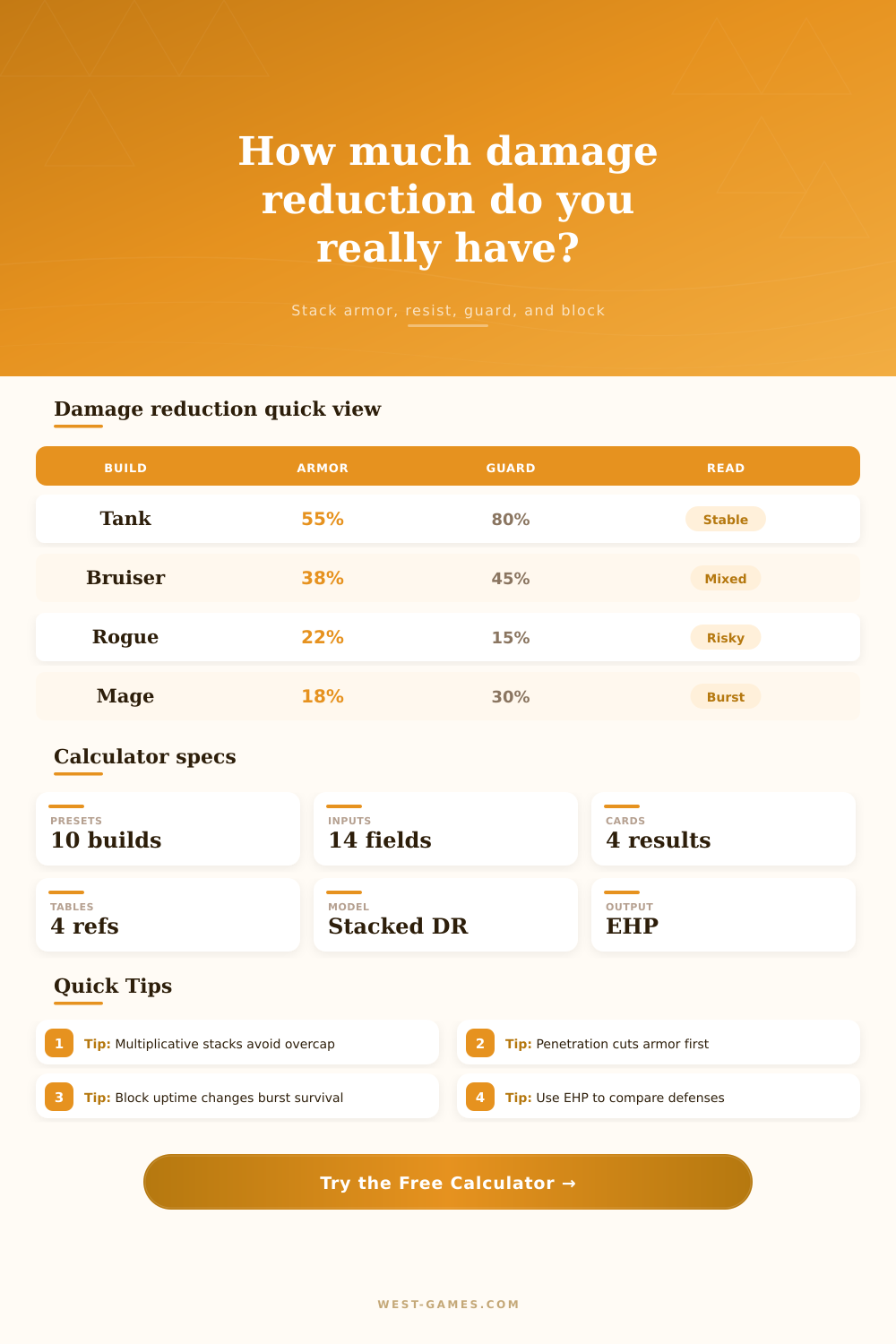
Estimate true damage taken after armor, resistance, flat mitigation, percent reduction, block chance, guard uptime, enemy penetration, vulnerability, and burst-window hit count.
Stacking model: flat mitigation is removed first, armor and resist are reduced by penetration, percent reductions stack multiplicatively, block is weighted by chance and guard uptime, then vulnerability increases the final taken damage.
Calculation Breakdown
Defense Read
Ready: choose a preset or edit the fields to calculate true mitigation.
No Block
Removes expected block and guard contribution to show the value of shield, parry, or guard uptime.
Plus 10% Armor
Adds ten percent more armor rating while keeping penetration and encounter type unchanged.
Plus 10% Health
Shows how raw health compares against another mitigation upgrade for the same hit profile.
High Penalty
Adds ten points of enemy penetration and ten points of vulnerability to model dangerous debuffs.
| Encounter | Curve constant | Typical role | Practical read |
|---|---|---|---|
| Open world | 250 | Survival gear | Armor ramps quickly at low values |
| Elite pack | 900 | ARPG clears | Moderate armor investment matters |
| Dungeon boss | 3500 | Group tanking | Armor needs support from DR layers |
| Raid boss | 12000 | Main tank | High armor still faces diminishing returns |
| Final boss | 450 | Action RPG | Flat and block can change breakpoints |
| PvP duel | 260 | Arena trades | Penetration can erase soft defenses |
Armor reduction uses armor divided by armor plus the encounter constant.
| Profile | Armor share | Resist share | True share |
|---|---|---|---|
| Mostly physical | 85% | 10% | 5% |
| Mostly magic | 15% | 75% | 10% |
| Mixed physical and magic | 45% | 45% | 10% |
| True damage heavy | 25% | 20% | 55% |
True damage bypasses armor and resist, but still receives generic percent reductions if your game allows them.
| Layer A | Layer B | Combined DR | Why it matters |
|---|---|---|---|
| 10% | 10% | 19.0% | Two layers do not add to 20% |
| 20% | 15% | 32.0% | Common stance plus aura stack |
| 30% | 20% | 44.0% | Strong cooldown still has remaining damage |
| 50% | 25% | 62.5% | Multiplication prevents easy immunity |
| 80% | 50% | 90.0% | Extreme stacks approach a hard cap |
The calculator uses one minus the product of remaining damage multipliers.
| Block chance | Block value | Guard uptime | Expected DR |
|---|---|---|---|
| 20% | 30% | 50% | 3.0% |
| 35% | 35% | 70% | 8.6% |
| 50% | 40% | 80% | 16.0% |
| 65% | 55% | 75% | 26.8% |
| 100% | 60% | 50% | 30.0% |
Expected block is chance multiplied by blocked portion and guard uptime.
| Preset | Defense pattern | Main risk | Calculator use |
|---|---|---|---|
| Raid Main Tank | High armor, block, and uptime | Boss penetration | Checks real raid mitigation after stacks |
| Mythic Bruiser | Medium armor with mixed DR | Mixed damage spikes | Compares armor against health upgrades |
| PvP Shield Wall | Cooldown-heavy blocking | Penetration and vulnerability | Tests defensive windows in duels |
| Glass Cannon Rogue | Low armor, low block, high damage taken | Burst windows | Shows how small DR layers affect survival |
| Elemental Mage Ward | High resistance and temporary warding | Physical follow-up hits | Models magic-heavy encounters |
| ARPG Fortify Build | Layered generic DR and resist | Vulnerable debuffs | Calculates fortify-style survivability |
Your character takes a shot to the face. Your character falls over dead. The screen turns red. What happened? On paper, you have 60% damage reduction. So what was that about? How did this work?
Armor doesn’t simply “add” to block chance or resistance. They doesn’t “stack.” Rather, they stack in ways that tend to cancel out. It’s not always simple math. That’s where hours goes into guessing at how much survival your build has… Rather than figuring it out.
Why Armor Math Is Tricky
Sometimes, we feel safer then we actualy are. Feeling safe and being safe aren’t the same thing.
Plug the stats of your gear into the calculator above. It will do the complicated math for how they stack. This saves you from having to make assumptions about how they work together.
In most games with percent based-reductions, it’s a multiplicative model. What this means is that if there’s a 20% damage reduction and then an additional 15%, it doesn’t add up to 35%. It’s something less than that. Only what gets through the first will apply to the second. That little difference makes all the diffrence in the world as you’re trying to determine whether to upgrade your armor rating or invest in a defensive cooldown.
However, armor also works on a curve. Each point provide a little bit less benefit compared to previous one. That curve steepens based off enemy types. The page has a reference table laying this out. In lower-tier content like open world, the base damage from enemies is low and so lower levels of armor feel mighty. Against a raid boss, however, that same level of armor hardly even slows down the incoming blow. Before trusting in the raw numbers, take into account nature of the battle. What holds up fine against elite mobs may melt instently in a structured arena match with more penetration effects.
High-defense builds dies silently because of penetration and vulnerability: they strip away your hard-earned mitigation right before the damage lands, forcing you to re-calculate your whole effective health pool from scratch. A -10% armor effectiveness penalty isn’t some minor inconvenience, it’s going back to square-one and recalculating from there.
Effective health is what counts here: How much damage will you actualy survive? It is not about what % of incoming damage you’ll prevent. A character with double the health pool could be twice as long-lived than another character who enjoys the same percent reduction.
On top of that are block and guard systems that uses uptime instead of being constant. A shield that protects 40% of your incoming damage sounds sweet until you see its cooldown means it only goes up half the time. The gaps between those blocks reduce expected value of the block a lot. That’s a tiny detail. But for those brief bursts when fractions of a second matter, like a phase transition, it can mean the difference between life and death. Reduced damage over time is one thing, but three quick hits are enough to kill you if you’re in a grinding phase.
But, the ultimate equalizer is true damage: it doesn’t care about any of this. Your build may be all about physical defense but you’ll fall apart when faced with an enemy who ignores it completeley. These profiles are reflected in the calculator which weights them based on the expected source of incoming damage. That’s how you know where you’re weakest, no need for a spreadsheet, and why some builds focuses less on specialization (armor) and more on general percent reduction. General reduction covers everything, even true damage when true damage is present (though it isn’t in this game).
The classic dilemma of health vs mitigation has no one right answer. More health provides larger pools to absorb damage, while more mitigation makes each hit less impactful. The optimal solution come down to the encounter design. Bosses that hit hard but infrequently favor mitigation. Enemies that attack often with low damage gets less use out of armor, so they benefit more from having more health.
Try both ends of the spectrum and discover your personal breaking point. So quit guessing and start measuring. Hook up existing gear in this thing, change one stat at a time, and see which ones make a difference for health. Chances are that what you think you want isn’t what you need. The math doesn’t lie, though our gut instincts may.
Seeing the math line up with reality is when you stop fearing the surprise burst, and instead control it. That’s the difference between guessing. And knowing. That’s the difference between being a casual player and someone who reliably clears the toughest stuff.