♟ Elo Calculator Chess
Estimate chess Elo expected score, single-game rating change, tournament batch movement, performance rating, and likely volatility from one set of match inputs.
| K-factor | Typical use | Win swing at 50% | Notes |
|---|---|---|---|
| K10 | Established master | +5 | Slow movement |
| K20 | Established player | +10 | Common baseline |
| K30 | Provisional pool | +15 | Faster updates |
| K40 | Junior or new rating | +20 | High volatility |
Exact K rules vary by federation, age, rating, activity, and platform; this calculator lets you choose the update speed directly.
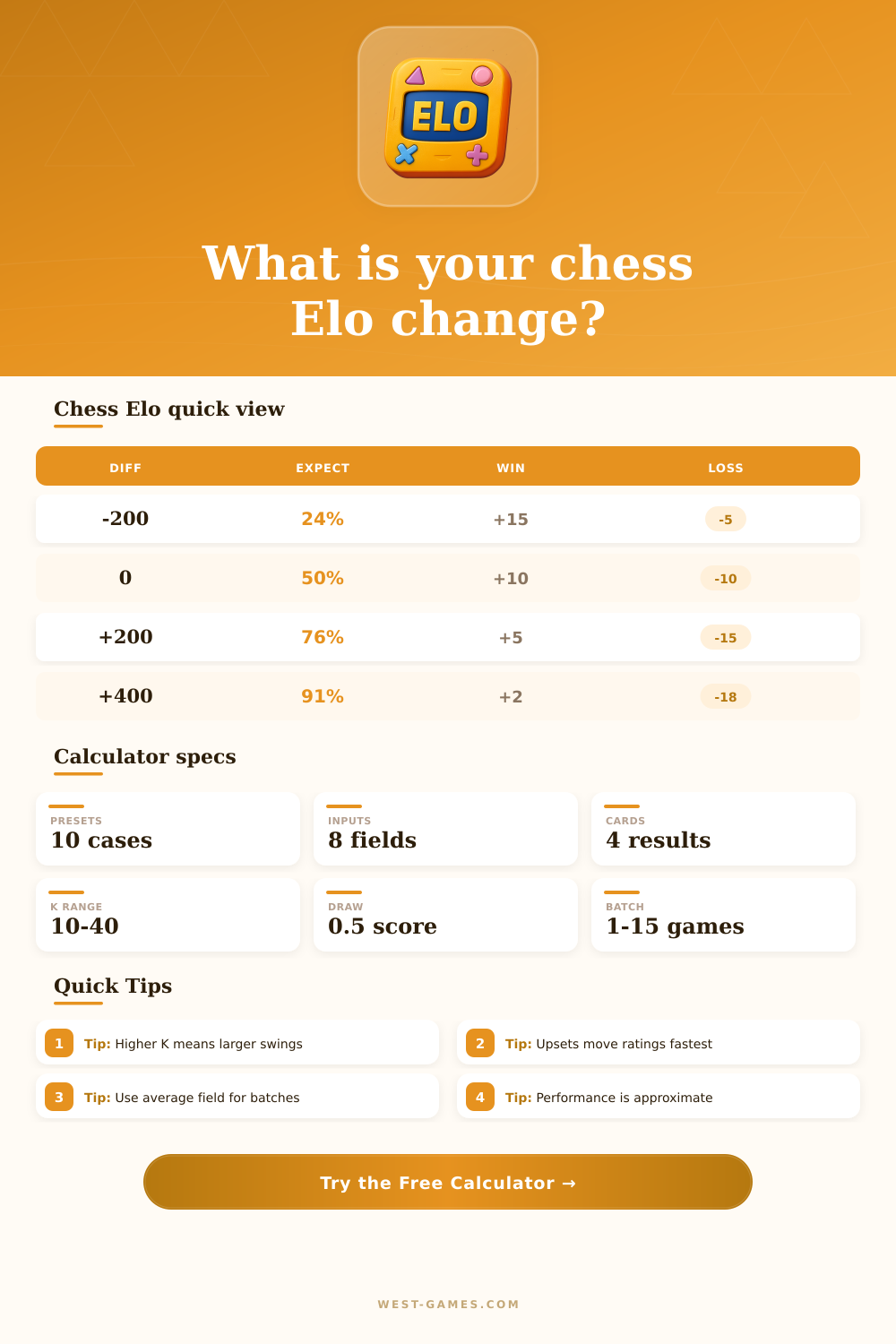
| Your gap | Expected | K20 win | K20 loss |
|---|---|---|---|
| -400 | 9.1% | +18.2 | -1.8 |
| -200 | 24.0% | +15.2 | -4.8 |
| 0 | 50.0% | +10.0 | -10.0 |
| +200 | 76.0% | +4.8 | -15.2 |
| +400 | 90.9% | +1.8 | -18.2 |
The curve is symmetrical: beating a much stronger opponent gains much more than beating a much weaker one.
| Score rate | Perf offset | Event meaning | Use carefully when |
|---|---|---|---|
| 25% | -191 | Under field | Very short events |
| 50% | 0 | At field | Balanced result |
| 65% | +107 | Good event | Mixed opponent ratings |
| 75% | +191 | Strong event | Few games |
| 90% | +382 | Dominant event | Near perfect scores |
The calculator caps extreme score rates to keep 0% and 100% events from producing infinite performance values.
| Scenario | Rating | Field avg | Score |
|---|---|---|---|
| Even Swiss | 1600 | 1600 | 3.5/7 |
| Upset run | 1500 | 1700 | 4/7 |
| Favorite slip | 1900 | 1700 | 3/5 |
| Norm push | 2300 | 2450 | 6/9 |
| Junior rise | 1200 | 1350 | 4.5/6 |
For exact tournament submission, calculate each opponent separately; the batch field average is a planning approximation.
Chess rating are a way of indicating the skill level of a chess player. Chess ratings can changes based off the outcomes of the games that a chess player plays. When comparing the results of the games that a person plays to the results that is expected by the players chess rating, change to that players chess rating can occur.
If a person have the same rating as there opponent, the chess game will be even. An even chess game will award a specific amount to the player if they win the chess game, it will remove that specific amount from the player’s rating if they lose the chess game, and it wont change the players rating if the chess game end in a draws.
How Chess Ratings Change