🎲 D&D Experience Points Calculator
Calculate XP needed to level up, track encounter XP & split rewards among your party
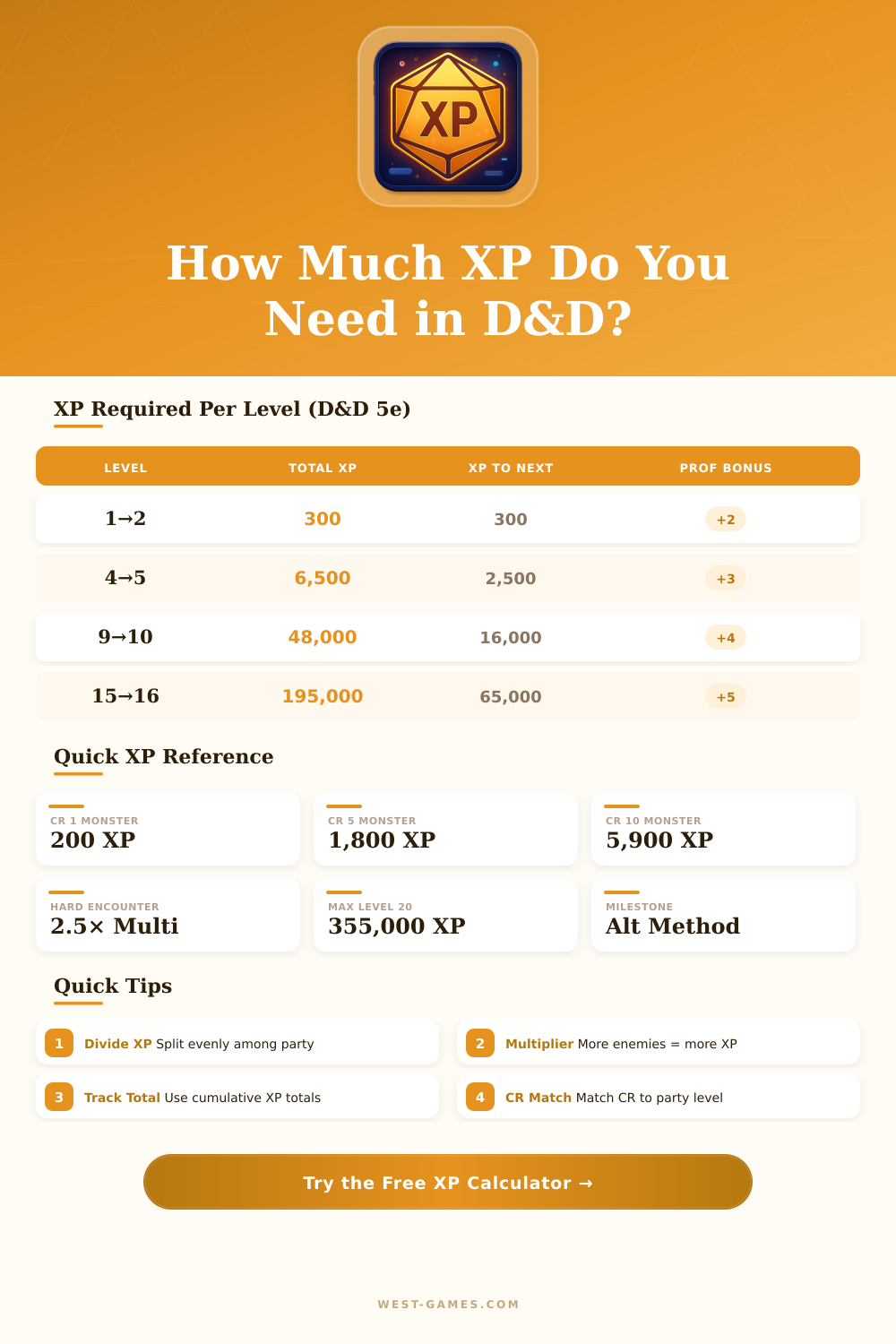
| Level | Total XP Required | XP to Reach This Level | Proficiency Bonus | Encounter Difficulty (Medium) |
|---|
| Number of Monsters | Multiplier | Party Size 1–2 | Party Size 3–5 | Party Size 6+ |
|---|---|---|---|---|
| 1 monster | x1.0 | x1.5 | x1.0 | x0.5 |
| 2 monsters | x1.5 | x2.0 | x1.5 | x1.0 |
| 3–6 monsters | x2.0 | x2.5 | x2.0 | x1.5 |
| 7–10 monsters | x2.5 | x3.0 | x2.5 | x2.0 |
| 11–14 monsters | x3.0 | x4.0 | x3.0 | x2.5 |
| 15+ monsters | x4.0 | x5.0 | x4.0 | x3.0 |
| Level | Easy | Medium | Hard | Deadly | Daily Budget |
|---|---|---|---|---|---|
| 1 | 25 | 50 | 75 | 100 | 300 |
| 2 | 50 | 100 | 150 | 200 | 600 |
| 3 | 75 | 150 | 225 | 400 | 1,200 |
| 4 | 125 | 250 | 375 | 500 | 1,700 |
| 5 | 250 | 500 | 750 | 1,100 | 3,500 |
| 6 | 300 | 600 | 900 | 1,400 | 4,000 |
| 7 | 350 | 750 | 1,100 | 1,700 | 5,000 |
| 8 | 450 | 900 | 1,400 | 2,100 | 6,000 |
| 9 | 550 | 1,100 | 1,600 | 2,400 | 7,500 |
| 10 | 600 | 1,200 | 1,900 | 2,800 | 9,000 |
Experience point are a tool that Dungeon Masters uses to manage the pacing and difficulty of the campaign for the players. Experience points are important to the campaign because experience points determine how quickly the party of players reach the next level. Furthermore, experience points helps the Dungeon Master to determine the risks and rewards for the players.
Using experience points allow the Dungeon Master to see how quickly the party is growing, whether it is at a steady rate or if the players is gaining experience with very rapid growth. Experience points also has an influence on how the players think about the monsters that they encounter and the decisions that they must make outside of combat with those monster. Experience points use a base value of experience points for each type of creature in the campaign, but the DM relate that base value to the challenge rating of that creature.
How Experience Points Help the Dungeon Master
The experience value for each creature must be adjusted when they are to be entered into a fight within the campaign, since there are different numbers of monsters that can be encountered and the number of players in the party. For instance, a fight with one hill giant is a completely different challenge to a fight with eight goblin. Thus, adjusting the experience points for each party and encounter is an essential component of creating an enjoyable experience for the players.
Furthermore, adjusting the experience points prevents encounter from being too overwhelming or too easy for the players. The experience point adjustment allow for different parties to receive different amount of experience for the same dungeon that is explored. In some cases, a party may encounter fights that are more challenging than others, and the experience point calculations will allow for the more challenging encounters to provide more experience point for players.
The experience point calculation for encounters, though, will not provide such rewards to a party beyond a certain point; any encounter with too many monster will result in the same amount of experience points as an encounter with a high number of monsters, but with fewer monster overall. A calculator can automatically handle the experience point calculations to make this easier for the Dungeon Master. Often, experience points will be awarded for roleplaying, problem solving tasks, and other objectives within the campaign.
These experience points is separate from the experience point calculations for combat. The bonuses for roleplaying are usually evened out among the players, but the Dungeon Master decide how much bonus experience to award to each player and in what instances the Dungeon Master will award the bonuses. Any system for awarding these experience points is valid for the Dungeon Master, as long as the bonus experience is awarded in a consistant manner to the players.
The Dungeon Master must also decide whether experience points will be tracked or if the parties will use milestone leveling. Milestone leveling removes the need to track each goblin that is slain in a dungeon, but does remove the sense of accomplishment that accompanies earning experience points. Both systems can be satisfying for the players, but the difference between the two systems are a preference on the part of the Dungeon Master and the players as to which is of most interest.
Experience points have a budget that can be allotted each day to the players. Using experience points at a high rate each day will deplete the daily experience point budget for that party, preventing them from using the same amount of experience points the following session. Not using the experience point budget each day may cause the players to feel like nothing is at stake within the game.
Thus, this experience point budget is a guideline for the Dungeon Master for the players, but it does help to explain the pacing of the campaign. Encounters can be built within the campaign by considering the number of experience points that should be awarded for the players. Considerations of experience points allow the Dungeon Master to determine the type of experience that will be had by the players each session.
For example, encounters of medium difficulty will allow the players to earn experience points for the session, but encounters that are of high difficulty will require the players to use their healing potion or magic spell. Both encounter types are enjoyable, but the difference is the type of experience that the Dungeon Master and players wish to have. A calculator for experience points can help to test these different type of encounters.
Eventually, most tables and players will develop a rhythm for experience points. Thus, experience points become a language that all players and the Dungeon Master understand. Any player can understand the experience point total for that session and recognize when a fight was dangerous or when the party had time to breath during the game.
Using the experience point calculator ensures that experience points are tracked correctly and consistantly among all gaming session.