⛏ NEI Crafting Calculator
Plan Minecraft NEI-style recipe chains with target counts, shaped output sizes, subcomponents, smelting, machine processing, leftovers, and raw material totals.
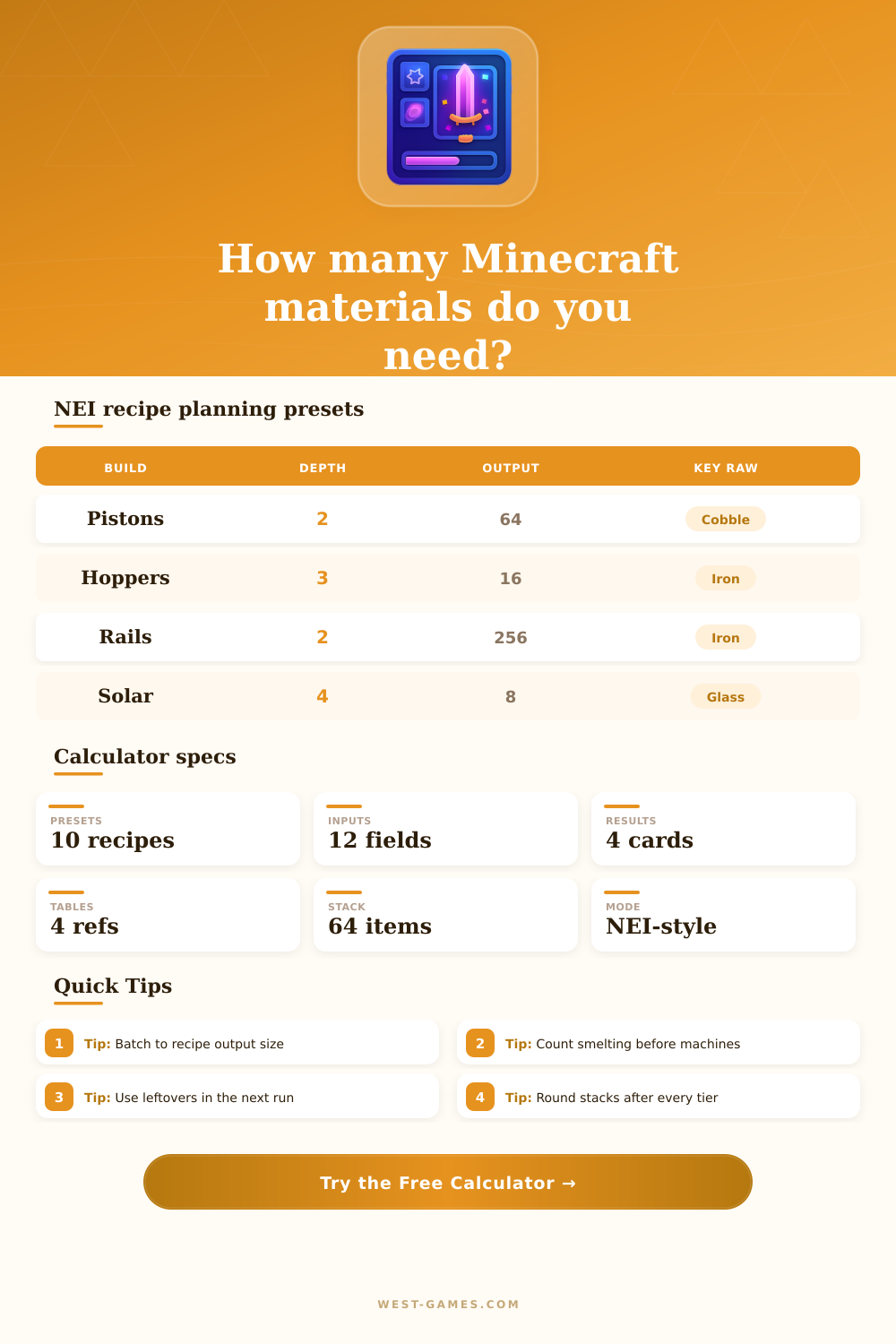
| Preset | Output | Depth | Key chain |
|---|---|---|---|
| 64 Pistons | 1 | 2 | Planks, cobble, iron, redstone |
| 16 Hoppers | 1 | 3 | Iron plus chest subcomponents |
| 256 Powered Rails | 6 | 2 | Gold, sticks, redstone |
| 8 Basic Solar Panels | 1 | 4 | Glass, circuits, generators |
Preset numbers are transparent planning defaults. Any field can be edited to match the exact NEI recipe in your modpack.
| Item type | Stack | Rounding | Use |
|---|---|---|---|
| Normal blocks and items | 64 | Round up stacks | Bulk storage |
| Buckets and ender pearls | 16 | Round up stacks | Odd storage |
| Tools or filled cells | 1 | One slot each | Non-stackable |
| Recipe outputs | Any | Round batches | Leftover tracking |
The calculator rounds top-level and subcomponent craft counts separately so a 6-output recipe behaves like NEI craft requests.
| Process | Factor | Example | Planning effect |
|---|---|---|---|
| Vanilla smelting | 1.00x | Ore to ingot | Raw equals smelted |
| Ore doubling | 0.50x | Macerator line | Half raw ore count |
| Pulverizer chain | 0.75x | Dust and byproduct | Moderate reduction |
| Alloy/compressor | 1.20x | Plates or casing | Extra raw pressure |
Use the machine factor for raw mining pressure, not for the crafted output count shown by the recipe itself.
| Recipe | Output | Subcomponent | Typical depth |
|---|---|---|---|
| Planks from logs | 4 | Logs | 1 |
| Sticks from planks | 4 | Planks | 2 |
| Rails | 16 | Iron and sticks | 2 |
| Modded circuits | 1 | Plates, cable, redstone | 3 to 5 |
Deep trees gain more from leftovers because every nested tier can overproduce a small amount.
| Step | Formula | Why it matters | Result type |
|---|---|---|---|
| Net target | max(target - owned, 0) | Storage items reduce the request | Final item count |
| Top crafts | ceil(net target / output) | NEI crafts whole recipe batches | Crafting operations |
| Sub crafts | ceil(sub need / sub output) | Nested recipes create leftovers | Component operations |
| Buffered raw | ceil(raw x machine x buffer) | Final shopping or mining list | Raw material total |
The row marker for this build is index 841 and gid 1450490472.
Every time you decide to automate something big in Minecraft, you start panicking before you even check your inventory. You find a recipe for eighty solar panels, you think “Yeah, I’ve got that,” and then remember they need circuits, which need plates, which means digging deeper into the ground for raw materials. That’s what always happens right as you’re mining out three hundred iron ingots and realize you don’t have enough glass… or whatever component was missing. Everyone playing Minecraft learn this lesson over time. However, if you plan ahead, this calculator can do the math for you instead of forcing you to guess how much you’ll need of each part and whether or not you’ll have any left over.
Crafting chains can get complex and are hardly ever linear. A piston needs iron, redstone, planks, and cobblestone. But a hopper need chests. Those chests need planks. This makes the process more like a tree with branches than a straight line. Players don’t consider their intermediate steps, they only see how many items they need at the end, and forget about all the wasted stuff along the way. For example, when a recipe produces 16 rails for every 3 sticks and 9 iron ingots, there is no way to make even part of a batch; you have to round up and do an entire operation. Every tier in this tree has some extra leftover materials. If left unchecked, those scraps accumulate rapidly over hundreds of batches. This results in wasted resources or inventory space.
How to Plan Your Resources Better
Beyond the craft, it’s equally vital to understand what goes into machine and how it processes those inputs. Vanilla games have a simple equation: each ore becomes one ingot with nothing lost, but modded worlds add variables that alter their input needs completeley. Pulverizers and ore doublers can change required inputs by altering input/output ratios. For example, you may require 1/2 of the amount of rock mined if it doubles the ore, whereas an alloying machine may compress materials, wasting a few percent of what went in. Though all seemingly insignificant on their own, they compound over thousands of operations. Before you go digging, you must consider these mechanical facts, or else you’ll either run out of time far too soon or spend way longer different than necessary.
Another silent resource sink that surprises many builder is fuel consumption. Whether it’s coal, charcoal, lava buckets, or custom fuel sources, these provide the energy needed to smelt your items. Depending on how much you’re crafting at once, fuel might end up costing as much (if not more) then the raw materials themselves! Players should never forget about fuel because many realize they are running low midway through their project and have to wait for furnaces to cool down. Knowing where your fuel will come from ahead of time makes sure that there aren’t any bumps in your production line. Plus, if you have access to alternative fuels in your pack, it’ll help you determine which might be most efficient: go mining some more coal, or switch?
More important than it sounds is understanding the rules on stack sizes. For example, buckets and ender pearls only stacks to sixteen rather than the usual sixty-four. This means you’ll have to consider additional inventory spaces for storage and transportation. If you’re setting up a logistic network with items transported via pipes or hoppers throughout your base, multiple single item stacks may cause issues by clogging up your logistics network. Knowing precisely how many stacks you’re dealing with lets you set aside the proper quantity of chests beforehand so you don’t start making something and then discover you’re out of room in your inventory.
Finally, it’s always good to include some wiggle room into your estimates. Recipes will shift as mods are updated. People will drop stuff. There might also be a mistake with crafting. That five percent safety net protects against those human factors without making you over-prepare so much that you’re losing more resources than necessary. This is the distinction between having enough to complete the task comfortabley versus just barely scraping by. The system isn’t designed for perfection; it’s designed for reliability.
You don’t want a plan based off idealized conditions; you want one that can handle the real world with its friction. Minecraft isn’t about rapid button clicks, it’s about running efficient supply chains, whether that’s a basic wooden home or an elaborate factory full of electronic circuits. Figure out your desired outcome, determine its parts, consider waste and rounding, account for processing loss and plan how to store and move all that stuff around. Do this before breaking ground and the construction process will be stress-free. You won’t waste time second-guessing your material totals; instead, you’ll know what you’re making and what’s coming next. This mental adjustment transforms the experience from frantic scrounging to a smooth flow of forward motion. Once you input your target quantity and how many layers of a recipe you want to include, the calculator above does the rest (you should of guessed at nested ingredients and excess stack quantities).