🎮 Path of Exile Skill Tree Calculator
Plan passive points, travel efficiency, masteries, jewels, clusters, offense, and survivability before locking in your PoE tree.
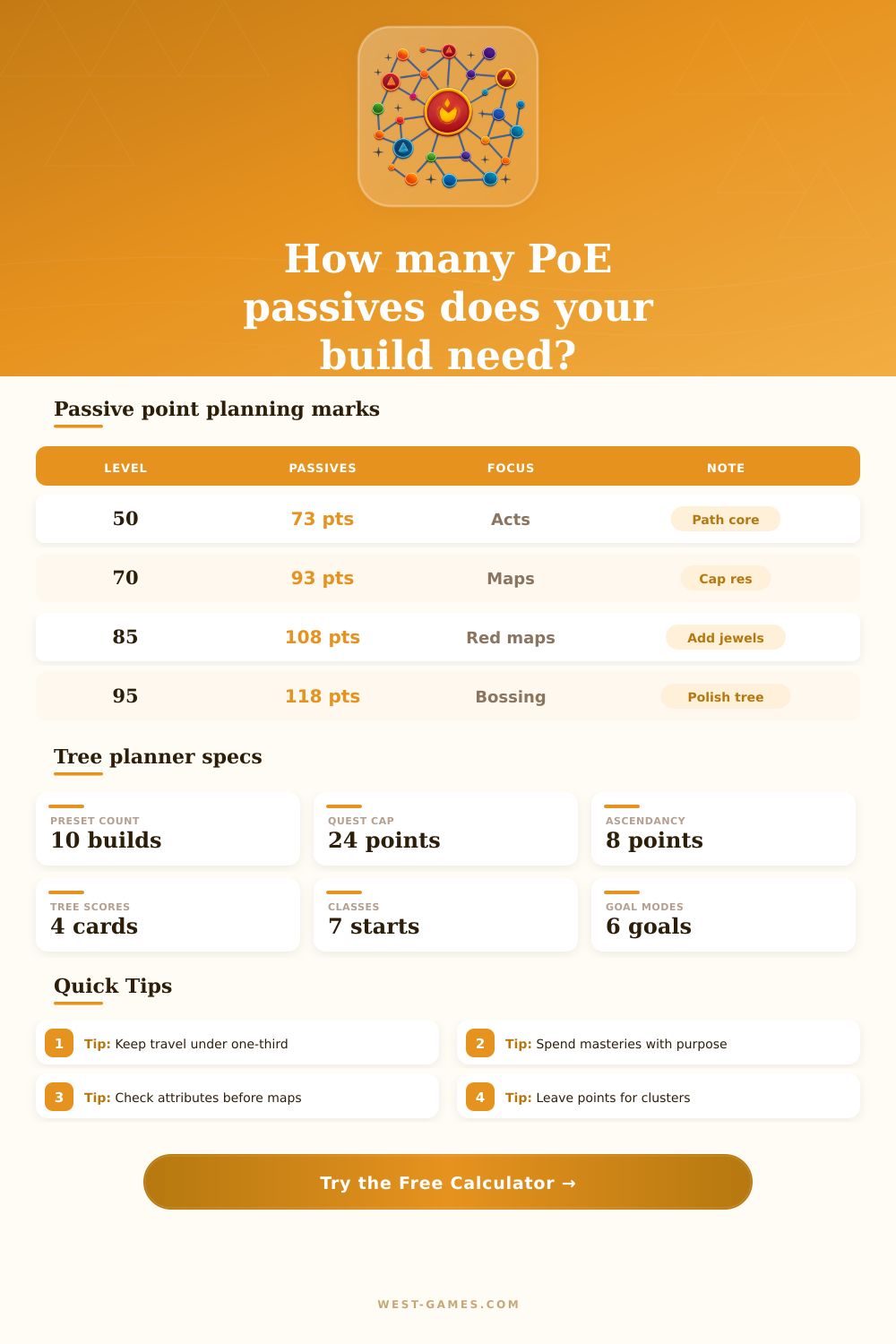
| Level | Regular passives | Typical use |
|---|---|---|
| 50 | 73 with full quests | Core damage and first life wheels |
| 70 | 93 with full quests | Early map defenses and key masteries |
| 85 | 108 with full quests | Jewels, clusters, and specialization |
| 95 | 118 with full quests | Luxury notables and boss polish |
Regular passives assume kill-all bandits and completed passive quests.
| Travel share | Rating | Tree meaning |
|---|---|---|
| Under 24% | Excellent | Dense pathing with nearby value |
| 24% to 31% | Good | Normal build spread for maps |
| 31% to 38% | Stretched | Review distant clusters or keystones |
| Over 38% | Risky | Too much pathing for most trees |
Some Scion or multi-cluster trees tolerate higher travel if every endpoint is high impact.
| Archetype | Offense weight | Defense need | Cluster value |
|---|---|---|---|
| Fire DoT | 1.05x | High | Medium |
| Bow Projectile | 1.18x | Medium | High |
| Mine or Trap | 1.20x | Medium | Medium |
| Minion Poison | 1.12x | High | High |
| Cold DoT | 1.08x | High | Medium |
Weights are planner coefficients for comparing tree shape, not exact in-game DPS.
| Build shape | Point pressure | Watch first | Good sign |
|---|---|---|---|
| League starter mapper | Travel and defenses | Attribute gaps | 5+ free points by level 90 |
| Cluster scaling build | Cluster jewel paths | Socket travel | Cluster score beats nearby notables |
| Bossing tree | Damage uptime | Ailment and recovery holes | Defense score stays above goal target |
| Speed clear tree | Projectile, AoE, movement | Too little effective pool | Travel remains below 34% |
Use the result cards as a planning signal, then verify exact nodes in the in-game or official passive tree planner.
Path of Exile builds depend upon the efficient use of passive point. The efficiency of a Path of Exile build is dependent upon the number of passive points that are spent on useful nodes versus the number of passive points that are spent on travel nodes. Most players that begin a league with Path of Exile will first choose a class and a defensive goal for that class.
After choosing a class and a defensive goal for their character, players must decide which skill cluster to select for their passive tree, which masteries to select for their passive tree, and if they will have enough passive points to spend on jewel sockets and reservation wheels. The calculator require the player to provide several different inputs in order to calculate the efficiency of their passive skill tree. The start for the character is one of the most important of these inputs.
How to Plan Your Passive Skill Points in Path of Exile
Each class provides different attribute coverage and distance to important skill clusters. For instance, the Marauder class start provides players with the ability to save passive points if they wish to invest in life and armour; the Shadow class start, however, provides shorter paths to acquiring skills related to critical strikes, traps, and poison. The archetype dropdown menu allow players to weight the importance of offense versus defense in their character build, which will impact the numbers provided by the calculator.
Builds that rely upon fire damage-over-time will have different requirement for passive points than builds that rely upon projectiles. The level and the quest point inputs allow players to indicate the total number of passive skill points that they will have access to within the game. Players will receive 24 quest points during the Campaign mode and 2 passive skill points from the bandit choices in the campaign.
The calculator will also subtract the player’s ascendancy points separately from the total number of passive skill points available to the player. This is because ascendancy points can be used in a different portion of the game than passive skill points. Thus, players must also decide if it is worth it to take a keystone node in the passive tree that is more distant than those at the beginning of the tree with the available ascendancy points.
Travel nodes and connector nodes are nodes in the passive tree that many player often underconsidered. Any passive point spent on travel nodes is a passive point that is not spent on damage or life. The travel node percentage for a players character can help players to determine if they have overinvested in travel nodes in comparison to the rest of their skills in the passive tree.
Any player whose game includes travel nodes that use more than one-third of their available passive points will find that their other skills have less than sufficient passive points allotted to them. The presets for travel nodes can help players that are new to the game to understand what is considered a reasonable number of travel nodes in a game of Path of Exile. Inputs for defense allow players to account for the defensive component of their build.
Defense includes life, energy shield, ailment mitigation, and recovery wheel skills, all of which may require the player to spend some of their available passive points. The goal dropdown menu allow for players to change the defense score that is displayed in the game. For instance, a player whose goal is to map red maps in the game will have a different defense score than a player whose goal is to kill bosses in hardcore modes.
Thus, a defense score that is enough for one goal may not be enough for another goal for the same player. The offense score within the calculator works in the same way as the defense score. Both reward the player for investing in the offensive skills for their character and punish them for not investing in those skills.
However, like the defense score, the offense score does not replace the in-game passive point planner for players, but instead makes it clear to the player that they may be overinvesting in travel nodes or underinvesting in defensive skills for their character. The page provides tables to allow players to understand the typical number of passive points that are required for each skill and the typical ratio of travel skill points to other skill points. These tables allow the player to understand how their passive points compare to other players without having to remember the number of skill points required to reach various nodes in the game.
If the remaining budget is negative on the calculator, the player will need to change their passive tree by cutting some of the more distant notables or other skill cluster. These more valuable nodes should not be cut, however, as they are the most important for the survival of the player in the game. By calculating the number of passive points that will be required before opening the in-game passive tree planner, players can determine whether their planned skills are within the total available points for players at that level in the game.
It is easy for players to ignore the need for certain skills and attribute points at the beginning of the game, as they may feel that these skills or attributes can be obtained through gear later in the game. However, once the players spend the passive points for these nodes, they cannot be taken back. Thus, before spending the passive points, players should use the calculator to determine if their planned passive tree will be within their available passive points at their target level.
The same logic can be applied to any situation in which a player decides to change their starter character into a different type of build. The inputs will be the same, but the goals for the character and the targets for their defense and offense scores will change. Thus, the scores that the calculator provides will change as well.
This type of tool is beneficial to players throughout the entire game league. The calculator helps players to understand the tradeoffs that they will need to make within the passive skills tree. Thus, the planning process for players will be significantly more faster with this tool.