✨ WoW Classic Priest Talent Calculator
Plan Discipline, Holy, and Shadow points for healing, leveling, raid utility, and PvP survival with Classic-era breakpoint validation.
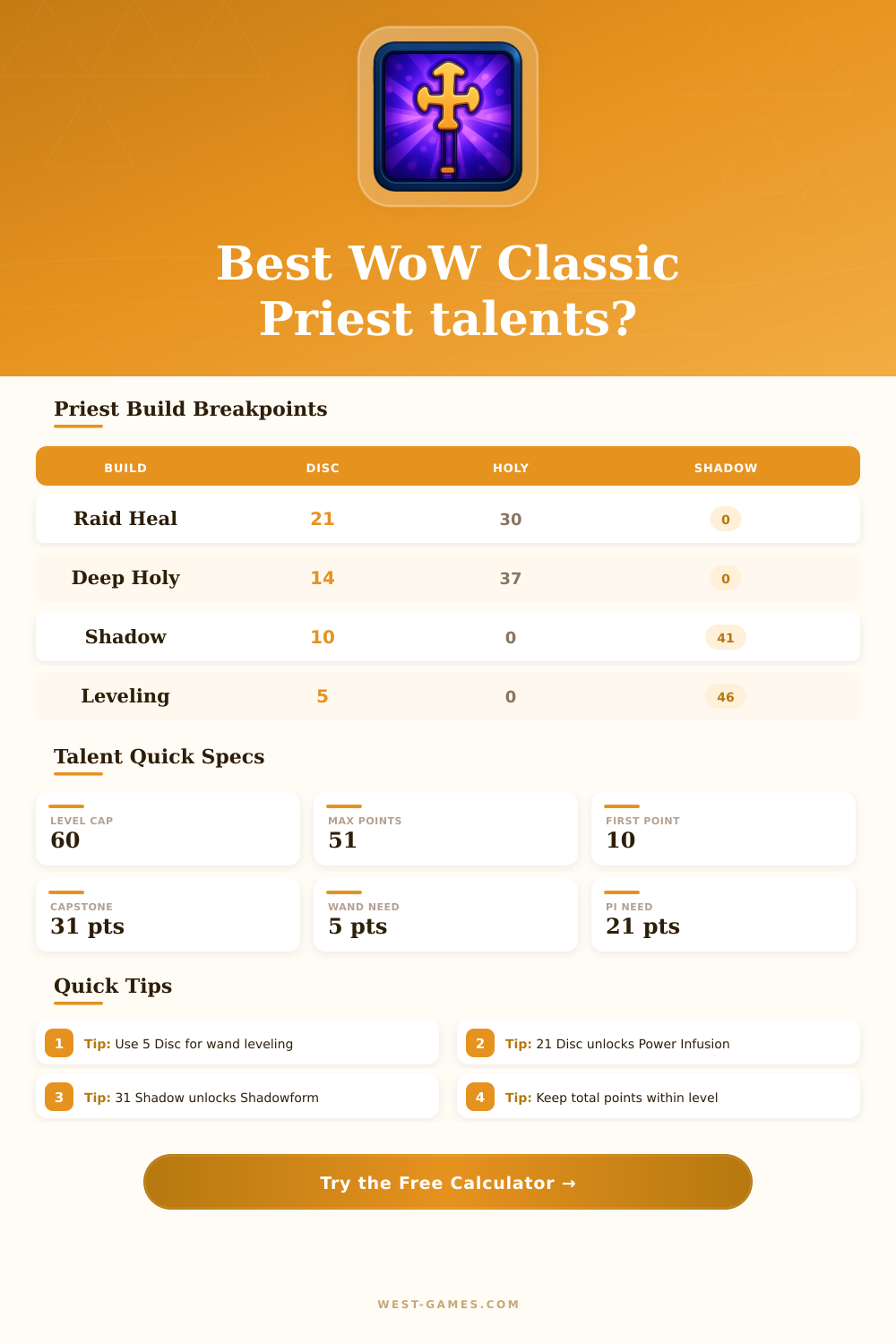
| Breakpoint | Tree | Points | Calculator meaning |
|---|---|---|---|
| Wand Specialization | Discipline | 5 | Strong early leveling value when wand points are also set to 5. |
| Inner Focus range | Discipline | 11+ | Counts as healer efficiency and PvP emergency value. |
| Power Infusion | Discipline | 21+ | Flags major raid utility for caster DPS or throughput windows. |
| Divine Spirit route | Discipline | 31+ | Counts as deep raid support and high survivability Discipline. |
| Inspiration access | Holy | 10+ | Useful tank-healing support in dungeon and raid healing plans. |
| Spiritual Healing range | Holy | 25+ | Marks a serious Holy throughput investment. |
| Vampiric Embrace | Shadow | 20+ | Adds solo sustain and group utility to Shadow builds. |
| Shadowform | Shadow | 31+ | Confirms the primary Shadow DPS breakpoint. |
This calculator validates point thresholds, not exact in-game talent ordering. Use it to check the shape of a build before placing individual talent ranks.
Raid PI
Best when your raid values Power Infusion while keeping enough Holy points for direct healing throughput.
Deep Holy
Leans into raw healing and tank support. It trades Discipline utility for a stronger Holy identity.
Shadowform
Uses 31 or more Shadow points to validate the damage role, then spends extras on efficiency or utility.
PvP Disc
Prioritizes Discipline survivability, flexible healing, and defensive control over pure raid throughput.
| Role target | High-value tree | Useful breakpoints | What the score rewards |
|---|---|---|---|
| Raid healing | Holy plus Discipline | 21 Disc, 25 Holy | Healing throughput, Power Infusion, Inspiration, and clean point budget. |
| Dungeon healing | Holy | 10 Holy, 20 Holy | Flexible healing value with enough Discipline for efficiency. |
| Solo leveling | Shadow plus Discipline | 5 Wand, 5 Spirit Tap, 31 Shadow | Wand damage, recovery, Shadow damage, and low downtime. |
| PvP survival | Discipline plus Shadow | 21 Disc, Silence range, 31 Disc | Survival emphasis, shields, control utility, and instant-response value. |
| Hybrid utility | Any two trees | 21 Disc, 20 Shadow, 20 Holy | Balanced spread without spending past the available level budget. |
| Character level | Available points | Common milestone | Calculator check |
|---|---|---|---|
| 20 | 11 | Early Discipline or Holy access | Total points must be 11 or fewer. |
| 30 | 21 | Power Infusion or mid-tree progress | A 21-point breakpoint is legal at level 30. |
| 40 | 31 | Shadowform or deep-tree capstone | A 31-point tree is legal at level 40. |
| 50 | 41 | Deep primary tree plus support | Enough points for 31 plus a 10-point support package. |
| 60 | 51 | Final Classic talent build | Full endgame calculator budget. |
At level sixty, standing in front of the training dummy, there’s a certain panic. There’s a realization that your talent points has been scattered about like breadcrumbs left by a confused bird. And the Priest class in World of Warcraft Classic require choices, ones that will shape who you are for months. You can’t just dip your toe into each and every pool, each build is punished by a poor result in all categories. This calculator is designed to prevent you from making that error before it becomes too late. Let it do the arithmetic of fifty-one slots, while you concentrate on the strategy behind those choices.
There’s one key concept to understand: breakpoints. Many talent trees in today’s games are smooth gradients. Classic is not like that, it’s a bunch of cliffs. Either you’ve got Power Infusion or you don’t. Either you’ve got Shadowform or your hands is full and you have no spell damage bonus. The calculator tells you if your proposed build actualy reaches those breakpoints.
How to Use the Talent Calculator
Are you dumping two dozen points in Discipline just because you think it’ll get you within spitting distance of the capstone? The tool will spit back at you and say that you fell short by exactly one point. And that point makes all the difference, because that point is the difference between being useful in a raid and being invisible.
Some people take half points in everything, and then they feel versatile. They never has enough deep Holy healing to keep tanks topped off, and they also don’t have Power Infusion for their caster. That’s when the presets come in handy as a sanity check. Twenty-one Discipline thirty Holy isn’t some random build. It picks up all the required utility and then just stuffs the rest full of healing oomph.
The calculator looks at that and give it high marks for being respectful off the raid economy. Your score here reflect the service you provide by staying alive through Shield specialization or Inner Focus and giving the raid something no other class can. It changes things completely for someone who wants to level solo.
Early on, Wand Specialization is king. You can get five points here. This may not sound like much but it greatly improves your damage output against out-of-range enemies. You can plug in values and toggle them around to see what effect it has on your overall score. It doesn’t pass judgment on your builds, but it points out where you’re leaving some juice on the table.
If you’re making a shadow caster for leveling, the tool will let you know if you’ve forgotten Vampiric Embrace or Spirit Tap. These aren’t numbers representing damage. These are survival tools that make the difference between running back to town every thirty seconds or continuing to move forward through the zone.
The PvP adds an additional complication. In battlegrounds, survivability is sometimes more important then just raw throughput. A Holy tree can be very strong, but it has less immediate response than Discipline. More control and ability to respond quickly are Discipline’s strength. It weights the calculator depending on what content you want to go into. So if you are looking at a build that doesn’t perform well as a healer in raids, it may work very well for arena survival. Know that difference so you don’t take on a meta build that isn’t appropriate for how you actualy play. Never optimize for a role you aren’t going to take.
Finally, there’s a tight but flexible spending limit, the point budget. With 51 points at level sixty, you’ll be able to dole out some points here or there while going deep in one tree or two. It rarely lets you max out all three furnitures. There’s a clear grid on the page called the milestone grid which tell you exactly how many points you’ll receive at every step along the way. It also lets you know Shadowform will cost you thirty-one points. Good luck making that happen before level forty-one, you should of planned ahead; save yourself awkward transitions that leave you feeling like your talents don’t match up for weeks.
Accepting tradeoffs is talent planning. In Classic, you can’t do it all. You’re not going to be top-tier both as a damage dealer and a healer. The calculator makes those sacrifices real. It takes out the noise and shows you where you need to make decisions to get what you want. Accept that limit, then it’s easier to see how you move on from there. Pick an identity, reach the breakpoints, let the rest follow from gear.