⚾ Dynasty Baseball Trade Calculator
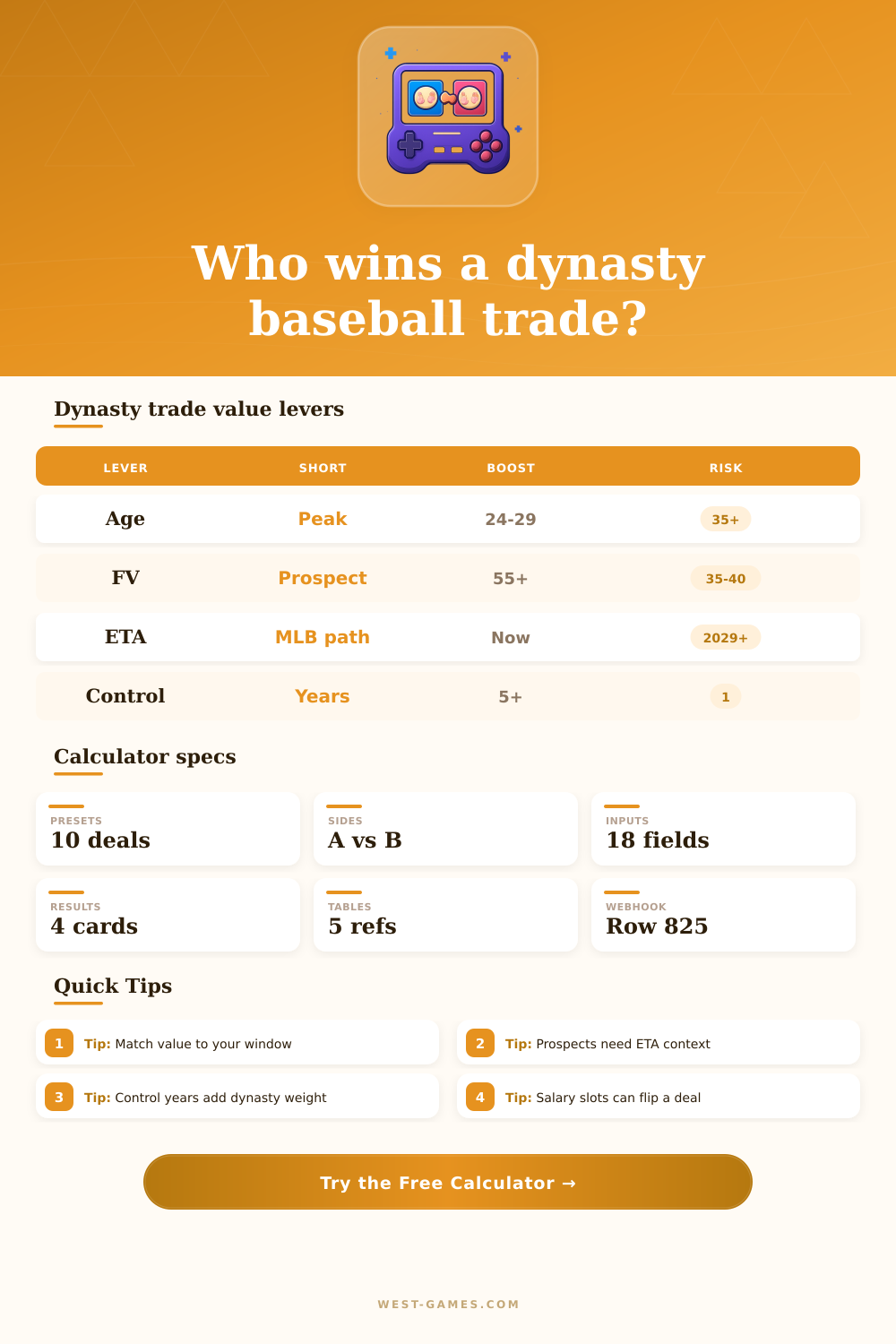
Compare dynasty baseball trades with age curve, prospect FV, MLB ETA, contract or control years, competing window, risk grade, draft pick value, salary slot pressure, and side totals.
Side A receives
Side B receives
| Age band | Hitter lean | Pitcher lean | Dynasty note |
|---|---|---|---|
| 17-20 | 1.10 | 1.05 | High upside, long ETA risk |
| 21-23 | 1.18 | 1.12 | Prospect-to-MLB growth window |
| 24-29 | 1.15 | 1.08 | Prime dynasty production years |
| 30-32 | 0.95 | 0.92 | Still useful for contenders |
| 33-35 | 0.75 | 0.70 | Shorter keeper runway |
| 36+ | 0.55 | 0.50 | Mostly win-now value |
The calculator uses one blended age curve for packages. Adjust production and control to reflect special outliers.
| FV grade | Base value | Typical role | Trade use |
|---|---|---|---|
| 70 FV | 80 | Elite prospect | Foundation asset |
| 65 FV | 68 | Star upside | Core rebuild piece |
| 60 FV | 56 | Plus regular | Premium prospect |
| 55 FV | 42 | Above-average | Strong secondary |
| 50 FV | 30 | Regular | Useful piece |
| 45 FV | 18 | Role player | Depth add-on |
| 40 FV | 9 | Bench or relief | League-depth dependent |
FV is then modified by ETA, risk, market inflation, and your competitive window.
| ETA | Win-now fit | Rebuild fit | Calculator effect |
|---|---|---|---|
| Already MLB | Excellent | Good if young | No ETA discount |
| This season | Good | Excellent | Small discount |
| Next season | Neutral | Strong | Moderate discount |
| 2 seasons away | Weak | Good | Large win-now discount |
| 3+ seasons away | Poor | Speculative | Large ETA and risk drag |
Far-away prospects can still win a rebuild trade, but only if the FV, control, and salary advantages justify the wait.
| Control years | Keeper meaning | Value effect | Slot note |
|---|---|---|---|
| 0-1 | Rental or final year | Low dynasty lift | Contender only |
| 2-3 | Short keeper window | Useful | Needs production |
| 4-5 | Prime keeper runway | Strong | Ideal core range |
| 6+ | Long control or minors | Premium | Best with age/FV |
| Negative salary | Overpriced slot | Subtract | Cap drag matters |
| Positive salary | Surplus keeper | Add | Can flip close deals |
Salary or slot adjustment is intentionally manual because league rules vary widely.
| Preset | Side A shape | Side B shape | Best use | Watch item |
|---|---|---|---|---|
| Win-Now Ace | Ace starter | Two prospects plus pick | Flag push | Pitcher attrition |
| Rebuild Bat | Young bat package | Older power bat | Future core | ETA timing |
| Elite Rookie | MLB rookie star | Veteran plus prospect | Keeper premium | Hype inflation |
| Closer Window | Saves arm | Young depth hitter | Category push | Role volatility |
| Salary Relief | Cheap keeper | Costly veteran | Cap leagues | Slot pressure |
| Pick Heavy | Prospect and picks | Current MLB regular | FYPD leagues | Pick conversion |
Presets are not player rankings. They are dynasty trade shapes that show how age, FV, ETA, control, risk, picks, and salary slots interact.
Regret is something many Dynasty baseball owner experience regarding trades. It’s selling an important piece for pennies on the dollar, or it’s holding onto prospects when nobody is ready to contribute while the team flounders anyway. It is a transaction that looks good on paper but when you look at it, it doesn’t feel right. And most of the time, it’s trading two types of value against each other, but assuming they’re the same thing.
On one end, you have immediate production; on the other, you have years of control, age advantages, and future potential. That don’t translate evenly from one side to the next. Now, there are some things the calculator do for you, and knowing them can help. For example, the tool needs inputs that casual managers tend to overlook.
How to Make Better Trades in Dynasty Baseball
It wants to know not only the age of the star player, but rather the average age of the whole damn package. It splits out current production in the major league from the ceiling grade of prospects. And then it wants to know how many years of control you have on those assets. This makes sense because dynasty leagues penalize inconsistency. A guy who’s great now but trending down on his age has one type of value curve, while someone with an excellent set of tools at 18 who might never become anything at all has another.
The age bands is where we go from a premium to a discount (the reference table). Before plugging in any names to the calculator, however, it helps to have defined your competitive window. That means an ace who is 34 has greater value than a 21-year-old prospect with two years until his debut. It’s the truth. This is reflected in the math, which place a premium on what’s happening now and favors the win-now team.
On the flip side, if you’re rebuilding, then that same ace is only a rental with no future value except today’s numbers. His upside and five years of control make him the anchor for young gun with high upside but just two years of control. This is why most trades goes bust: one guy thinks he’s rebuilding, another thinks he’s got a shot to contend this season. Different definitions of value.
This is true particulary when it comes to valuing prospects. Most deals fail here. Everybody want a high Future Value grade, but what’s a fifty-five (or whatever) worth without knowing when they’ll arrive? A fifty-five due in the majors next spring has much greater value then a fifty-five not likely to be there for another three years. There are variables: will he get hurt? Will he fulfill his role? Will he live up to the hype? The delay adds some uncertainty to the situation.
To make up for it, the tool applies risk-grades as discounts against ETA. And it factors in salaries in auction or keeper leagues. That pricey dude eats up space in your budget, so even if he’s not a great asset, he’s less desirable if he clogs your wallet. Often, a cheap prospect with potential beats out a decent one because you can hold onto him longer.
The secret variable that will wreck your rosters is risk. Some pitchers strike out many batters but are inconsistent. Sluggers with big swings who chase balls outside the zone. These player lose their luster quickly. A risk grade tames the potential upside of vulnerable assets, it’s the calculator’s way to prevent you from paying top dollar for fragile players destined to shatter into a million pieces.
Every trade you make is a test of your roster’s overall health; is this move going to provide stability for the coming three years, or deliver a good year and then nothing? You should of looked at it that way. The goal isn’t just to get points. Focus on matching your timeline with your asset allocation. Consider roster depth and category balance if the value edge is modest.
At times it’s the player who can take on some of the extras because he has empty spots. Trade as though you understand the season. Chase production if the window is closing; keep the core young when you need time. That discipline will beat guesswork every time.