🐾 WoW Classic Druid Talent Calculator
Allocate Balance, Feral Combat, and Restoration points, then compare Classic Druid breakpoints for leveling, raid, and PvP plans.
| Character level | Talent points | Planning meaning |
|---|---|---|
| 10 | 1 | First talent point becomes available. |
| 20 | 11 | Early utility tier can be reached in one tree. |
| 30 | 21 | Mid-tree breakpoint packages become possible. |
| 40 | 31 | A 31-point capstone can be reached. |
| 50 | 41 | Deep tree plus a small support package. |
| 60 | 51 | Classic level-cap build is complete. |
The calculator clamps the level range to 10-60 and uses level minus 9 for available talent points.
| Breakpoint | Tree need | Role signal | Calculator check |
|---|---|---|---|
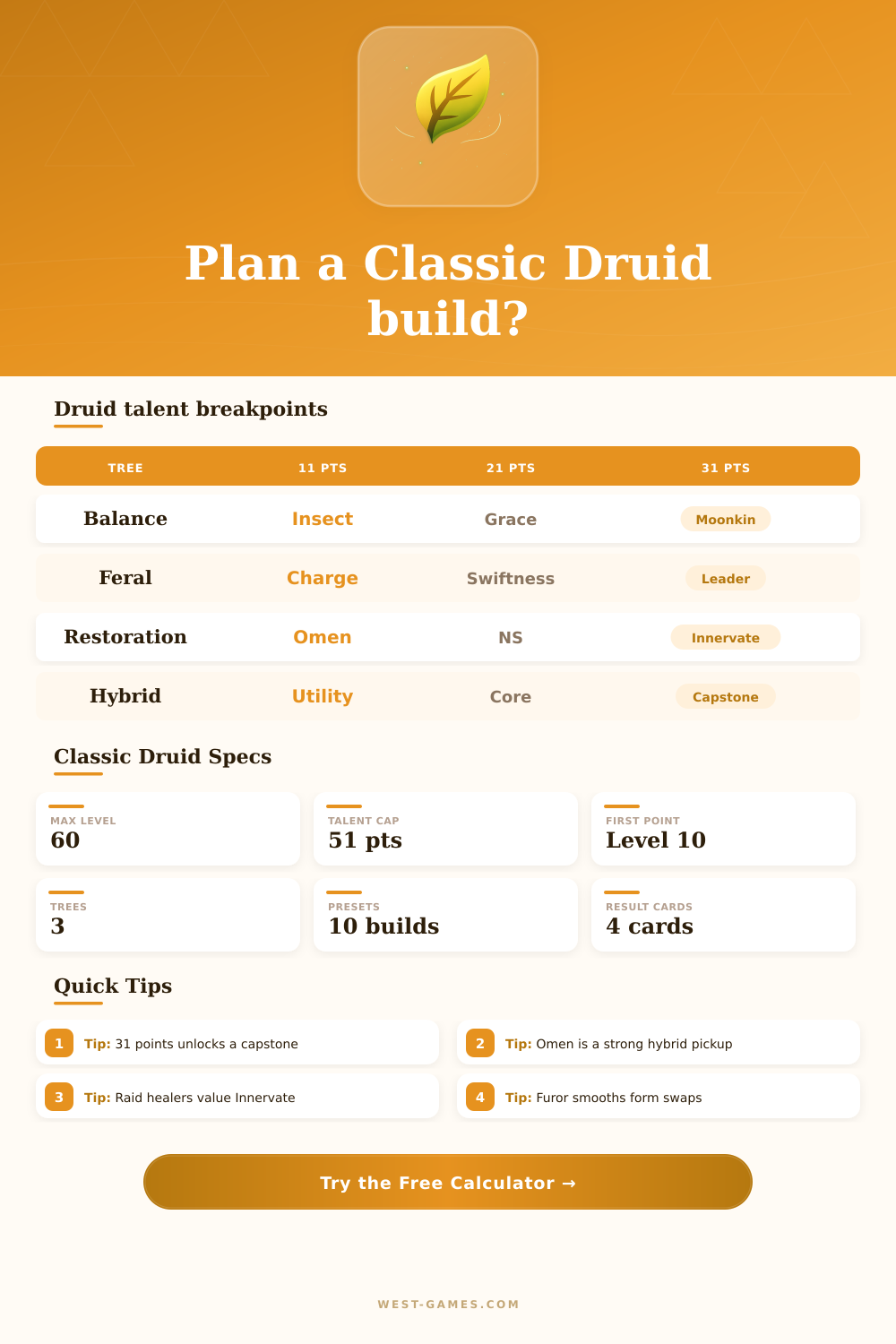
| Feral Charge | 11 Feral | Bear PvP or tank control | Feral points |
| Omen of Clarity | 11 Restoration | Efficient hybrid melee or casting | Resto points |
| Nature's Swiftness | 21 Restoration | Emergency heal or PvP burst | Resto points |
| Moonkin Form | 31 Balance | Balance capstone identity | Balance points |
| Leader of the Pack | 31 Feral | Feral group damage support | Feral points |
| Innervate | 31 Restoration | Raid healing mana utility | Resto points |
Talent names are grouped as practical breakpoints rather than a full in-game talent tree clone.
| Preset | Split | Best use | Breakpoint idea |
|---|---|---|---|
| Feral Leveling | 14/32/5 | Questing and dungeons | Deep Feral with basic Furor |
| Heart NS Hybrid | 0/30/21 | Hybrid PvP and emergency healing | Feral core plus Nature's Swiftness |
| Feral Tank | 0/31/20 | Dungeon or raid tank utility | Leader of the Pack plus strong support |
| Cat PvP | 1/29/21 | Open world pressure | Nature's Swiftness with strong cat damage |
| Moonglow Heal | 24/0/27 | Efficient healing and caster utility | Balance mana efficiency plus NS |
| Deep Resto | 8/11/32 | Raid healing and Innervate | Resto capstone with Feral utility |
| Moonkin PvP | 31/0/20 | Balance burst and off-healing | Moonkin Form near NS support |
| Flag Carrier | 0/30/21 | Warsong mobility and survival | Feral mobility plus NS reset |
Presets are editable planning starters, not a ranking. Tune points to match faction gear, raid needs, and PvP style.
| Tree | Primary value | Secondary value |
|---|---|---|
| Balance | Wrath and Starfire support | Mana efficiency and Moonkin armor |
| Feral Combat | Cat damage and bear tanking | Mobility, crit, and dungeon flexibility |
| Restoration | Healing throughput and mana tools | Furor, Omen, NS, and Innervate utility |
| Hybrid split | Multiple jobs in one spec | Less capstone depth, more encounter coverage |
The hybrid score rewards useful second-tree depth without ignoring the cost of missing capstones.
| Focus | Raise when | Calculator effect |
|---|---|---|
| Leveling | Questing, farming, solo travel | Rewards Feral efficiency and uptime. |
| Raid | Healing assignments or tank slots | Rewards role depth and gear support. |
| PvP | Warsong, duels, world PvP | Rewards NS, Charge, and hybrid utility. |
| Balanced | You swap jobs often | Rewards two-tree depth and flexible breakpoints. |
The three sliders do not need to total 100. The calculator normalizes them internally.
In World of Warcraft Classic, becoming a druid mean fulfilling many roles. A druid is a tank, a melee damage dealer, a ranged caster, and a healer all rolled into one. Fifty-one points, distributed among three trees, makes the talent interface look easy. In practice, though, restrictions are tight: every point you sink into one area is a point you cannot use for something else, like cat damage or moonkin armor. Druids live life of tradeoffs between utility and specialization.
That’s where this calculator comes in. On this page, it’s not just doing basic math to see if you have enough points for the capstone. Rather, it asks what play style you want and then weighs that against rules of the talent grid.
How to Choose Your Talents
Do you want to level solo? Then it will flag builds that leave you slow in cat stealth or otherwise vulnerable outside of bear form. Want to raid? Then it will see if the loss of feral mobility are balanced by increased healing output.
Why? Because many people spend their points boosting numbers that look great on paper but fall flat in practice. Taking Innervate from a restoration tree give you one of the best abilities: a skill required for any serious raid healer. However, if you want to hit capstone at level 31, you ignore the other two trees completely. Perhaps you try a hybrid build with enough feral to get good cat damage plus Nature’s Swiftness for emergencies? That sounds great until you find yourself without any armor when human and lacking tanking stats. The calculator lets you know that in advance; maybe before it’s too late against a tough boss or mean player.
In the end, it makes you pick one (and only one) and go all out, knowing you’ll compromise elsewhere. There are other trade offs in feral combat. For example, Leader of the Pack buffs melee crit chance. While that helps with damage, it doesn’t help your healing uptime at all. Deep feral specs will sometimes dip into restoration for Furor or balance for Moonglow. All these complicated hybrid specs defines how high-level druids play.
The presets in the tool demonstrate popular patterns where players have succeeded, like a traditional one point dip into Furor so you can even out your rage generation when swapping forms. Those little choices has a huge impact on how you actualy end up playing the game.
For balance druids, it’s a little more complicated. With thirty-one points in Moonkin Form, you’re left with just twenty to cover everything else. If you want to compete, you’ll need at least one point in restoration for Furor or Omen of Clarity, which means that you’ll have to dip. The calculator takes those mandatory dips into account and tells you exactly where the breakpoints are. And there is also sliders that allow you to weight your priorities towards leveling, raiding, or PvP. Because the best build for dominating in Warsong Gulch could be abysmal if you’re questing through high-level zones… It lacks survivability or some form of self-healing.
Early on, most people overcomplicate their build. Instead of learning to master one, they try to optimize for all scenarios. This page lays out the talent landmarks clearly with reference tables telling you precisely where you should of be able to afford key talents such as Nature’s Swiftness or Feral Charge. Plan your leveling path based on that info. Learn a solid feral spec first, then switch to either deep healing or balance depending on your raid role and gear. That’s what the tool is there for, to check your plans, not to override your judgment of what’s fun for you.
Opportunity cost is name of a Druid game. We aren’t all things to all people; you can’t be everything at once. But we can be pretty solid at two if we give up being best-in-slot for the other. Pick a suitable starting preset, then tinker with points to suit your playstyle and gear, using the weighted scoring system to help inform the last few choices. It’s meant to be useful, not perfect. When you discover your preferred “split,” one which doesn’t leave you fuming because there’s some talent you could have had instead, run with it. Consistency is what distinguishes great Druids from merely good ones.