⏱ WoW Global Cooldown Calculator
Estimate effective global cooldown, haste pressure, minimum cap contact, latency loss, spell exceptions, burst-window actions, and practical rotation actions per minute.
| Total haste | 1.5s base | 1.0s base | Cap pressure |
|---|---|---|---|
| 0% | 1.50s | 1.00s | No cap contact |
| 10% | 1.36s | 0.91s | Comfortable |
| 25% | 1.20s | 0.80s | Fast melee close |
| 50% | 1.00s | 0.75s | 1.0s base capped |
| 100% | 0.75s | 0.75s | Both at common floor |
Formula used for haste-scaled rows: base GCD divided by 1 plus total haste, then limited by the selected minimum cap.
| Profile | Base GCD | Typical model | Watch point |
|---|---|---|---|
| Fire Mage | 1.50s | Haste-scaled caster | Combustion button density |
| Shadow Priest | 1.50s | DoT and channel planning | Voidform haste ramp |
| Outlaw Rogue | 1.00s | Energy melee rhythm | Fixed-GCD feeling |
| Feral Druid | 1.00s | Cat Form pacing | Energy pooling gaps |
| Restoration Druid | 1.50s | HoT ramp planner | Late ramp compression |
Presets are timing profiles for planning. Use custom values when a spell, talent, stance, form, or expansion rule differs.
| Exception | Calculator behavior | APM effect | Use case |
|---|---|---|---|
| Standard haste-scaled | Base divided by haste | Main rotation limiter | Most instant spells |
| Fixed 1.0s global | Ignores haste reduction | Caps speed directly | Specific ability checks |
| Off-GCD ability | No lockout added | Raises keypress APM | Cooldowns or interrupts |
| Pet command pulse | 0.50s planning lock | Small weave penalty | Command timing |
| Channeled or cast-gated | Uses slower planning gate | May hide GCD gains | Channels and hard casts |
The selected exception changes the ability lockout card, while the rotation APM still shows your normal on-GCD rhythm plus delay.
| Window | 0.75s GCD | 1.00s GCD | 1.50s GCD |
|---|---|---|---|
| 10 sec | 13 actions | 10 actions | 6 actions |
| 15 sec | 20 actions | 15 actions | 10 actions |
| 20 sec | 26 actions | 20 actions | 13 actions |
| 30 sec | 40 actions | 30 actions | 20 actions |
| 60 sec | 80 actions | 60 actions | 40 actions |
These are clean lockout counts before latency, resource pooling, movement, cast times, target swaps, or off-GCD weaves are added.
Global cooldowns are a central part of every rotation decision that a player make in World of Warcraft. Global cooldowns will have an effect on the players experience of the burst window of abilities that can be used. A player may feel like a burst window is too short, but only due to a lack of understanding of how haste, the minimum global cooldown cap, and input delay interact with each of the instance ability.
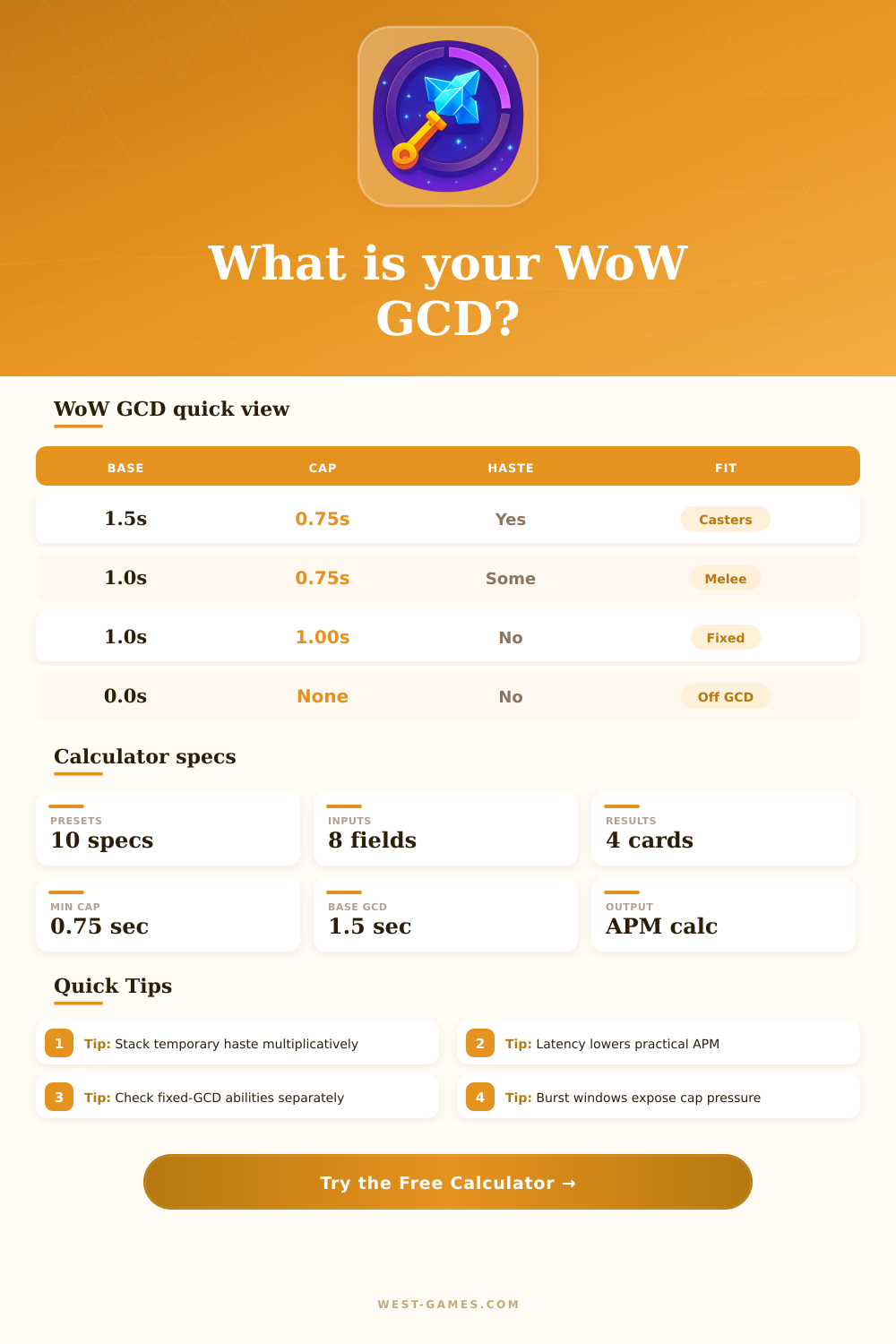
By understanding these three factors and how they interact with those abilities, a player can begin to make choices based off these feelings. Each specialization has a baseline cooldown for there abilities. Casters will have a 1.5 second cooldown while melee specializations will has a 1 second cooldown.
How Global Cooldown, Haste and Latency Affect Your Burst Window
Because fire mages and feral druids has different base cooldowns, each of these professions will experience haste different. By plugging a players permanent and temporary haste into a calculator, it will be able to calculate the impact that haste will have upon their baseline global cooldown. With this information, a player can decide if new gear will impact their burst window, or if it will simply change their global cooldown to the unbeattable cap.
Temporary haste can be stack with permanent haste. However, the interaction between these two type of haste is a multiplicative interaction. For instance, if a player has a thirty percent chance to gain temporary haste, and their gear provides twenty five percent haste, it will not be fifty five percent haste.
Instead, each percent will multiply. By using a tool that models a combustion window and an adrenaline rush window, a player can separate these two types of haste, and determine if gaining a major cooldown for a haste buff will provide additional actions for the player while utilizing there burst window. The minimum global cooldown cap exist to ensure that rotation windows do not become contests of how fast a player can hit the global cooldowns of their spells.
Without a minimum global cooldown cap, haste would reduce the cooldown of abilities to fractions of a second. Most specializations has a minimum global cooldown of 0.75 seconds, but some abilities will ignore haste. By using the exception model built into the calculator, the player can model how often that ability will prevent a player from hitting the global cooldown cap.
For example, a channeled spell will provide some benefits to a player that will hide some of the gains from haste, and the calculator will account for this benefit when projecting action counts for burst length determined by the player. Finally, the impact of latency can be modeled in the calculator. Even with perfect spell queuing, a player with a forty-five millisecond latency between each spell will perform fewer actions in a given amount of time than a player with zero latency.
This latency can be accounted for in the calculator to provide an accurate actions-per-minute value for the players. Additionally, the calculator separate global cooldown actions from off-GCD weaves, as many specializations have abilities that rely upon interrupts, racials, or maintenance spells that dont use a global cooldown. Burst windows will display the impact of haste, the minimum global cooldown cap, latency, and other factors upon a players burst window.
Each of these factors will create a series of decisions for the player as to which abilities should be utilize within that burst window. Within the calculator are reference tables that detail how many action can be performed within burst windows of various lengths, given different global cooldown speeds. These values will provide a baseline for a player prior to the incorporation of movement, target swapping, and other factors that impact the rotation other than global cooldowns.
Burst window calculators allow a player to begin to test the rotation of their abilities prior to beginning to play with them. A player can use the calculator to determine how many extra actions per minute are required to reach the global cooldown, how many action will be lost if a player utilizes a one-second ability, or how many actions per minute will be lost due to latency. These comparisons will allow a player to become comfortabley with their abilities and their costs before ever beginning to play with them.
Furthermore, when a player obtains new gear or talents, a player will be aware of which variable will change, and which variables will remain at the global cooldown cap.