⚔ Tainted Grail Skill Tree Calculator
Balance attributes, skill tiers, and sustain loops to route your strongest melee, ranged, or arcane build path.
| Tree | Primary Scale | Tier 3 Unlock | Tier 4 Unlock | Best Use |
|---|---|---|---|---|
| Warfare | Vigor + Endurance | 18 points | 32 points | Heavy melee burst and guard breaks |
| Archery | Precision + Cunning | 16 points | 30 points | Single target burst and safe kiting |
| Mystic | Spirit + Precision | 20 points | 34 points | Ward conversion and ranged spells |
| Guile | Cunning + Precision | 15 points | 28 points | Crit loops, bleed stacks, and finishers |
| Weapon | Base Coeff | Best Tree Pair | Drain/sec | Synergy Note |
|---|---|---|---|---|
| Greatsword | 1.34 | Warfare + Guile | 18 | Large tier spikes from heavy chains |
| Spear | 1.18 | Warfare + Archery | 14 | Strong spacing for elite packs |
| Longbow | 1.22 | Archery + Guile | 16 | Stable DPS with precision scaling |
| Arc Staff | 1.28 | Mystic + Archery | 19 | Best ward pressure and chain casting |
| Armor Class | Defense Mult | Dodge Mult | Resource Tax | Recommended For |
|---|---|---|---|---|
| Light Leather | 1.05 | 1.20 | 0.90 | Assassin and ranged pressure loops |
| Medium Mail | 1.18 | 1.00 | 1.00 | Balanced hybrids and safe progression |
| Heavy Plate | 1.34 | 0.82 | 1.16 | Boss tanking and high pressure melee |
| Warded Robe | 1.12 | 1.05 | 0.96 | Mystic channels and sustain casting |
| Tier | Offense Index | Survival Window | Sustain Goal | Notes |
|---|---|---|---|---|
| Patrol | 140+ | 10s+ | 75%+ | Low risk route clearing |
| Elite | 190+ | 14s+ | 90%+ | Normal dungeon and event checks |
| Boss | 250+ | 18s+ | 105%+ | Main quest boss checkpoints |
| Nightmare | 320+ | 24s+ | 120%+ | High pressure endgame combat |
When you build a character in Tainted Grail, you must allocate point to various attribute for your character. Every point that you allocate to attributes like Vigor, Precision, or Spirit will impact the character’s performance during fights and there effect on the length of each fight. These attributes must be balanced in a way that ensure that the character can stand up to the challenges of the fight, even when their stamina is low and the enemy’s pressure is high.
Each of these attributes will have an impact on the character’s performance in fights of any length, but there is a difference between the character’s potential strength vs. They actual strength. Players will find themselves choosing the more visually conspicuous nodes to allocate to their character first. However, this can leave the remainder of the character’s build without enough game points to allocate to those attribute.
How to Build a Balanced Character in Tainted Grail
A battle resource calculator is available to assist player with the math behind each build. The resource calculator allow players to input the weapon that they will use, the armor class of the player, and the length of the fight. With these parameters, the calculator will tell the player what their best balance of offense vs. Survival is for the fight.
However, it will not provide an experience of the fight that are generated by certain weapons. Another of the main choice for players is the armor choice for their character. This choice will impact the character, and the player must consider the various effect of armor choices after playing for extended periods of time.
For instance, light leather armor will cost the player fewer resource and allow for better dodge chances, but every hit will land harder on the player if they choose the wrong moment to dodge. In contrast, heavy plate armor will take more resource and stamina to use, but will provide better defense and give the player longer to end their combat combos. However, the armor that they choose will depend on the weapon that they use.
Weapons with high uptime require one type of armor vs. Others that require spacing between the player and their enemy. Certain weapon work better with certain trees. For instance, a greatsword and the warfare tree may look good together, but will deplete the player’s resources quick if they are performing their combos at a high rate.
In contrast, a longbow and the archery tree will work together better, but will require the player to remain mobile during the fight. The calculator display these trade-offs because the calculator show the percentage of offense, survival, and sustain values when a variable is changed. The calculator can help you decide if your point split is appropriate for your desired playstyle.
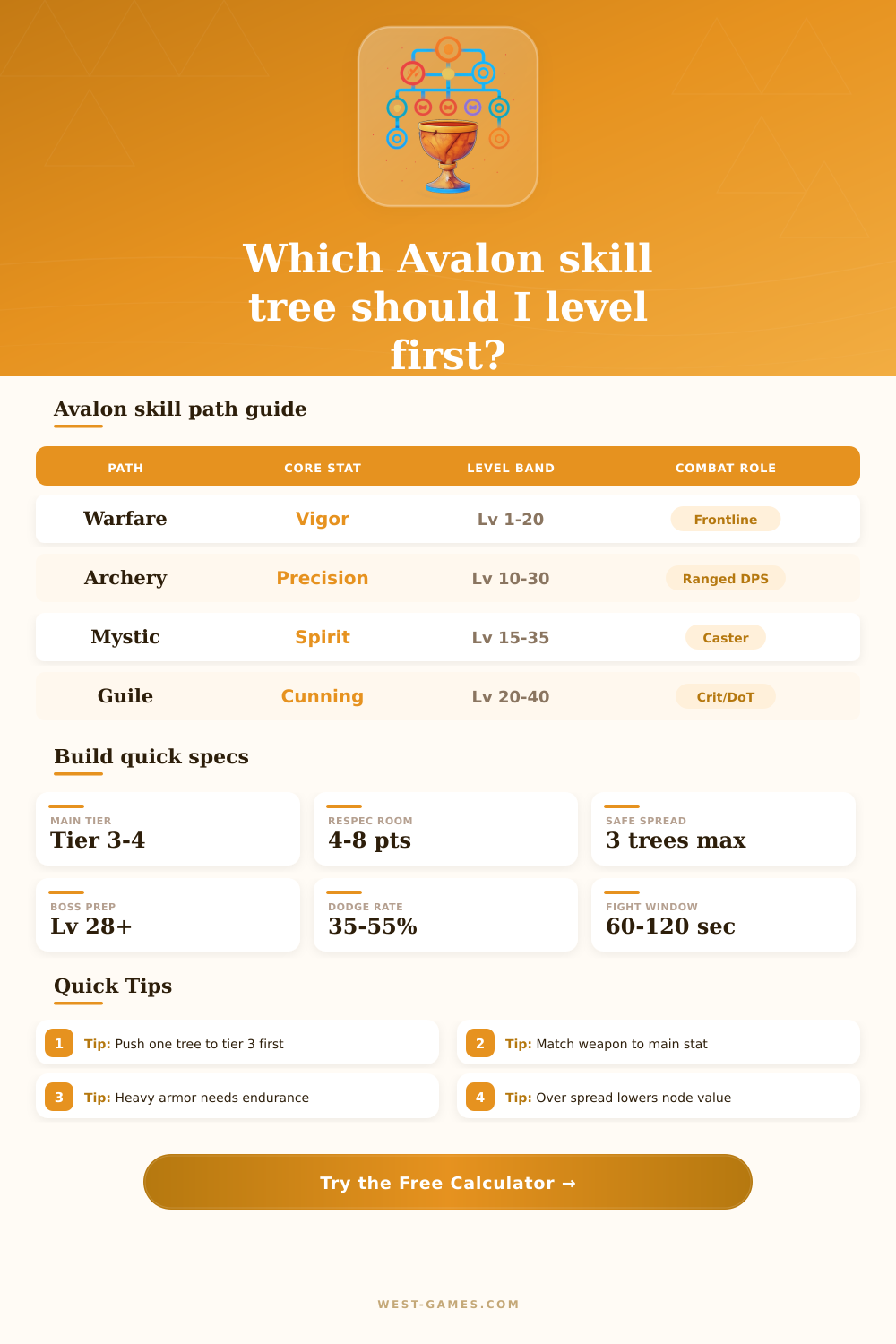
Do not spread your points across too many different tree. By spreading your points across many different tree, you will dilute the progression you will make within each tree. A diluted progression will not provide you with the best multiplier for your stats.
It is better to push your points into one tree to tier three before you begin the second tree. This same idea can be applied to your attribute. For example, if you have too much of one attribute and not enough of another, you could have an abundance of burst damage but be unable to dodge attack.
Sustain is essential in your character build and is often something that people dont consider until they are struggling against a boss fight. Your character may be able to defeat smaller enemy but fail against the bosses due to insufficient resource for the fight. The fight duration will allow you to think about your resource pool and your spend rate for skill.
If your sustain is below 90%, you should consider using lighter armor or reducing your combo uptime so that there is an even better chance of gaining additional uptime from your character’s point. There is value in comparing two different build. One build may have higher offense but require better dodge percentage to survive the fight.
The other build might be slower but have a steadier rate of success in clearing the encounter. You can compare this before spending your points on the character to avoid needing to respec later. The goal for building your character is not to reach the highest percentage of viability.
The goal is to make sure that the number on the calculator match the character’s performance within the game. When these two variable match, you will have a character build that you can trust.