🎮 Minecraft Elytra Travel Time Calculator
Estimate elytra route distance from coordinates, compare Overworld and Nether travel, count fireworks, model Unbreaking durability, and convert speed into arrival time.
Uses the full X/Z coordinate distance in the same dimension.
Uses one eighth of Overworld X/Z travel before buffer time.
Estimated seconds between rockets at the selected average speed.
Expected durability remaining after route and Unbreaking effect.
Shows vertical coordinate change so steep routes are easy to spot.
| Profile | Average speed | Best use | Time formula | Calculator note |
|---|---|---|---|---|
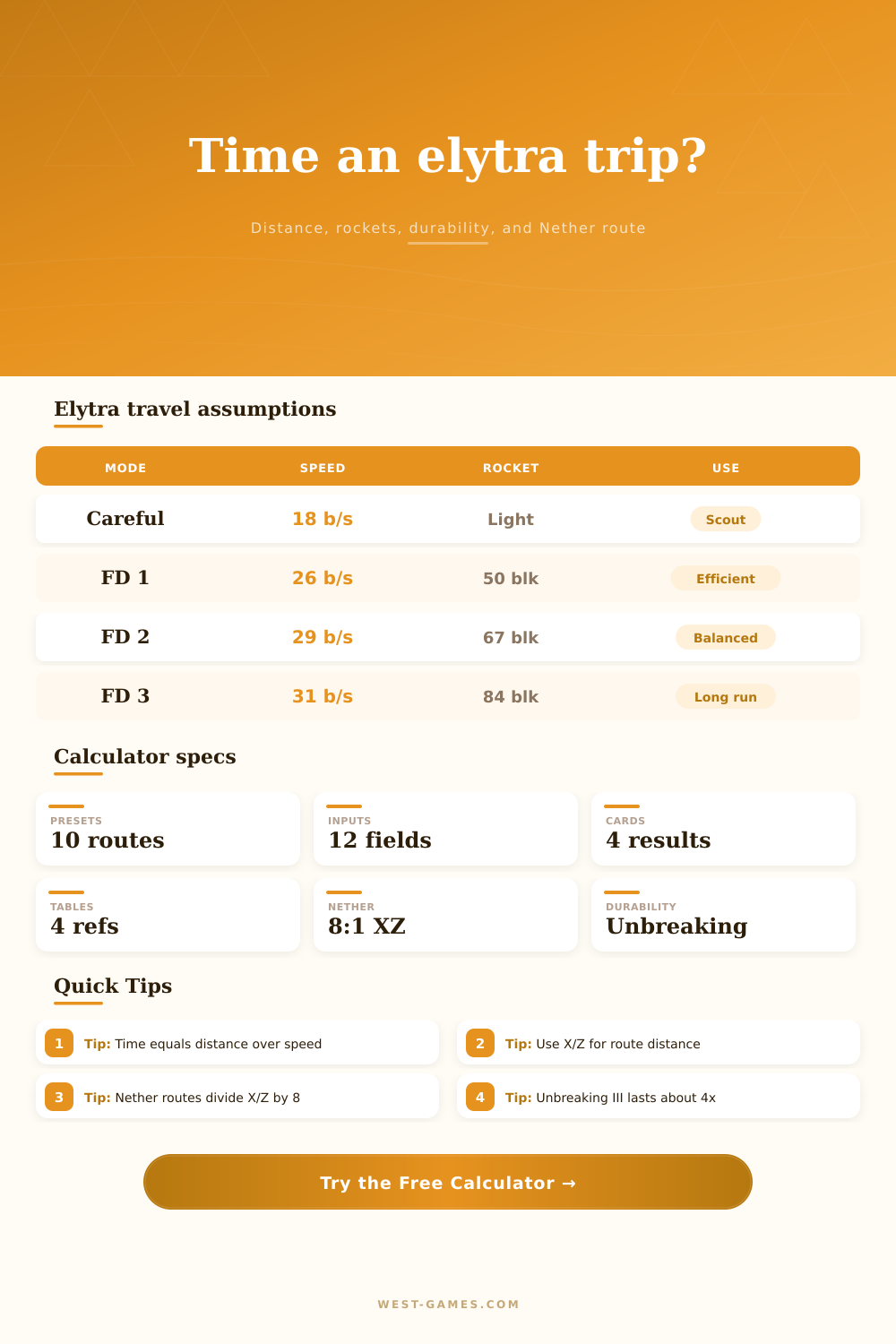
| Careful rocket travel | 18 blocks/sec | Turning, scouting, terrain reading | Distance divided by 18 | Uses slower average for course corrections |
| Flight duration 1 rhythm | 26 blocks/sec | Common efficient travel | Distance divided by 26 | Good default for regular survival flights |
| Flight duration 2 rhythm | 29 blocks/sec | Longer boosts with fewer clicks | Distance divided by 29 | Balanced speed and rocket spacing |
| Flight duration 3 rhythm | 31 blocks/sec | Long straight routes | Distance divided by 31 | Close to fast travel while allowing steering loss |
| No-rocket glide estimate | 12 blocks/sec | Descending glide only | Distance divided by 12 | Assumes no repeated firework boosting |
| Rocket setting | Gunpowder per rocket | Boost duration model | Default blocks per rocket | Count formula |
|---|---|---|---|---|
| No rockets | 0 | None | Not used | Fireworks needed equals 0 |
| Flight duration 1 | 1 | 10 x (2 + 1) ticks | 50 blocks | Timed distance divided by 50 |
| Flight duration 2 | 2 | 10 x (2 + 2) ticks | 67 blocks | Timed distance divided by 67 |
| Flight duration 3 | 3 | 10 x (2 + 3) ticks | 84 blocks | Timed distance divided by 84 |
| Metric | Formula | Uses Y? | Route effect | Calculator output |
|---|---|---|---|---|
| X/Z horizontal distance | Square root of dx squared plus dz squared | No | Base travel distance | Horizontal distance row |
| 3D line distance | Square root of dx squared plus dy squared plus dz squared | Yes | Climb/drop awareness | 3D line row |
| Direct route distance | Horizontal distance x 1 | No | Normal Overworld or same-dimension flight | Direct comparison card |
| Nether route distance | Horizontal distance divided by 8 | No | Overworld coordinate shortcut | Nether comparison card |
| Total route time | Flight distance divided by speed, plus buffer | No | Final arrival estimate | Travel time result card |
| Setting | Base rule | Unbreaking effect | Formula used | Planning meaning |
|---|---|---|---|---|
| No Unbreaking | 1x base durability | No multiplier | Expected use x 1 | Most conservative enchanted comparison |
| Unbreaking I | Chance-based durability save | About 2x average life | Expected use divided by 2 | Light enchantment reserve |
| Unbreaking II | Chance-based durability save | About 3x average life | Expected use divided by 3 | Medium enchantment reserve |
| Unbreaking III | Chance-based durability save | About 4x average life | Expected use divided by 4 | Common long-route setup |
| Glide-time model | 1 point per flight second | Divide expected points by L + 1 | Total seconds / multiplier | Classic elytra durability planning |
| Rocket-use model | 3 points per rocket boost | Divide expected points by L + 1 | Rockets x 3 / multiplier | Server or version-specific planning |
The initial rush of diving off a mountain with elytra feels like flying, not transportation. You’re going to take over the world! Then you tumble down into some trees, run out of rockets and realize that youve ended up thirty blocks away from where you started.
That’s the distinction between traveling efficient versus feeling fast. While most players is using elytra for pure adrenaline rushes, efficient long-distance travel are a math problem.
How to Use the Minecraft Elytra Calculator
What exactly do we want to measure? After plugging in your starting and ending points (the calculator is above), it spits out an approximation of how long it will take you to get from Point A to B in the real world after it has done all of the hard work of turning the difference between X and Z blocks into time. You tell it where you are, then you tell it where you want to go. Then it calculates distance horizontally between two points. That’s what counts for time.
You also tell it about the vertical change. Vertical doesn’t really count when it comes to speed. But a big climb or drop will throw off your pace and your fuel consumption. Horizontal distance is used in the final time calculation, but you still have to account for height. You don’t want to be fighting gravity or going with it.
And then there’s speed. In Minecraft, speed isn’t one size fits all. It’s whatever speed you want. There are multiple profile within the tool, ranging from slow-and-careful-scout-to-max-velocity-runs. With a run like that, eighteen blocks per second or so is fairly slow, taking into account dodges and corrections as well as the need to steer around obstacles and avoid terrain. On the other end of the scale, near thirty-one blocks per second, is a pretty fast speed but one which expects a relatively unimpeded path: a straight shot. That leaves most players in-between, typically in the twenty-six block per second range when firing off standard firework rockets. Selecting correct profile has much more to do with how straight you expect to be able to fly then how quickly you think you’ll be moving.
That’s where most trips go wrong: Fireworks management. If your route is unobstructed but you use up your boosters, well… congratulations, you’re a fancy parachute. Here’s how many fireworks it thinks you’ll need: The calculator figures that out by looking at the number of blocks covered by each rocket. Generally speaking, longer-duration rockets can travels further in one shot, but require more gunpowder to create. So there’s a balance here between spending resources vs inventory space. Then it will split total distance by its estimate of how far each rocket goes; plus add a safety margin for delays caused by chunk loading, missed boosters, and the time when you inevitably sneeze mid-journey. That safety margin is crucial.
Durability is another silent killer. Your Elytra breaks, and the trip is over. The calculator shows Unbreaking enchantments that extend how long it’ll take your gear to die. Unbreaking III will roughly quadruple your flight time. Put in how much durability you have left and let the tool calculate whether or not you has enough margin for the return trip. Better to be warned than to crash in the void.
That’s all changed in the Nether. Distances are compressed eight-fold while traveling through the Nether. The calculator takes your straight line travel time on the Overworld then compares it to the Nether short-cut. For longer trips, it makes a huge difference despite the extra time going into and out of portals. You pay an up-front cost for setting up portals and managing vertical movement but you get pure horizontal efficiency back in return. It’s just a matter of multiplication but it translates into hours of flight saved.
The math matters, but you don’t have to be a mathematician. Your rockets matters. Your durability matters. The Nether route matters. The little checks make for a controlled flight instead of a desperate glide. It’s a big world out there but if you do the math, you can feel like you’re managing it. And as your gear tells you to slow down, keep in mind that while the straightest line is sometimes the fastest, it isn’t always.
You should of checked the math first.