⛏ Rust Sulfur Farming Calculator
Estimate sulfur ore from nodes, small rocks, Mining Quarry diesel, Giant Excavator diesel, tool timing, smelting output, charcoal demand, explosive conversion, and the farming time needed for a raid plan.
| Explosive | Quantity | Sulfur each | Total sulfur | Charcoal estimate |
|---|---|---|---|---|
| Run the calculator to fill explosive rows. | ||||
| Tool | Ore per node | Normal duration | Hotspot duration | Use case |
|---|---|---|---|---|
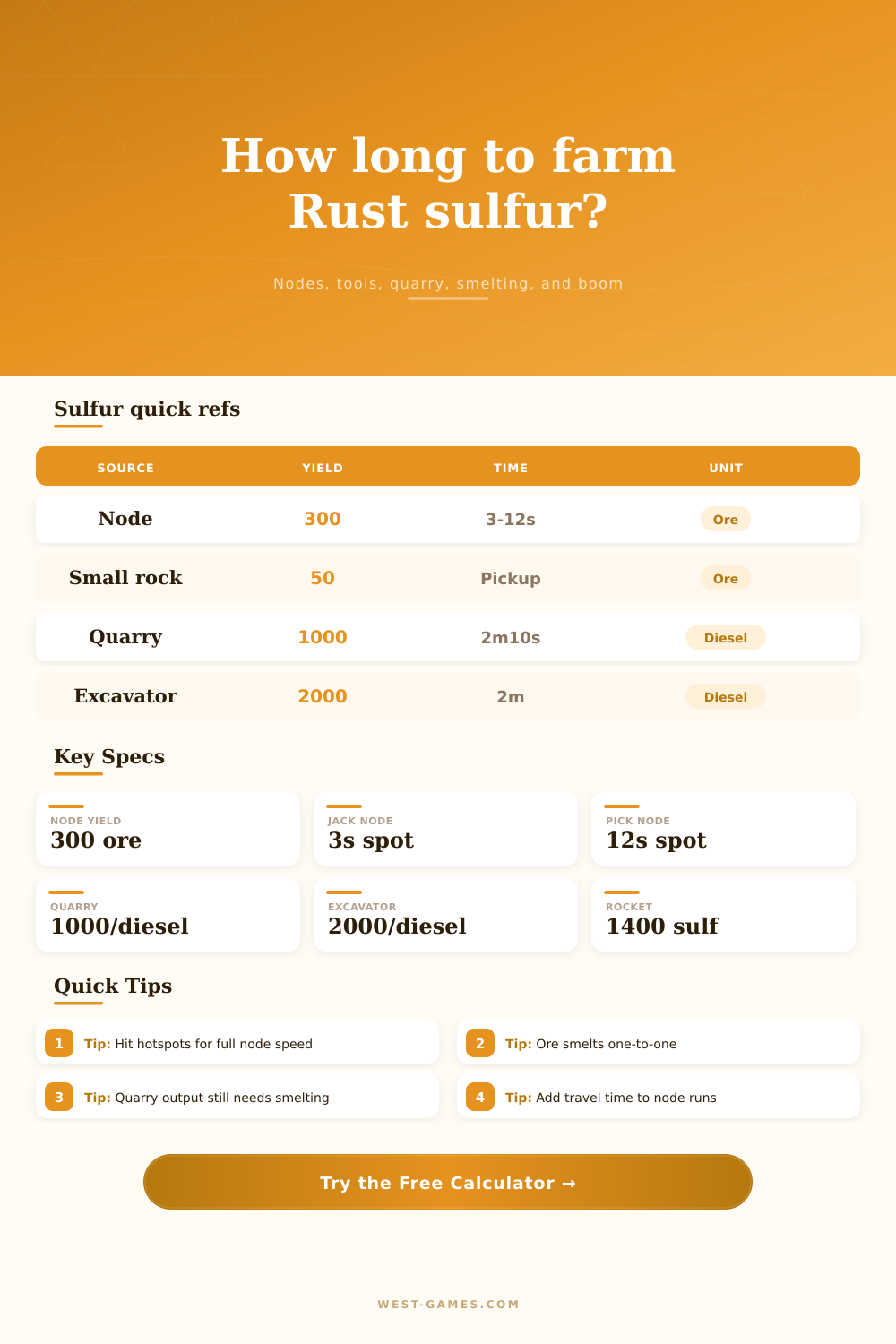
| Jackhammer | 300 sulfur ore | 4 seconds | 3 seconds | Fastest node clear when fuel and repair access are available. |
| Salvaged icepick | 300 sulfur ore | 14 seconds | 8 seconds | Strong manual option with full yield and quick hotspot mining. |
| Pickaxe | 300 sulfur ore | 27 seconds | 12 seconds | Cheap full-yield fallback when you do not have a jackhammer. |
| Stone pickaxe | 257 sulfur ore | 28 seconds | 11 seconds | Early-wipe tool with lower node yield. |
| Rock | 100 sulfur ore | 66 seconds | 25 seconds | Emergency only; the time cost is severe. |
Hotspot timing assumes the player consistently hits the glowing marker. Missing hotspots keeps the same full-yield tools slower, not richer.
| Source | Diesel output | Machine time | Output type | Calculator behavior |
|---|---|---|---|---|
| Sulfur Mining Quarry | 1,000 sulfur ore per diesel | 2 minutes 10 seconds | Ore | Counts diesel output, then applies smelting if enabled. |
| Giant Excavator | 2,000 sulfur ore per diesel | 2 minutes per diesel | Ore | Counts diesel output, then applies smelting if enabled. |
| Scattered sulfur rock | 50 sulfur ore pickup | Pickup | Ore | Adds small-rock ore to the farmed total before smelting. |
| Custom multiplier server | Scaled by gather rate | Scaled output | Ore | Multiplies node, small-rock, quarry, and excavator ore. |
| Item or setup | Value used | Output | Why it matters |
|---|---|---|---|
| Sulfur ore smelting | 1 ore to 1 sulfur | Raw sulfur | Farmed ore and machine ore become equal sulfur after cooking. |
| Furnace | About 1.67s per ore | Slow queue | Small bases need more furnace count or more time. |
| Electric furnace | About 1s per ore | Medium queue | No wood math, useful for steady indoor processing. |
| Large furnace | About 0.33s per ore | Fast queue | Best for turning a large farm run into craft-ready sulfur. |
| Gun powder | 20 sulfur per 10 | 3 charcoal per GP | Explosives need sulfur plus large charcoal reserves. |
| Explosive | Sulfur each | Charcoal each | Recipe-chain note | Common planning use |
|---|---|---|---|---|
| Rocket | 1,400 | 1,950 | 150 gun powder plus 10 explosives. | Doors, walls, splash damage, raid cores. |
| Timed explosive charge / C4 | 2,200 | 3,000 | 20 explosives per C4. | Fast single-target wall or door damage. |
| Satchel charge | 480 | 720 | Four beancan grenades per satchel. | Early raiding with unstable detonation timing. |
| Explosive 5.56 ammo | 25 | 30 | Per round, after gun powder and raw sulfur. | Precise door, turret, and cleanup damage. |
| High velocity rocket | 200 | 300 | 100 gun powder per rocket. | Vehicle, heli, or utility use rather than splash raiding. |
| Beancan grenade | 120 | 180 | 60 gun powder per beancan. | Satchel chain, traps, and low-tier pressure. |
“I always dread my raid timer ticking down while I’m scrambling to get some sulfur in order to make more rockets.”
Chances are that you’re not short on resources, you’re just misjudging the amount of time it’ll take to find ore, carry it back to base, smelt it into bars, and turn those bars into whatever material you desire. Sulfur nodes aren’t just resources; they’re a time sink with a travel cost associated with them. Treat them accordingly and you’ll have no problem with the next raid.
Plan Your Raid Resources
Farming is a logistics operation, not a combat one, and it’s a crucial aspect of most successful raids. Based on how much explosive power you want to have, the calc (above) will tell you exactly how many nodes you need to hit. It’s backwards engineering, but it stops people from just mindlessly farming until they’re happy; happiness isn’t an objective.
Firing four rockets takes roughly 5,600 sulfur, or around nineteen nodes blasted with a jackhammer at hot spots. Travel time between each node is taken into account in the calculator, something many players forget about till it’s midnight and they’re running across snow. With overhead factored in, it becomes a real plan rather than a fantasy.
And then there’s the tools themselves. This is what determines everything. If you use a jackhammer, you’ll mine down hotspots in three seconds flat…but you burn fuel, and need access to fix that. With a pickaxe, it’ll take you a dozen seconds per hotspot. Not bad…until you multiply it by twenty nodes. That translates into extra three and a half minutes spent just mining. Which is precious minute you don’t have if raiders are patrolling the area.
The tool shows you this in its own reference table, where you learn that trying to farm with rocks and a stone pickaxe will increase your mining time well past something you can manage. Go cheap early, sure, but you’ll be paying in terms of exposed time.
The one thing that kills a lot of raid preps is this: Bottleneck, Smelt. You can finish farming sulfur in twenty minutes. But with just two small furnaces, the ore sits in your depot for an hour before it’s usable. The calculator includes smelting time based on your furnace setup, so you has to consider it as part of the process. It’s not something you do afterwards. It’s something you do while you’re still out getting the ore. The only way to keep moving is by doing things at the same time. Waiting till you get back and have all the ore to smelt? You’ve already lost the initiative.
Machines made of diesel radically shift things. They eliminate the chance of where you find resources: a massive digger or sulfur quarry guarantees a fixed amount of ore per bar of fuel, making them more reliable. But they need to sit on some kind of solid ground and they need plenty of diesel, too. Enter the diesel bars into the calculator, it’ll tell you how much ore will be generated from your diesel, helping determine whether it’s better to secure the machine, or just wander around nodes.
It even takes into account the need for charcoal to convert into powder, a reminder that sulfur alone doesn’t do anything. You can have all the sulfur you want, but many raids fails because the charcoal stack is empty.
So in conclusion: Farming sulfur is a risk management game. It’s about giving up some time and security in exchange for resources that will only mean anything if they’re used properly. And the numbers are there thanks to the calculator. It’s up to you to be disciplined enough to follow them.
Rust isn’t perfect, so add a buffer for any missed shots or failed crafts. Then, when you plan out your next raid, begin at the end and work backwards. Let the tool tell you how many nodes to go for, not how many you’d like to hit. Remember, you’re trying to get back to base with what you need, not a new personal best for ore collected.