🔥 Rust Smelting Calculator
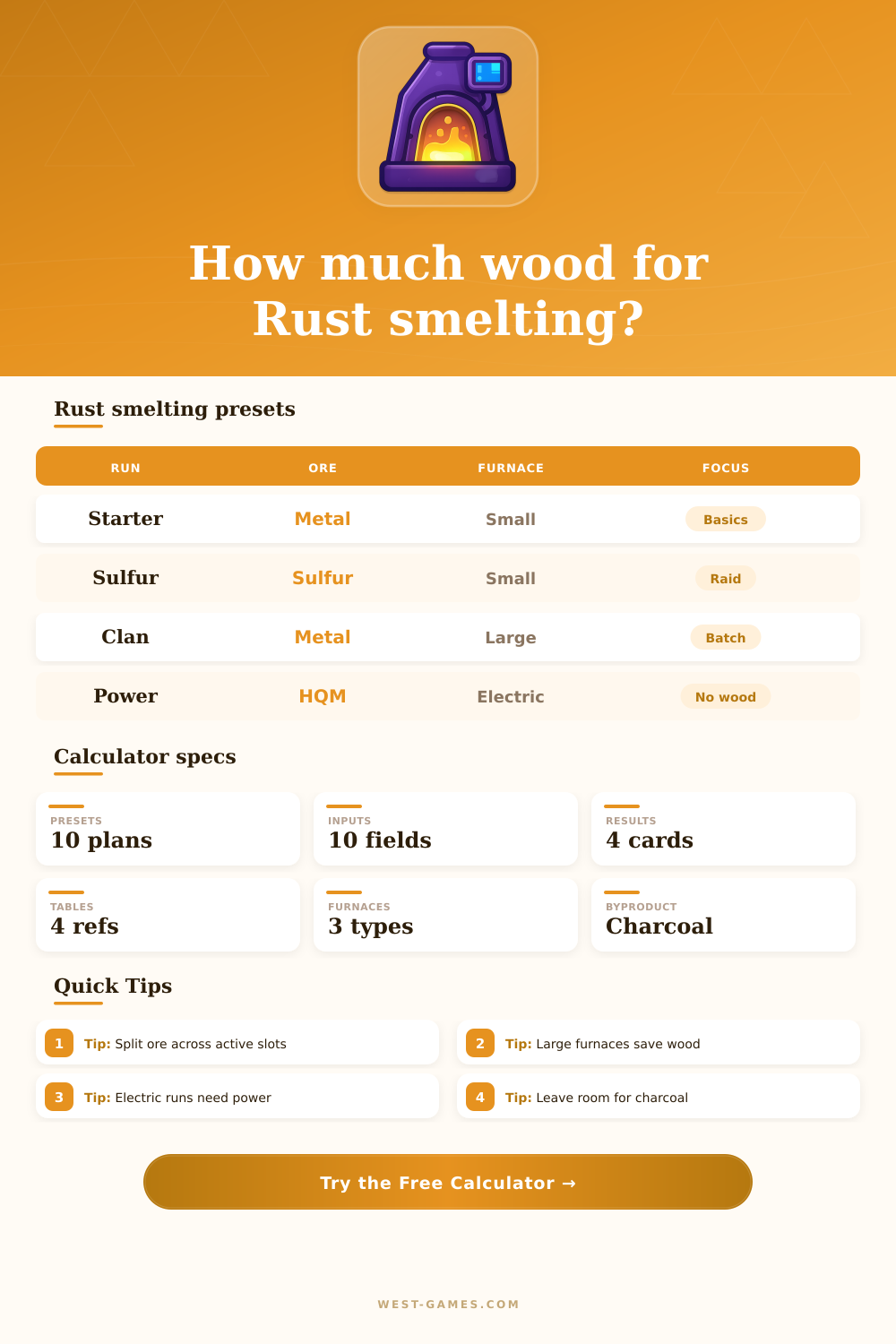
Plan Rust furnace type, ore quantity, wood or electric power, metal fragments, sulfur, high quality metal, charcoal byproduct, slot splitting, large furnace timing, and total batch time.
| Ore type | Output | Small wood | Large wood |
|---|---|---|---|
| Metal Ore | Metal Fragments | 1.67 per ore | 0.33 per ore |
| Sulfur Ore | Sulfur | 0.83 per ore | 0.17 per ore |
| HQM Ore | High Quality Metal | 3.33 per ore | 0.67 per ore |
| Any ore electric | Matching output | 0 wood | 0 wood |
Electric furnace runs are treated as wood-free. The calculator reports required power state instead of fuel burn for electric setups.
| Furnace | Metal | Sulfur | HQM |
|---|---|---|---|
| Small furnace | 6.5 sec | 2.5 sec | 13 sec |
| Large furnace | 3.3 sec | 1.5 sec | 6.5 sec |
| Electric furnace | 4 sec | 2 sec | 8 sec |
| Parallel effect | Time divides by active ore slots and furnace count | ||
Times are practical planning rates per active slot item. Server mods, item movement, and clogged outputs can change the real run.
| Setup | Ore splits | Keep free | Best use |
|---|---|---|---|
| Small metal | 3 ore stacks | 2 slots | Starter metal and charcoal |
| Small sulfur | 4 to 5 ore stacks | 1 slot | Fast sulfur if watched |
| Large furnace | 5 ore stacks | 5+ slots | Big ore boxes and clans |
| Electric line | 2 ore stacks | Output path | Automation and no wood |
The warning in the result breakdown is based on free output slots, charcoal production, and whether the setup needs wood.
| Preset | Furnace | Ore | Goal |
|---|---|---|---|
| Starter Metal Furnace | Small | Metal | Early base doors and tools |
| Solo Sulfur Run | Small | Sulfur | Small raid prep |
| Large Furnace Metal | Large | Metal | Box-level smelting |
| Electric Metal Line | Electric | Metal | Powered no-wood smelting |
| Raid Prep Mix | Large | Sulfur | High sulfur throughput |
Presets are editable. Use the custom inputs when your base uses industrial conveyors, modded stack sizes, or altered server rates.
In Rust, there’s always this fear of running out of wood and having more ore than needed. You’re stuck staring at your resources as they gathers dust while your furnace burns through its own supply of wood before the sun sets.
This smelting calculator gets rid of that worry. Resource management become a simple math problem. Now you don’t have to spend time fretting over a slowly advancing progress bar when expanding your base.
How to Use Smelting Calculator
Most problems in Rust don’t stem from the ore, it’s slots and fuel logistics that does people in. “I’ve got all this wood,” you say, only to watch it dissapears in moments as an inefficient rate sucks down your precious timber like nothing. The tool will handle those math problem for you. Should you pick up some more stuff? Is there a way to squeeze more out of what you’ve got?
That’s important since every second lost smelting is another second not building defenses or raiding. New players misunderstand how slot splitting work. Items don’t go into furnace alone. They go into it based off how much output space there is, and what’s currently in input slots. That means that if you fill up all the slots with ore without leaving any room for charcoal, it won’t work at all.
The calculator takes this friction into account. It will warn you if your setup is too tight so that you don’t accidentaly block off your production line. Freeing up one or two slot for output might take an extra moment now, but over time, it will save hours.
But with big furnaces, everything changes. Big furnace consume far less wood for each unit of ore produced. In fact they are significantly more fuel efficient than their smaller counterparts, often requiring only a fraction of the wood per unit of ore. That’s why veteran clans builds big furnace walls up front. It costs big bucks: lots of metal frame, lots of concrete, no getting around that. But, man, do you reap the rewards! Less chopping down trees means more minerals processed.
The numbers don’t lie: see them in the tables on this page. Upgrade your facilities and you’ll know exactly what percentage of firewood you’re saving.
For players that has figured out how to generate enough power, there’s another option: Electric furnaces. These eliminate all wood requirements. They are perfect if you are automating smelting with conveyor belts or just placing a base somewhere with little to no resources nearby. But it does bring its own restriction: Power draw. Your grid must be able to support the draw of these furnaces or else they turns off and everything you’ve been doing up until now goes to waste.
The planner estimates your overall run time versus your power capacity, allowing you to plan out exactly how much electricity your setup will require for the amount you intend to run.
Most players overlook another layer until it becomes a problem: charcoal. Wood also generates charcoal when burned. That charcoal occupies storage box space. If you’re doing a big run and don’t watch out for this by-product, it will soon fill all of your storage boxes with charcoal. Your calculator figures this by-product for you (so plan accordingly to make sure you have enough storage solutions.) Small thing on its own, but it adds up to a significant logistical nightmare when building large things.
Ultimately, that’s what smelting boils down to: flow. How do you get resources efficienty from the ground into your inventory? Anything that interrupts this process wastes your time, and in Rust, time is life. Before you start running around with random amounts of slots on furnaces, figure out how many slots you need. Figure out how many furnace you’ll need. Plan out how much reserve fuel you’re going to need. Eventually you’ll get to a point where you don’t need to look at your hopper every five seconds wondering if there’s any wood left; you just know.
That lets you play more aggressiveley. You could of been confident that your base is self-sustaining thanks to smart planning instead of panicking with last-minute runs for resources.