⚒ Vintage Story Smelting Calculator
Plan ore nuggets, metal units, alloy ratios, bloomery or crucible capacity, charcoal or coke fuel, mold count, cast output, and heat time.
| Planning item | Units | Nuggets | Use in calculator |
|---|---|---|---|
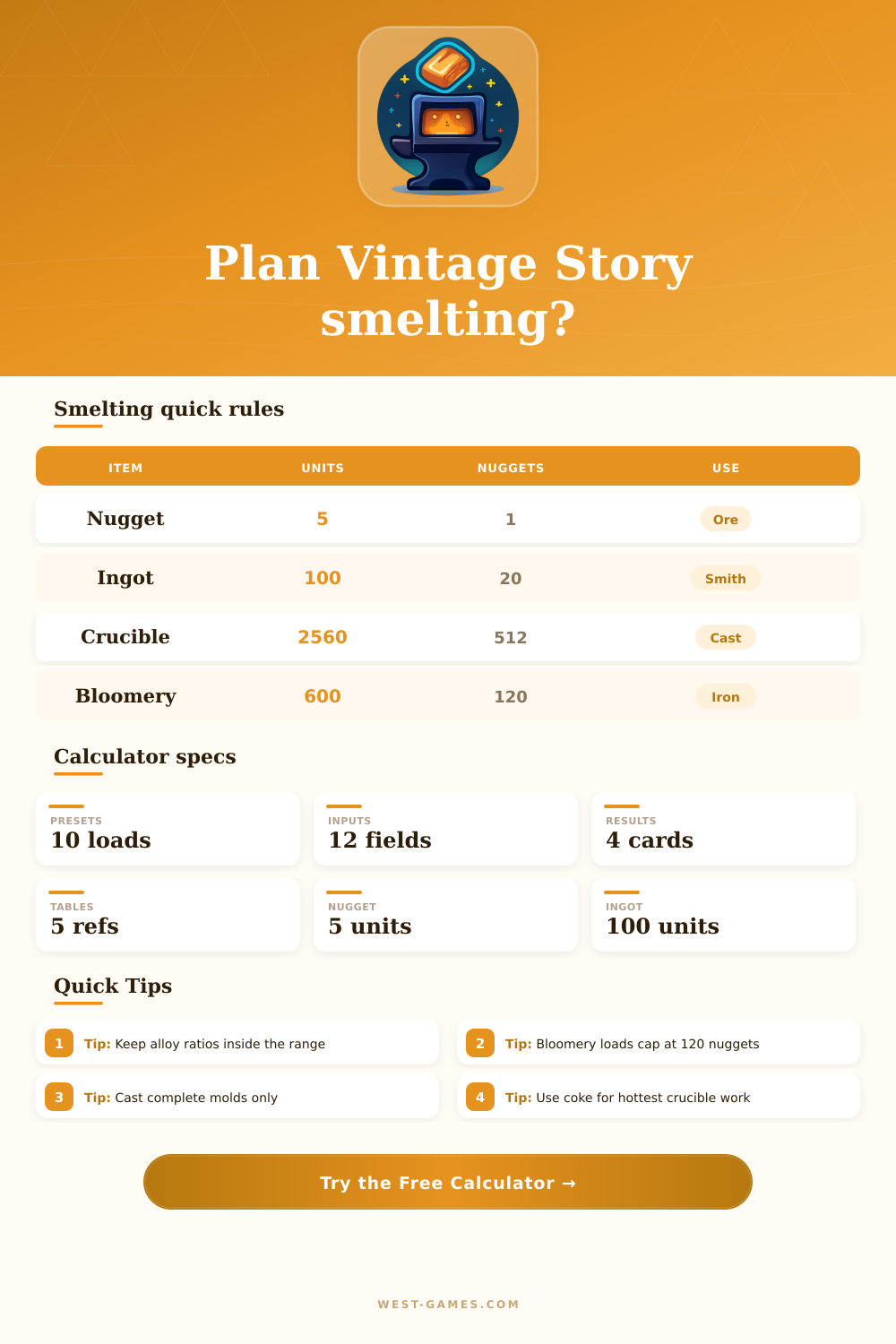
| Ore nugget | 5 units | 1 | Base input for ores and alloy parts |
| Standard ingot | 100 units | 20 | Most ingot and tool-head casts |
| Full crucible | 2,560 units | 512 | Four stacks of 128 nuggets |
| Bloomery load | 600 units | 120 | Up to 6 blooms or ingots per firing |
| Heavy target | 200+ units | 40+ | Plates, parts, and multi-ingot plans |
The calculator uses 5 units per nugget and 100 units per normal ingot or tool-head target.
| Alloy | Component A | Component B | Component C |
|---|---|---|---|
| Tin Bronze | Copper 88-92% | Tin 8-12% | None |
| Bismuth Bronze | Copper 50-70% | Bismuth 10-20% | Zinc 20-30% |
| Black Bronze | Copper 68-84% | Gold 8-16% | Silver 8-16% |
| Brass | Copper 60-70% | Zinc 30-40% | None |
| Cupronickel | Copper 65-75% | Nickel 25-35% | None |
Component labels change with the selected recipe so the percentage check stays readable.
| Fuel | Planner max | Typical route | Warning signal |
|---|---|---|---|
| Brown coal | 1,100°C | Low-temp crucible | Fails hot bronze and iron |
| Black coal | 1,200°C | Bronze and bloomery | Too cool for coke work |
| Anthracite | 1,200°C | Efficient high heat | Capacity still matters |
| Charcoal | 1,300°C | Crucible and bloomery | Below iron melt point |
| Coke | 1,340°C | Hottest crucible plan | Still not iron casting |
Bloomery and refractory routes can process metals that ordinary crucible casting cannot pour as liquid ingots.
| Target | Units each | Nuggets each | Planning note |
|---|---|---|---|
| Ingot mold | 100 | 20 | Base storage and smithing unit |
| Tool head mold | 100 | 20 | Common copper and bronze casts |
| Plate or parts | 200 | 40 | Use for heavier cast planning |
| Anvil plan | 900 | 180 | Multi-ingot planning target |
| Custom target | Editable | Units / 5 | Set exact units for modded items |
When molds are fewer than possible casts, the result card reports the pour-limited count.
| Metric | Formula idea | Inputs used | Meaning |
|---|---|---|---|
| Metal units | Nuggets x 5 + scrap units | All component nuggets and extra units | Total liquid or bloomable metal volume |
| Complete casts | Units / units per target | Target, mold count, unit total | How many usable outputs are available |
| Alloy status | Component units / total units | Selected recipe and nugget mix | Whether the alloy ratio is in range |
| Batch capacity | Units / route capacity | Route and parallel stations | Number of crucible or bloomery loads |
| Heat time | Ramp seconds + nuggets / 20 x 30 | Fuel, temp, route, start temp | Planning estimate for crucible heating |
Bloomery timing is shown as a fixed 10 in-game hour firing because it is not a normal crucible heat ramp.
The furnace is up, the ore has been collected. In Vintage Story, smelting isn’t just a matter of pushing a button, it’s about understanding chemistry and thermodynamics. Overshoot the ratio or the temperature and you waste your resources on an unsuccessful cast. Underfuel the batch and your metal will never melt. This tool does the math so that you don’t have to. It’s the link between raw materials and completed tools. Now you can concentrate on when, not how.
Nuggets are the basic unit. Five metal units make one nugget. Why does that matter? Because if you’re filling up a mold, you need to know. The mold holds a hundred units. Each standard ingot contain 20 nuggets. I learned this the hard way (i.e. I lost some partial casts. Many times there’s leftover sludge in the bottom that won’t fit into next mold. The tool above calculates it out for you based off amount of units you have. For example, how many complete casts should of I get out of my current nuggets & scrap units? And it saves you from getting frustrated after heating a full crucible. You don’t want to find yourself three unit shy of a pour.
How to Use the Smelting Calculator
Then it gets complicated: Alloying. Just because you have some bronze, doesn’t mean it’s a chunk of copper laced with whatever amount of tin happened to be in the kettle. For the game to acknowledge your metal as anything other than “copper” you’ve got to nail the right percentages, and there are tight ranges on those. Eight to twelve percent tin is a Tin Bronze. Three components, including zinc, make a Bismuth Bronze. If your ratios gets off, out come the duds. The calculator verifies your inputs against the rules. Before lighting the fire, it alerts you if you’re mixing too much of something or not enough. No need to rebalance mid-melt; saves you time.
What you can make depends on fuel choices. Fuels with lower heat limits include charcoal and brown coal. They won’t get hot enough to melt iron or higher grade alloys. In real life, charcoal burns hot. But that isn’t how it works in the game. The temperature of charcoal never gets high enough to melt even iron. For heavy metals, you need coke and anthracite. You’ll see that on the reference table on the page. One common newbie error is trying to melt iron using brown coal. All you get is waste time and a cold hearth.
Unlike with bloomery, crucible firing is different than. That alters capacity planning. With a crucible, you can process hundreds of nuggets at once: that’s a 512-nugget limit. You can make large batches of both brass and copper. With a bloomery, there is only one-hundred-twenty nuggets in each load. And it yields solid blooms, not molten metal. There isn’t room to just pour into a bloomery as if it were a bucket. Depending on which route you choose the calculator will adjust to match. When planning, don’t expect more space than your station can accommodate.
One thing, and that’s time. Time tends to get ignored until its too late at night. Run out of gas? Well, that’s on you. Didn’t plan for the cold? Not anymore. It figures out how much heat is needed based on your start temp and what fuel you have. If you preheat the furnace it takes less ramp time. Coke is a hotter fuel so that shortens the ramp time as well. This allows you to plan around the day-night cycle. Manage your hunger better. Know if there’s enough time to complete an iron run without starving. Figure out if you should stash some additional fuel just in case.
Plan for waste. Some of the metal will be lost through spillage, even if it’s a perfect batch. Losses occur during inefficient cooling as well. To ensure that you’re not coming up short, add a five percent safety margin. It doesn’t have to be a stressful guessing game anymore. It becomes a manageable production line. Collect your ore. Measure out the ratios. Load your fuel. Pour confidently.
Poor planning leads to a cluttered inventory. When you know exactly how many nuggets can go into the mold, you don’t run into this problem. Light the fire and work with accurate data.