League of Legends Ranked Placement Calculator
Project your split landing rank, LP pace, duo queue context, and target climb from previous rank, placements, MMR, and gains.
Conservative Path
Uses lower win rate and a weaker LP spread to show the rank if MMR stays stubborn.
Expected Path
Uses your entered record, MMR offset, LP gains, and planned ranked volume.
Hot Streak Path
Adds placement momentum and stronger LP gains to estimate a cleaner climb window.
Target Pressure
Compares your target rank against the projected post-placement rank and net LP pace.
| Rank band | Division structure | Calculator score range | LP movement meaning |
|---|---|---|---|
| Iron to Silver | IV through I, 100 LP each | 0 to 1199 | Large MMR swings can visibly move placement expectations. |
| Gold to Platinum | IV through I, 100 LP each | 1200 to 1999 | Strong records often convert into cleaner LP gains after placement. |
| Emerald to Diamond | IV through I, 100 LP each | 2000 to 2799 | Small LP gaps matter because duo and MMR restrictions tighten. |
| Master and above | LP ladder, no IV to I division | 2800 and above | Placement projection is treated as ladder LP after the base tier. |
| Five-game record | Rank pressure | LP pace signal | Best input to adjust |
|---|---|---|---|
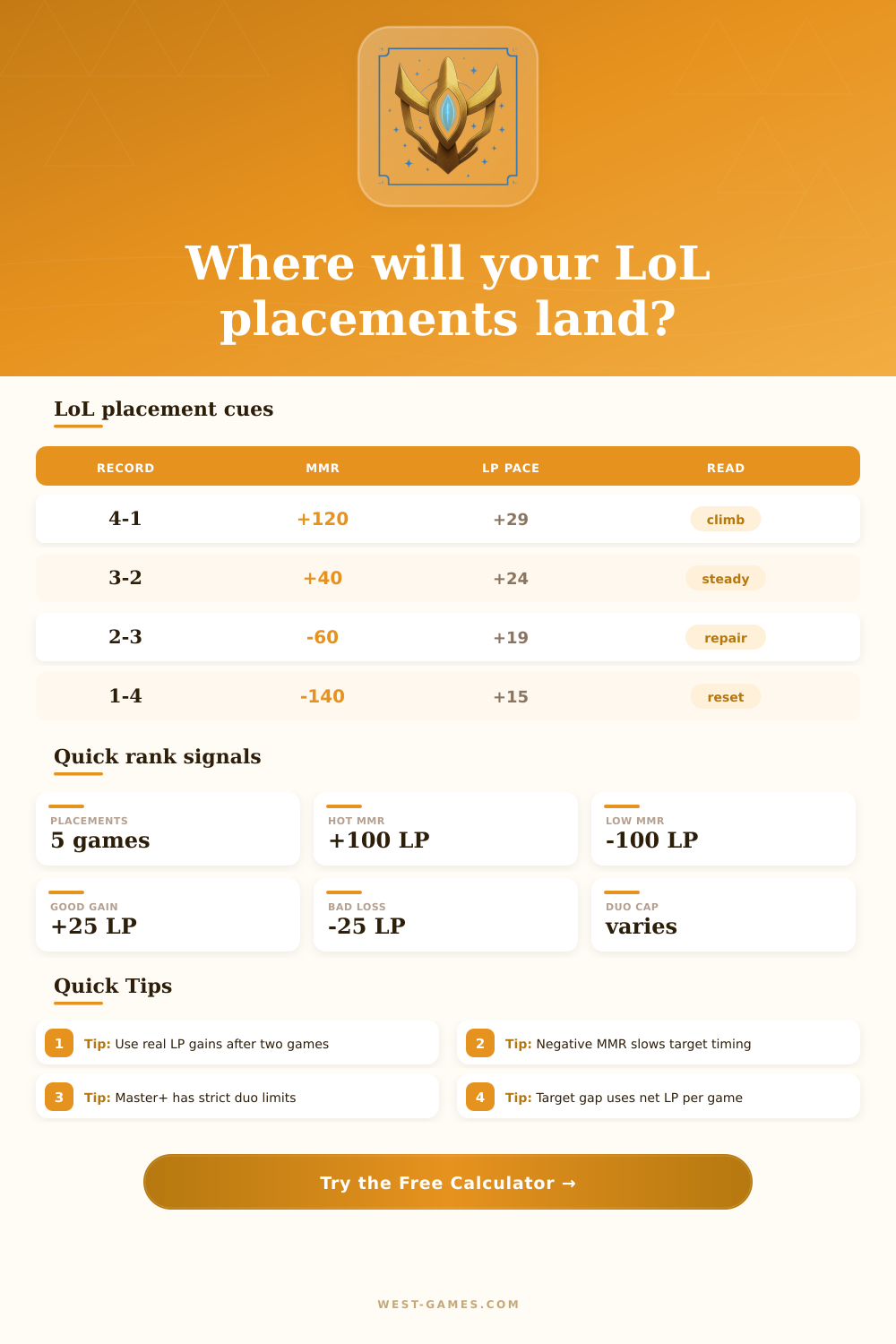
| 5-0 or 4-1 | Positive placement lift | Often supports higher gains if MMR already matched. | Increase MMR offset only if lobbies feel above visible rank. |
| 3-2 | Stable landing range | Usually keeps the calculator near the soft-reset baseline. | Use your real LP gain and loss after the first few wins. |
| 2-3 | Minor downward pull | Net LP pace decides whether the target remains quick. | Lower recent form or MMR offset if gains drop sharply. |
| 1-4 or 0-5 | Repair path | Requires positive gains or higher win rate to recover pace. | Set MMR offset negative if LP losses exceed wins. |
| Visible LP pattern | Suggested MMR offset | Calculator effect | Readout to watch |
|---|---|---|---|
| Winning gives 28+ LP and losses are below 18 LP | +120 to +220 | Raises placement score and expected win-rate ceiling. | Target gap can shrink by several games. |
| Winning gives 23 to 27 LP with normal losses | +20 to +90 | Keeps projected rank slightly above visible reset path. | Good for steady one-tier goals. |
| Wins and losses are nearly equal LP | -30 to +30 | Centers the estimate on record and planned games. | Net LP pace becomes the key result. |
| Winning gives under 19 LP or losses are heavy | -80 to -220 | Compresses placement and slows target timing. | Duo gap may widen after a poor placement set. |
| Visible rank area | Restriction style | Calculator threshold | Practical use |
|---|---|---|---|
| Iron through Gold | Broad visible-rank window | Up to about 8 divisions | Use for casual climb planning with a lower or higher duo. |
| Platinum and Emerald | Narrower rank gap window | Up to about 4 divisions | Watch the target rank if one account climbs faster. |
| Diamond | Tight visible-rank pairing | Up to about 2 divisions | Small LP changes can affect whether a duo remains viable. |
| Master, Grandmaster, Challenger | Strict high-ladder context | Solo-only warning | Use the calculator result as a red flag before queueing. |
| Target type | Useful planned games | Input sensitivity | Result to prioritize |
|---|---|---|---|
| Recover last split rank | 15 to 35 games | Placement record and MMR offset | Projected placement versus previous rank movement. |
| One full tier climb | 40 to 90 games | Net LP pace and role stability | Target gap and after-planned-games forecast. |
| Diamond push | 70 to 140 games | LP loss value and duo gap | Duo context plus conservative comparison path. |
| Master+ ladder return | 100+ games | MMR offset and win rate ceiling | Net LP pace and target pressure card. |
When queuing up for your initial placement match in the new split, you start getting anxious. Sure, you’re worried about winning. But beyond that, you wonder how many provisional matchmaking games it takes before you find out where you’ll end up. In that moment, system is attempting to pin you down. But you’re still meandering around in the fog. Do you start off on solid ground? Or do you face an uphill battle with an unseen MMR handicap? By the time someone mention this handicap, it’s already too late.
If you plug in your record and recent form, this will take away the need to guess at how those hidden variables stack up against each other. You simply enter your current form and record, and let the calculator do the work for you. It will show you what matters most. And it’s not necessarily your last tier, but rather your MMR offset, which is essentially the gap between where matchmaking system believes you should be versus what you actualy show as your rank.
How the Matchmaking System Works
On every win, you’re getting +28 LP, but only -18 if you lose. That means your badge isn’t showing how high your hidden score are. This is something most player fail to realize. Gold II? Stuck? No. They forget that they are mentally gaining momentum toward Platinum.
But placements are only five data points in a sea of noise. Sure that four-to-one record sounds great, but what if you were stomping people in Iron I lobbies? What if you lost two games to Diamond level opponent who was placed down for testing? The system is calibrated by the strength of your opponents. Two losses to Diamond peers will drop your MMR more quickly than a loss to a Gold peer.
This is why it asks how often you play the same role and how well you have been playing lately. Testing out a new pool of champions or playing in autofill add variance. The algorithm sees this as instability. It can’t accurately give you a skill ceiling yet, so it slows down your climb. The soft reset shouldn’t feel like punishment. Consider it returning to baseline.
By design, Riot wants lobbies to remain competitive. If no one retains their best LP carryover into next season, then everyone have a fair starting point in every split. Otherwise, lower elo matches become deathmatches. New players vs. Vets.
Your goal is to rapidly reestablish your secret score. You must also close the gap on your public ranking. This is where net LP pace matter. Winning more than you lose isn’t sufficient; you must win by so much that you overcome the MMR drag. You gain 25 and lose 22. Technically, you’re climbing … but it’s glacially slow. That tiny three-point cushion add up over time. In fact, many players get trapped at division walls for weeks due to this.
The addition of Duo queue complicates things, however: The system limits pairings by how far apart your ranks are when they’re visible. If you’re in a lower tier, you can pretty much queue up with anybody; it’ll help even out those streaks of bad luck. As you rise into Platinum and higher, those windows close.
The warning from the calculator’s duo context check tells you that you’re pairing with someone who’s too distant. This may force one of you to go solo, or at least put you in an awkward position where you know that you don’t stand a chance of winning without losing a couple of dozen games. That’s a useful safety valve. After all, nobody wants to spend twenty minutes playing a match just to find out that it was imbalanced due to matchmaking based off MMR. In that instance, one player had no business being there.
Your actual strategy involve management of expectations, not badge chasing. If the tool projects a landing spot lower than you hope, do not tilt. Don’t tilt. Play with stabilizing your win rate over the first several games following placements. Commit to one role that you play consistentely well. The algorithm rewards consistency. It will recognize when you have stopped feeding and are playing safe. These little tweaks add up much quicker then random luck.
You’re not trying to be Diamond or even Gold. You’re trying to establish a sustainable pace where you can keep going up without burning yourself out at each setback. Rank is a number. More important is momentum.