Queue Time Calculator
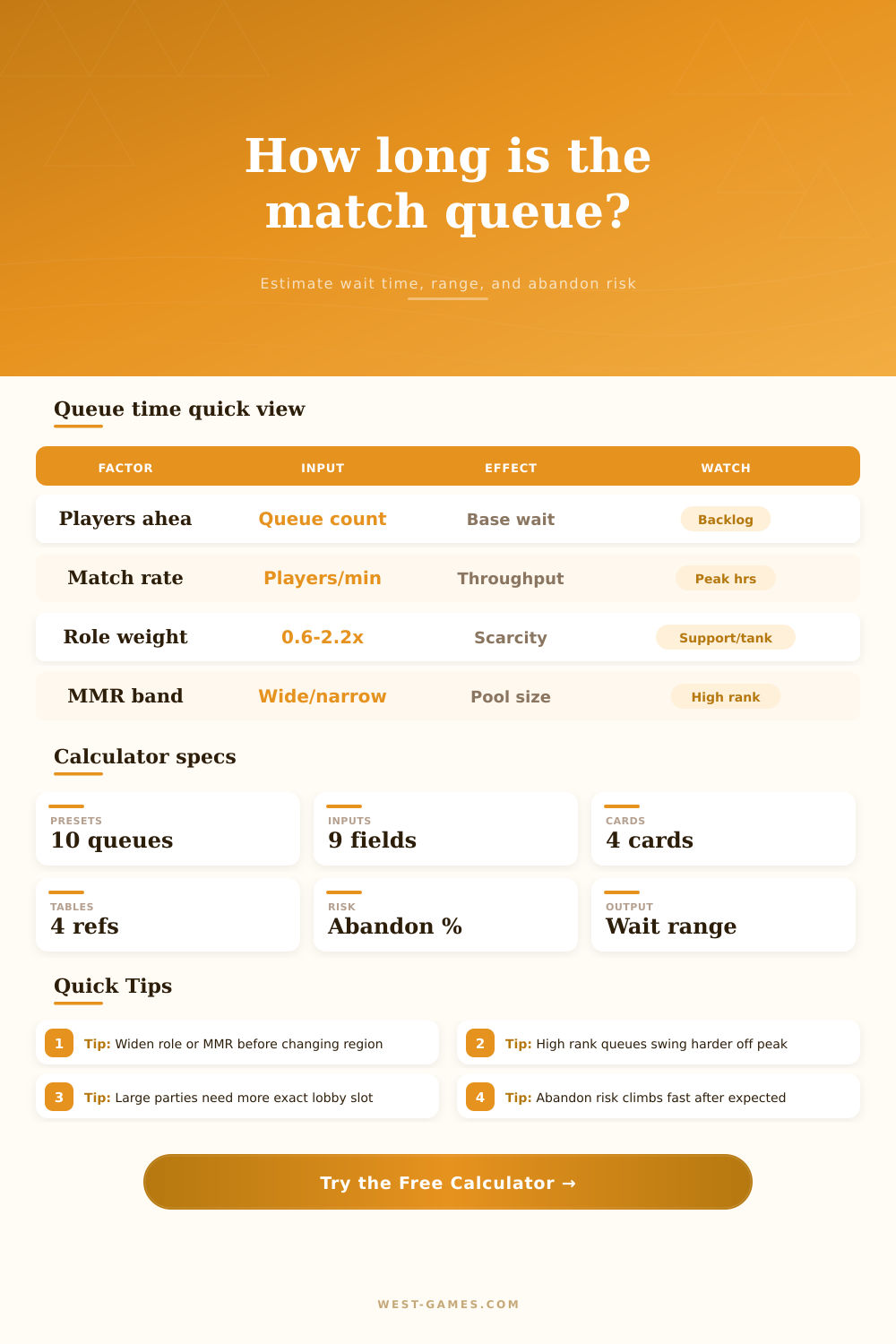
Estimate matchmaking wait from players ahead, matchmaker throughput, role scarcity, party size, region population, MMR band width, and likely abandonment risk.
How to read it: the calculator converts queue backlog into minutes, then adjusts for role scarcity, party fit, region population, MMR width, normal volatility, and how quickly players abandon or decline matches.
Queue Breakdown
Queue Pressure
Solo Same Role
Shows the same queue if you entered alone, useful when a party is causing slot fit delays.
Priority Role
Models a scarce or priority role at the same backlog, region, and MMR band.
Wider MMR
Estimates the queue if the matchmaker widens eligible skill range after a delay.
Peak Region
Models healthier population and higher placement rate without changing your role or party.
| Role state | Weight | Queue effect | Planning note |
|---|---|---|---|
| Priority or needed role | 0.68-0.82x | Shorter wait | Often tank, healer, support, or backfill role depending on the game. |
| Balanced role | 1.00x | Normal wait | Good baseline when the queue does not show role demand. |
| Popular role | 1.22-1.55x | Longer wait | DPS, carry, sniper, or high-demand lane queues often sit here. |
| Contested specialist | 1.55-1.90x | Much longer wait | One-trick or locked-role queues can bottleneck when mirrors are limited. |
| Party size | Typical multiplier | Why it changes | Best response |
|---|---|---|---|
| Solo | 1.00x | Flexible fill position across many lobbies. | Use normal MMR and preferred role. |
| Duo | 1.10x | Needs compatible team slots and enemy balance. | Pair complementary roles if possible. |
| Trio or four stack | 1.25-1.45x | Harder to match against fair party structure. | Queue during peak hours or widen role options. |
| Full stack | 1.70x+ | Often needs another stack or strict lobby shape. | Expect larger ranges at high MMR or off peak. |
| Pool factor | Fast queue | Slow queue | Calculator field |
|---|---|---|---|
| Region population | Mega region, crossplay on, peak evening | Small region, platform split, late night | Region population |
| MMR band | Wide casual search or middle ladder | Top ladder, placement games, tight ranked band | MMR band |
| Playlist health | Main ranked or event playlist | Old seasonal mode or niche ruleset | Matchmaker rate |
| Crossplay and input pool | Mixed input and all platforms | Console-only, input-locked, or disabled crossplay | Region and matchmaker rate |
| Risk | Typical wait | What players do | Mitigation |
|---|---|---|---|
| Low | Under 5 minutes | Most players stay queued and accept promptly. | No change needed unless the estimate keeps climbing. |
| Moderate | 5-12 minutes | Some players tab out, miss accepts, or swap playlists. | Queue priority role or avoid off-peak windows. |
| High | 12-25 minutes | Declines and dodges start to recycle the queue. | Widen MMR, split large parties, or change region if ping allows. |
| Severe | 25+ minutes | Many players abandon before a lobby finalizes. | Use peak times, broader roles, or a healthier playlist. |
Typically, when the spinning wheel appears, it’s because system is not “broken.” It’s just busy doing its thing. Queue math is invisible to most players, who view matchmaking as a sort of magic. But there’s nothing magical about it; it’s logical math that translates into either three or twenty minutes. The calculator up top change queuing time into plain minutes, which help you guess less and decide more.
The initial variable are role scarcity: Not all players gets matched immediately because some roles is favored by game design to keep things balanced. You wait for nine other player in your same skill bracket who picked a role similar to yours. This happens if you pick a role that only ten percent of player do. Your internet isn’t slow; the delay are caused by that distribution curve. What is a priority role? Sounds special! Actualy, that’s just a fast track in queue terms. Because demand doesn’t equal supply, stacking into popular damage-dealing slots create a bottleneck. The tool use a weight factor to reflect how crowded your lane is.
Why You Wait in the Queue
Group size play a big role here too. If you’re going solo, it’s mechanically the quickest way to get in game, because you’ll always fit into some random spot. When you form a duo or trio, there’s a bit more rigidity and the system has to identifies opponents who match your team shape but still don’t give either side an unfair advantage. That gets even tighter with larger group. A five-stack will sometimes require another full group to face off against, further shrinking its pool of eligible matches. You must choose between convenience and control, and you can see how that choice affect waiting time.
There’s also more friction added by region population and rank bands. Casual modes has many more people participating compared to high ranked queues. Tighten those skill limits and then shrink the pool of players even further; now you’re in an area where there isn’t much the algorithm can do. If it widens its net, it’ll start matching people incorrecty… And a delayed match beats a bad one every time.
The problem gets worse during off-peak periods. What might be a quick-turning queue during a Saturday evening might clog up on a Tuesday night when the eligible pool shrink. Efficient matchmaking will slow down. When the queue time reaches five-plus minutes, people starts getting twitchy, they leave. Each of those abandonments reset the timer for everybody who’s still waiting, forcing the system to begin searching again for that spot. The result is an unstable loop: Long waits gets longer.
That’s why it’s important to know when to bail yourself out (or re-evaluate your strategy). Perhaps you should of move up/down in your MMR band. Or perhaps you should jump between regions to avoid the churn. If you’re waiting in line, you should learn to use your time well. If you don’t handle time management correctly, then time becomes a resource that gives you less and less value.
While you have no say in number of people queuing up alongside you, you can influence it by altering party size and role preference. Being efficient means knowing when to compromise, this is what distinguishes the good gamer from the frustrated one. Adjust to the math and the wheel will stop sooner.