Season Pass Completion Calculator
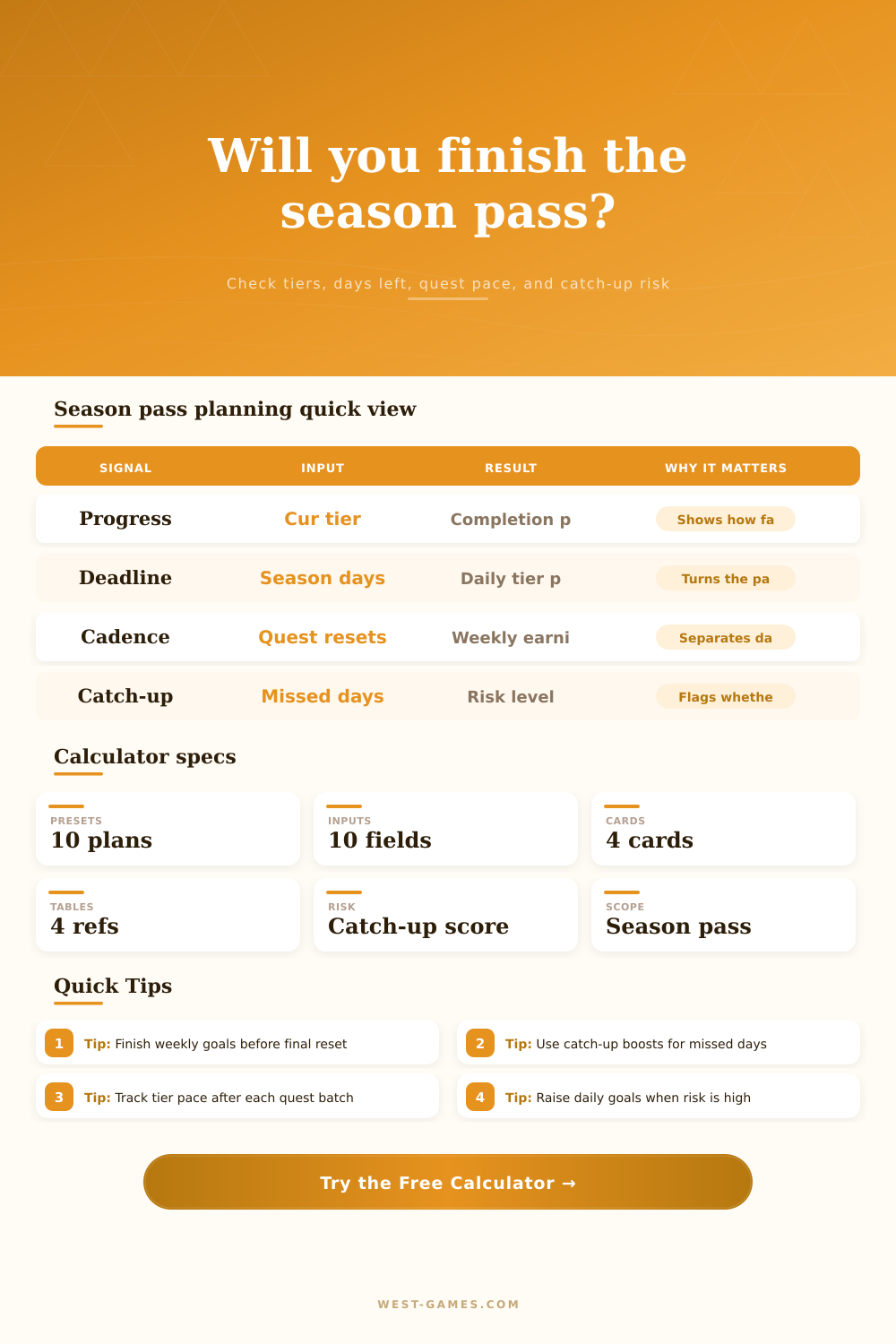
Estimate whether a season pass can be finished on time using completion percent, remaining tiers, season days left, daily play cadence, quests, missed days, and catch-up pressure.
Model note: This is a season pass completion calculator, not a battle pass tier price tool. It estimates calendar risk from remaining tiers, repeatable play XP, quest cadence, missed days, and your available catch-up multiplier.
Season Pass Breakdown
Cadence Fit
Low risk: current cadence can finish the season pass with room for a few weaker days.
| Completion | What it means | Planner signal | Action |
|---|---|---|---|
| 0%-24% | Early pass progress | Deadline matters more than current level | Build a repeatable daily floor |
| 25%-49% | Mid pass pressure begins | Weekly quests carry a lot of the plan | Do not miss reset objectives |
| 50%-74% | Finish is visible | Missed days can still hurt | Track active days and cushion |
| 75%-99% | End stretch | Small tier gaps are easy to misjudge | Use required tiers per day |
| 100% | Completed | Only bonus rewards remain | Switch to optional goals |
The calculator uses current tier divided by total tiers for completion percent, then separately models remaining pass XP.
| Cadence type | Common reset | Best input | Risk if missed |
|---|---|---|---|
| Daily quests | Every day | Average quests finished per active day | Low individually, high when stacked |
| Weekly quests | Every 7 days | Expected weekly completions | High because rewards are chunky |
| Event challenges | Limited windows | Add through catch-up multiplier | Medium if event repeats, high if one-time |
| Passive match XP | Every session | Average play XP per active day | Steady but easy to overestimate |
| Stored challenges | Backlog based | Catch-up multiplier or weekly quests | Helpful only if not capped |
Quest cadence is modeled as daily XP plus weekly XP converted across the remaining season days.
| Multiplier | Situation | What it covers | Planner caution |
|---|---|---|---|
| 1.00x | No boost | Normal play and normal quests | Best for honest baseline planning |
| 1.10x-1.25x | Small bonus | Premium pass XP, clan bonus, rested points | Good for light catch-up only |
| 1.30x-1.60x | Catch-up week | Double XP windows or stored challenges | Only works if you can play enough |
| 1.75x-2.50x | Hard recovery | Major event stacking or paid skips | Confirm caps before relying on it |
| 2.50x+ | Emergency | Heavy boosts, saved objectives, skip tokens | Likely high cost or high effort |
The calculator reports the multiplier needed to finish, so you can compare it with the multiplier you actually have.
| Risk band | Projected pace | Typical cause | Best response |
|---|---|---|---|
| Low | Projected XP is at least 10% above requirement | Healthy quest cadence | Keep the routine and protect weekly resets |
| Medium | Projected XP is close to requirement | Small cushion or many missed days | Add one more weekly or higher daily XP |
| High | Projected XP is below requirement | Too many tiers left for active days | Use boost windows or cut missed days |
| Critical | Less than 75% of required XP projected | Late start, short season, weak cadence | Rebuild the plan around catch-up sources |
Risk bands are based on projected XP divided by buffered required XP, with missed days already removed from active days.
Daily Player
2.3/dayBest when you can log in most days and collect reliable daily quest value.
Weekly Focus
14.5/weekBest when weekly quests, milestones, or reset challenges provide large tier chunks.
Catch-up Route
0.80xShows the multiplier required to finish with the current number of missed days.
Buffer Plan
10%Adds margin so one low-value session does not break the season pass plan.
After a long week I’m always afraid to open my game because I see the season pass progress bar hasn’t budged an inch. No, it’s not a matter of being upset over lost currency or skins. I fear there isn’t enough time left to complete it before reset rolls around. And that fear stems from the fact that you have no idea where you stand compared to the clock.
Most people freak out because they see their tier count and don’t bother to consider how many days they actualy have to work with after sleeping and working. Once you input your gameplay habits and current status into the season pass completion calculator, it do the math for you. Now you know if you need to sprint or chill out.
Why You Should Use a Season Pass Calculator
These raw tiers numbers can be deceptive, but it’s important to note that they don’t tell you much about your actual pace different than the deadline. For example, on paper, maybe you’re sitting at tier forty-two of a hundred; forty-two percent complete. But what does that really mean? If there are just three more days left in season, and you burned out for four others travelling or otherwise occupied, then having that 42% doesn’t mean anything at all.
What you need to know instead is what kind of daily pace you’ll need to catch up from your current tier to your target tier, and that’s where the tool gets smart. It use the average amount of experience you earn each day normally playing, plus the additional rewards granted through weekly and daily quests. That distinction is key: Passive match XP is different than quest XP. Passively earning XP increases or decreases based off your in-game performance, while quests are all-or-nothing, you either do them or you don’t. Combining both into a single lump of progress hides the danger of skipping over an easy login bonus.
In absolute numbers, weekly quests tend to matter more then daily. The reason is they reward more, and there is fewer of them per week. (And you lose more ground from missing one weekly vs. Missing several dailies.) That’s what the calculator wants to know, how many do you think you’ll complete each week? That way, it can balance those bigger chunks correctly compared to the rest of the calendar. So if your season days left are high, but you input few weekly quests, that means it flags you as having a greater risk. You’re banking on a steady drip-feed of XP, which may or may not be enough to fill in any unexpected gaps.
That’s where folks go awry. They believe that playing every day in a constant fashion guarantees completion, but it doesn’t factor in the efficiency bump you get from achieving big goals at the beginning of the week. What is the silent killer of season passes? Missed days. There’s no way in hell you’re going to do every single one of these days without missing one here and there. You might travel. Or you just need a mental health break.
Be honest with yourself when you use the calculator, how many days do you think you’ll miss? Take away those days from the remaining calendar days and that’s what we call your true active window. That’s a tougher pill to swallow than staring at end date, but it’s also far more useful. If you’ve got twenty-eight days remaining, but you know you’ll miss six of ’em, then you only got twenty-two days to get it done. That smaller number helps the tool adjust the required pace accordingly. It won’t give you an optimistic fantasy, it’ll give you a realistic target.
If you’re using catch-up multipliers correctly, it changes the whole equation. Double XP weekends, events that boost your premium pass level, saved challenge tokens that you can spend at a future date… Many of these games has some form of time-boosting mechanic. Plug a multiplier into the calculator and it’ll tell you whether you can still make your pace given those buffs. If you see that you require a 1.3x boost to hit the goal and you only have an event that gives 1.1x, you instantly know you’re running behind schedule. That’s where all that vague hope gets translated into something real. Decide whether to pony up for a skip token or just admit you aren’t going to complete this season before the clock runs out.
And let me tell you: Not completing each individual pass isn’t shameful. But knowing what will happen before time’s up? That has its own worth. The other part of realism most players overlook is the safety buffer. Adding a ten percent margin to your required pace ensures that one bad day does not derail your entire plan. That way, even if I have a bad day, it doesn’t throw the whole plan out of whack. It covers missing a quest reward that I didn’t notice and claim, or getting fewer match rewards than normal. The little buffer makes your plan more resilient instead of fragile. You want it to be strong enough that it can handle a few wrong turns without falling apart.
It’s not about whether you can finish; it’s about relaxing while playing. It doesn’t matter if you’re a weekend player who logs in casually to grind for all the rewards, or someone who grinds hard every day with one goal in mind. You will no longer has to guess whether or not you’ll get there. Know exactly how much time you need to invest each day and what needs to be prioritized. The math takes over so you can spend more time enjoying the game instead of stressing about the clock. When you’re ahead, know that you have room to breathe. If you’re behind, know that you have time to catch up, and do something about it right now. It puts the power back in your own hands until the final moments.