Playtime Cost Per Hour Calculator
Convert game price, DLC, subscription allocation, replay time, completion progress, and backlog share into a clean cost-per-played-hour accounting view.
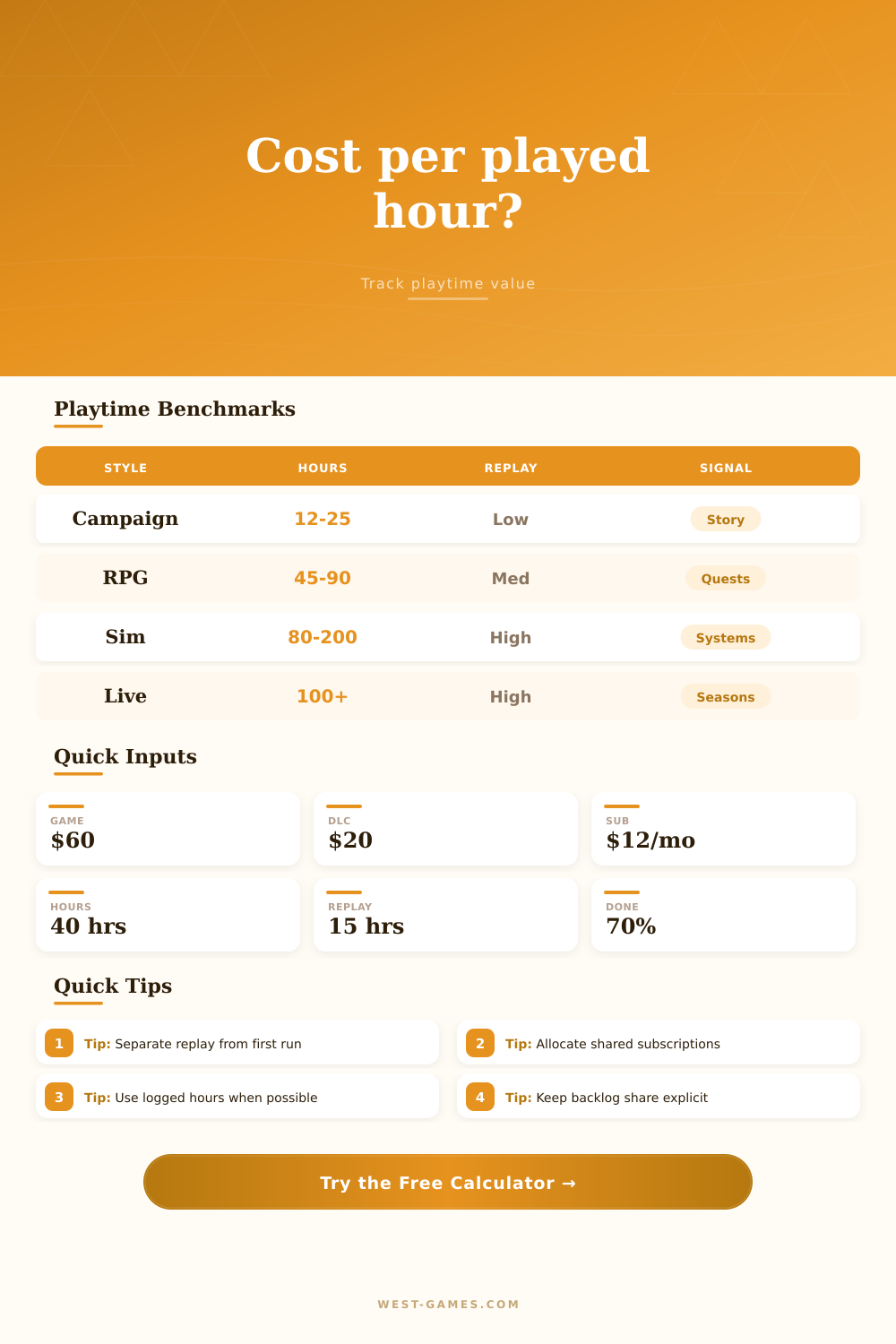
| Library Pattern | Typical Logged Hours | Replay Signal | Accounting Note |
|---|---|---|---|
| Short campaign | 8 to 15 hours | Low | Completion percent changes the read quickly. |
| Story action game | 15 to 30 hours | Medium | Post-credits hours often separate cleanly. |
| RPG or open world | 45 to 100 hours | Medium | Side content can dominate total hours. |
| Simulation builder | 80 to 250 hours | High | Replay time may be the main value driver. |
| Competitive practice | 100 to 500 hours | High | Skill practice makes replay share important. |
| Cost Per Hour Band | Reading | Useful Cross-Check | Best Input To Audit |
|---|---|---|---|
| Under $0.50 | Very high logged-hour density | Check if idle time is included. | Total hours |
| $0.50 to $1.50 | Common for long games | Separate replay from first completion. | Replay hours |
| $1.50 to $3.00 | Common for focused games | Review completion-weighted view. | Completion percent |
| $3.00 to $6.00 | Common for short campaigns | Compare expected run vs logged run. | Expected hours |
| Over $6.00 | Short-session or sampled title | Backlog allocation may matter most. | Backlog share |
| Subscription Allocation Method | Formula | When It Fits | Watch Point |
|---|---|---|---|
| Single-title month | Monthly cost x months | One game dominated the month. | Can overstate casual sampling. |
| Share of month | Monthly cost x months x share | Several games split the library time. | Share should total near 100%. |
| Backlog portion | Total allocation x backlog share | Bundles, collections, and rotations. | Keep the share consistent. |
| Completion weighted | Total cost / weighted hours | Progress tracking across saves. | Low completion can spike the rate. |
| Replay Classification | Replay Hours | What It Means | Calculator Impact |
|---|---|---|---|
| None | 0% | Single pass or sampled play. | Cost per hour relies on first run. |
| Light | 1% to 20% | Some cleanup, modes, or credits run. | Small improvement to played-hour rate. |
| Medium | 21% to 50% | New build, route, class, or co-op pass. | Replay is a visible value source. |
| Heavy | Over 50% | Practice, sandbox, seasonal, or mastery loop. | Replay dominates the accounting result. |
Logged View
Uses the exact played hours entered. This is the strictest cost per played hour result.
Replay View
Shows how much of the counted time came after the first run, unlock path, or core loop.
Completion View
Weights hours by completion percent so half-finished library entries remain visible.
Backlog View
Applies the selected backlog share before calculating the final accounting total.
At some point in every player’s life they open their digital library of hundreds of games and question if it was all worth it. They purchase games based off promises of adventure, yet the price tag never shows how little thought they actualy gave to the decision. The playtime cost per hour calculator turn the conversation away from spend and towards return on value. It ask players to consider their time played in terms of hours versus dollars to create a record for the true cost of their time.
Most libraries have complicated financial histories, so there’s more to it than just a base price. You might of gotten it through a subscription service, or you might have bought an expansion separately. The calculator prompts users for the game’s price, along with any DLC costs, as well as how much of your monthly subscription budget should goes toward each title.
How the Calculator Works
Because, franky, a lot of gamers don’t think to set aside part of their subscription bill for the exact games they was playing while subscribed. Sure, the downloaded version was free, but what about all that money you spent on the service? That represent the true cost of access, which you must assign as a percentage of your bill to the games that ate up your time.
But it’s more complicated than that… And oftentimes, replay value save the math. If you buy a game with a brief story-driven campaign and only spend a dozen hours playing through it, that may look like an expensive purchase in isolation. But what if you returned to the game for several replays? What if you spent weeks learning a challenging mechanic? Those additional hour would greatly reduce the price tag.
The tool breaks out replay hours from your first go-around, allowing you to easily see which portion of the game’s value was generated during repeated play-throughs rather than initial exploration. That difference matter, because replay time typically feels less expensive, even though it costs the same amount of money.
There’s also a second layer of realism that goes beyond straight-up hour counting: Completion percentages. How many games do any of us finish? If you stop playing a game halfway through, you have paid full price for only half an experience. The calculator accounts for that too, by weighting your hours based on how much of the game you did in fact consume. So it keeps from tricking you into thinking that spending ten hours with a sixty-hour epic count as the same thing than completing a ten-hour indie gem. Your completion-adjusted rate will reflect what you really got, rather than what you could of gotten.
It takes a little brainpower to split up subscription time, but it results in much clearer data. Splitting the bill by the number of games you play when you’re subscribed provide a better benchmark than charging all your furnitures with the full subscription rate. For instance, if you played three games during your subscription period, they’ll be billed as such, a fraction of the total per game rather than the whole price attached to just one. This prevents a large RPG from taking up the whole month’s cost and lets smaller games count for what you actualy played them for.
There are some reference tables on the page that put what you see in context with regular game playing behavior. You can then see what sort of hours is typical across different games and how much dead weight might be in your game library based off your own play time. This adds more detail to those numbers so you know how they compare to a baseline. It also gives you concrete ideas about how well you spend money versus what you like.
At its core, though, it’s a matter of perspective: it’s less about saving money and more about becoming aware. After all, when you see the actual cash-to-fun conversion rate without marketing spin, you may discover that smaller, denser games appeals to you. You might prefer them over vast expanses that tire you out before you can finish them.
Plug in some actual numbers into the calculator above and let it do the arithmetic for you; managing your game library will never be a guess again. But knowing how much an hour is worth doesn’t make you avoid pricy titles anymore. It makes you begin appreciating which ones are worth your time and which ones collect dust on your hard drive. It lets you recognize when a simulation game give you hundreds of hours of joy at a fraction of a dollar per minute. The value wasn’t hidden from you; it’s been there all along. You simply wanted to count it correcty.