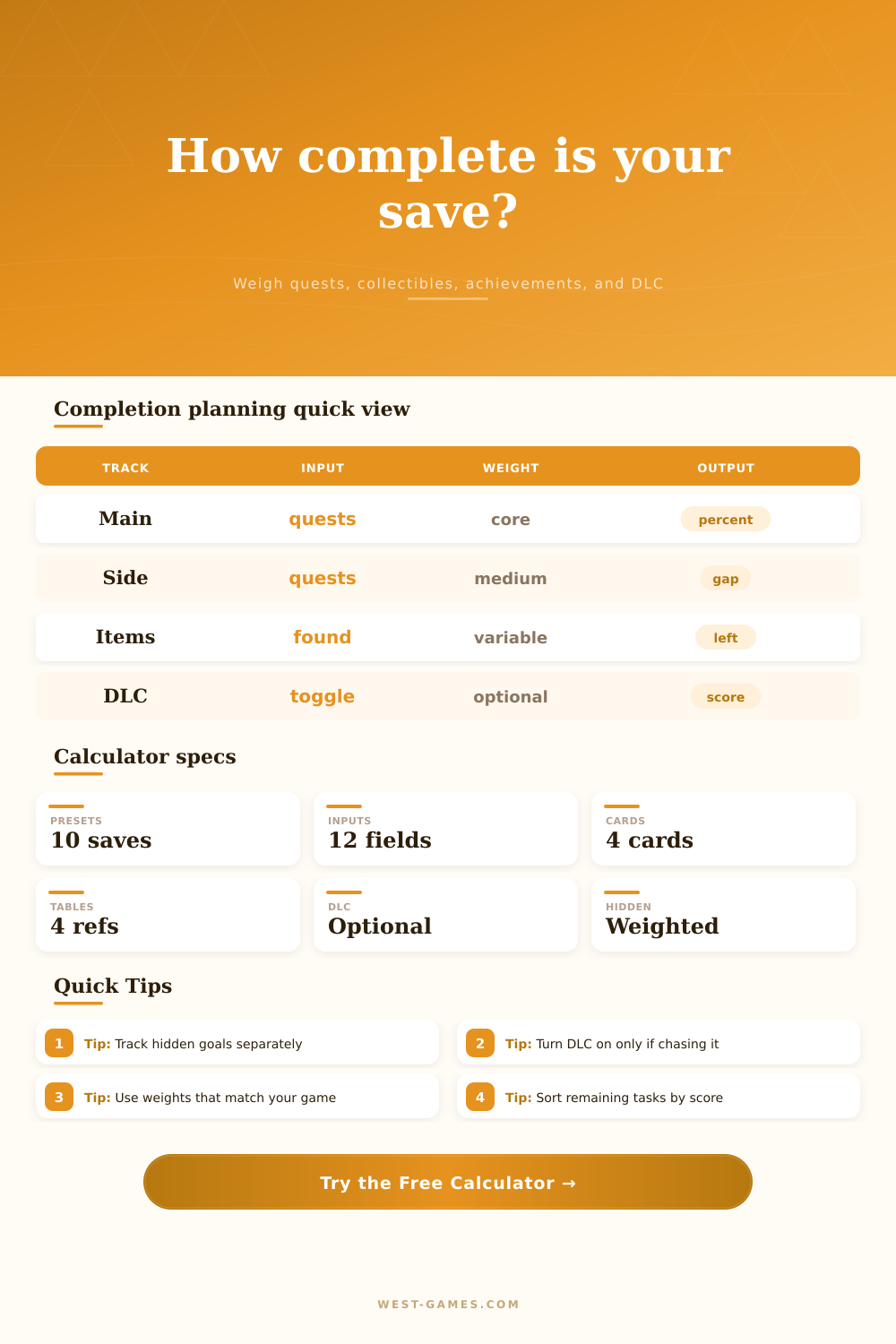
Game Completion Percentage Calculator
Estimate a weighted save-file completion percentage across main quests, side quests, collectibles, achievements, DLC, hidden objectives, and the remaining tasks that still move the final score.
Weighted model: Pick a weighting profile, enter completed and total counts, then decide whether DLC and hidden objectives should count toward the final completion percentage.
Weighted Breakdown
Remaining Task Plan
Shows each active category, its completed count, category percentage, weighting, and weighted contribution.
| Category | Progress | Category % | Weight | Contribution |
|---|---|---|---|---|
| Run the calculator to load category rows. | ||||
A higher score means that finishing one more item in that category moves weighted completion more.
| Task Type | Left | Score per Task | Est. Time | Best Use |
|---|---|---|---|---|
| Remaining task rows load after calculation. | ||||
Use the profile that matches how your game reports completion or how you personally define 100 percent.
| Profile | Main | Side | Collectibles | Achievements | Best Fit |
|---|---|---|---|---|---|
| Balanced adventure | 35% | 25% | 20% | 15% | Open world saves with mixed quest and item tracking. |
| Story focused | 60% | 20% | 8% | 8% | Campaign-first games where optional lists matter less. |
| Completionist checklist | 25% | 25% | 25% | 15% | Files chasing a broad in-game 100 percent marker. |
| Trophy and achievement | 25% | 15% | 15% | 35% | Platform trophy runs and achievement cleanups. |
| Collectible heavy | 20% | 20% | 40% | 10% | Map-based games with dense item or scan logs. |
| Custom weights | Manual | Manual | Manual | Manual | Use when an in-game tracker has known category weights. |
These bands help interpret the weighted percentage and the kind of cleanup usually left in the save file.
| Band | Weighted % | Typical State | Remaining Work | Planning Note |
|---|---|---|---|---|
| Early file | 0% to 35% | Core systems still unlocking | Main quests and broad side routes | Push story unlocks before micro-cleanup. |
| Midgame spread | 35% to 65% | Many categories partly open | Mixed quests, collectibles, and logs | Balance high-weight objectives with route efficiency. |
| Endgame cleanup | 65% to 90% | Story mostly done | Optional chains, achievements, rare finds | Prioritize categories with high score per task. |
| Completion push | 90% to 100% | Small gaps remain | Hidden objectives and missable checks | Audit lists carefully because one hidden item can block 100%. |
Sometimes, when a game tells you that you’re 70 percent done, you get annoyed because you suspect the dev team only counted main story as half of it. And yet you have this high percentage on your screen, but your save file is so empty.
For most gamers, completing things is just a checklist; if there’s an item and a quest, they’re both equally weighted. That doesn’t hold up very well in big open world games, or ones that focus heavily on role playing. Hunting obscure collectibles can be much more different than just grinding through some dull side content. It can mean the difference between finishing a game resentfully versus finishing it feeling satisfied.
How to Track Your Game Progress Better
That’s where this calculator comes into play (above). Once you input your own stats, it’ll do all the work for you so you don’t have to guess what categories matters most when it comes to your overall score. First, choose an appropriate weighting profile based off what “complete” means to you as a player. If you’re more focused on the story, maybe the bulk of your run should be weighed toward main quests at sixty percent, whereas a completionist who wants to find every hidden nook and cranny would need those hidden extras to weigh heavier.
Without making this split, main stories could end up overshadowing little things that really bring a game’s world to life. After that, simply fill in your numbers for main and side quest completions, collected items, and achieved or hidden goals. Also, include whether or not DLC should factor into the equation.
The problem with hidden tasks is that they rarely appear on a map until you accidentally stumble upon them. That means your percent complete number will be artificially high, which can lull you into false sense of accomplishment. Adding these helps you see what’s really ahead: the actual list of tasks still to do. Beyond just counting the raw number of unchecked tasks off your list, the tool also estimates an overall completion score that includes their relative importance.
This tells you not just “how far along I am,” but “how far along am I toward my desired end state? The middle game spread is where most players gets hung up on time management. There are hundreds of collectibles, dozens of side quests, and several achievement sprinkled all around the map. How do you know what to focus on? Prioritize efficienty with an understanding of which tasks will make the most progress.
This is represented in the reference table on the page, where it shows how many points each category can adds to your total completion per task. For example, completing a main quest can be worth upwards of 10 common collectible finds. Know that trade off to determine if it’s worth spending an hour searching for one rare artifact or taking out a whole district full of minor enemies/notes.
Another wrinkle comes when DLC is part of the equation. Frequently, DLC brings with it a new set of achievements that might or might not contribute to the hundred percent mark of parent game. For those who are targeting a platinum trophy, leaving out DLC means it won’t confuse your primary quest by factoring into your weighted percentage. That way, you can keep your focus sharp and your goals realistic. You’ll be able to flip the switch on this option to see how much the expansion changes the grand total. This helps you decide if it’s right for you regarding your time and budget.
Here are the remaining tasks and how many more evenings or weekends it will take to finish. The cleanup pace feature turns leftover task into sessions, changing them into an estimated number of evenings or weekends to complete the credits. Handy if you need to plan around commitments (family/work), but only have so much free time. You can tweak the estimate by changing the average minutes per task. If you’re a fast runner, you’ll get there quicker then one who carefully examines every corner.
At its core, though, it’s not so much an accomplishment, it’s simply mastering your own definition of completion. Once you weigh those measures against your actual priorities, the struggle becomes the planned result instead of the mindless work. You should of weighed them before starting. It’s no longer about blindly grinding for digits; it’s about being thoughtful with every action.
Once that mindset shifts, even the tedious postgame grind becomes rewarding. You near the finish line with a save file that feels complete, not just good enough on paper.