Swiss Round Calculator
Plan Swiss rounds from player count, undefeated targets, qualifier cut, match length, table count, and total pairings.
| Players | Base rounds | Top 8 pressure | Top 16 pressure | Tables needed |
|---|
| Match length | Round block | Total event time | Single wave | Limited table note |
|---|
| Cut size | Playoff rounds | Swiss confidence | Records sorted | Use case |
|---|
| Round | Pairings | Byes | Expected undefeated | Draw affected |
|---|
Until you know how to do the math, it’s hard to organize a tournament. Single elimination is easy. Round robin is exhausting. For big fields, Swiss systems is fairer then both. But fairness comes at a cost: time and table management. Run too few rounds and you’ll never get enough resolution; people will go away angry. Too many rounds and players will burn out before reaching the playoffs. There’s no way to guess that sweet spot. It takes more than guesswork to get it right.
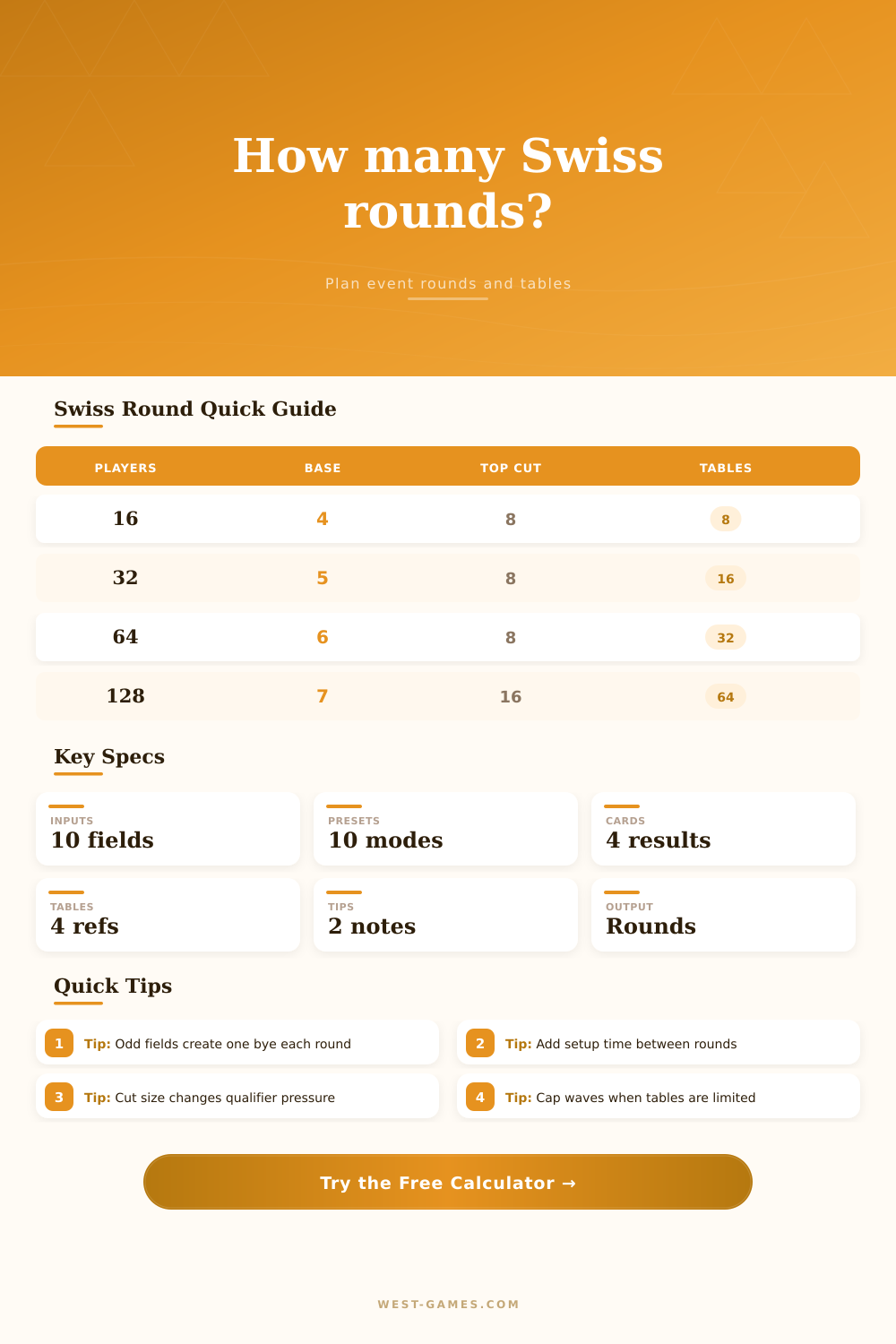
All you need to do is plug your match length (in minutes) into the calculator above along with how many players will be participating, and let it do the rest. It calculates using normal logarithmic scaling, which most people take as their base recommendation. This works because it naturaly separates the best of the bunch from the rest while not stretching the event day too far. If we expect 64 players, you type that in. The calculator comes back with a suggested round count of six. Why? Because six is statistically significant.
How to Plan Your Tournament Schedule
If you ran a four-round bracket for that many players, half of them would of have the same record and be tied together. A six-round format give enough variety to allow a clean top eight cutoff, without resorting to tiebreaker shenanigans. It’s not just what it shows you, it’s what it asks: What does your tournament need? How many people need to be in on each round? Why? Each round policy represent a bet on how final you want the tournament to feel. A standard policy is boringly sensible, while an undefeated-target policy means you’ll stretch things out a bit longer in pursuit of only the absolute best. This is a tiny knob on the whole slider but it changes the entire pressure curve of the competition.
Be mindful of table space, too. If you’ve got 64 players at a venue with only 32 tables, every round will effectively split into two waves. The calculator knows to adjust the overall length of the event accordingly. That doesn’t change the number of matches being played, only how long they last.
And here’s where most new organizers get tripped up: they’re calculating their match time but ignoring turnover. That includes pairing distribution and score reporting. It also covers seating rearrangement and necessary bathroom breaks or snack runs. Ten minutes don’t seem like much, but in six rounds that’s an extra hour to your schedule. Without a buffer, your matches are going to be rushed. Your refs will be mad. There’s even a place on the tool for this overhead time so you know when you should realistically start and end. You will no longer panic at 6 PM and suddenly realize you have two rounds to go and no tables free.
And then there’s draws. Games with ties also has undefeated records that cluster more than planners expect. To change the look of the standings, plug in your expected draw rate into the calculator. Five percent may not sound like much, but it could push an additional round to split a three-way tie for the last playoff position. Why? It shows how both qualitative and quantitative planning matter equally. No one knows their game like they do. Does your title match have a higher draw rate? Go long on your standings policy.
To run a smooth Swiss event, faster isnt always better. It’s all about managing expectations. Finishing quicker matters less to players than having enough matches to earn whatever rank they get. So use the tool to find that sweet spot between too much fatigue and not quite enough. The tables on the page have common scenarios laid out for you so you can see how different field sizes will work side by side. Tweak your round policy, play with your cut size, watch the table load shift around, and keep tweaking until the timeline looks good.
A well-run Swiss tournament won’t feel dragged out or rushed. Every player will know exactly where they are and why.