🎯 Overwatch 2 SR Calculator
Estimate visible competitive progress, rank division movement, wins, losses, calibration, streak pressure, role queue context, and next win or loss outcomes.
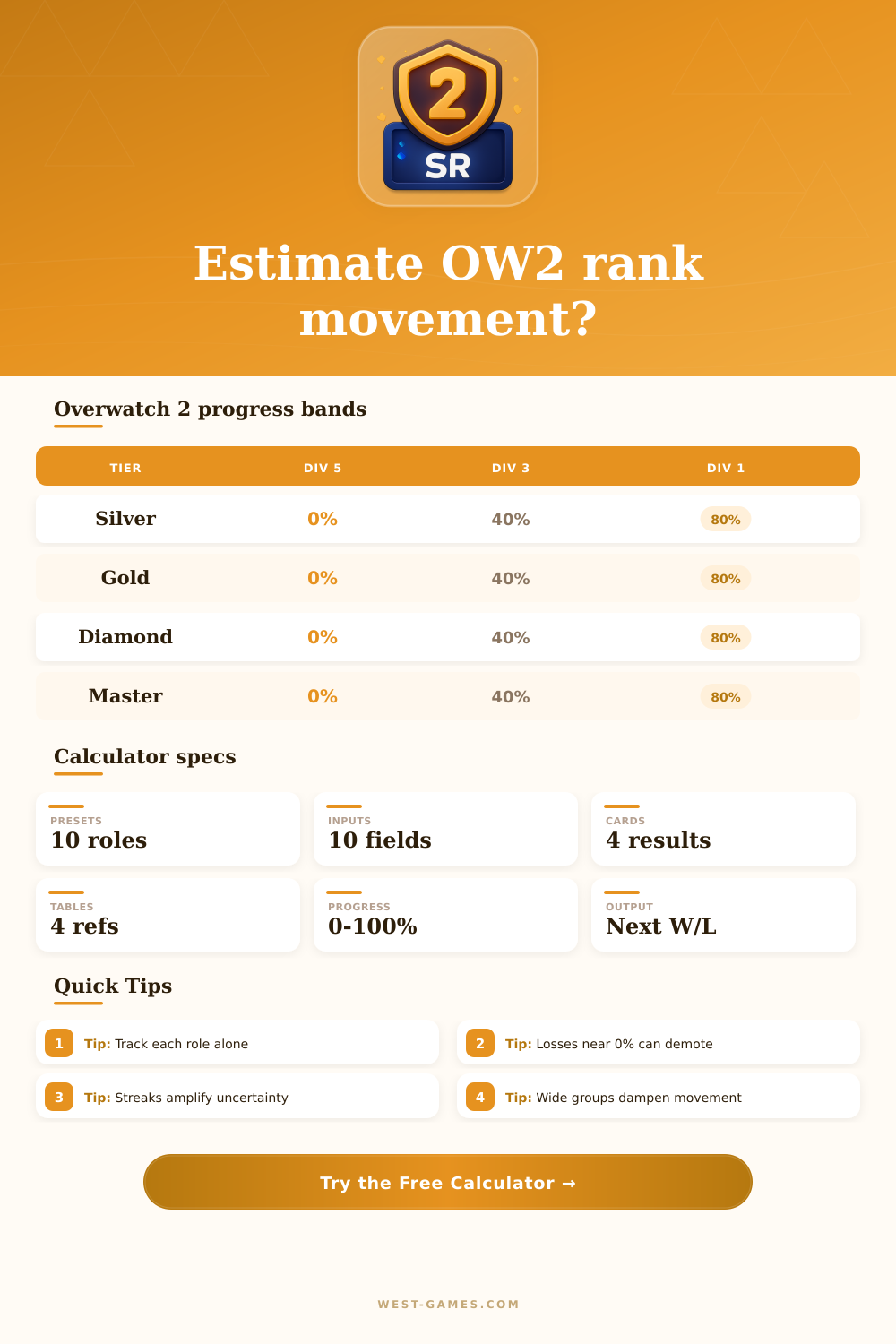
| Tier range | Division 5 | Division 3 | Division 1 | How to read it |
|---|---|---|---|---|
| Bronze to Silver | 0-99 | 200-299 | 400-499 | Every 100 points is one division |
| Gold to Platinum | 0-99 | 200-299 | 400-499 | Progress over 99 promotes |
| Diamond to Master | 0-99 | 200-299 | 400-499 | Negative progress demotes |
| GM to Champion | 0-99 | 200-299 | 400-499 | High ranks move in smaller samples |
The calculator models visible Competitive Progress with 100 points per division. It is an estimator, not an official SR readout.
| State | Win factor | Loss factor | Use case |
|---|---|---|---|
| Settled | 0.85x | 0.85x | Many recent games |
| Normal | 1.00x | 1.00x | Stable sample |
| Recalibrating | 1.22x | 1.18x | Returning role |
| Fresh card | 1.45x | 1.35x | Placement-like volatility |
Higher calibration volatility increases both gains and losses, so progress can jump or drop across divisions faster.
| Modifier | Win | Loss | Meaning |
|---|---|---|---|
| Expected | 1.00x | 1.00x | Normal lobby signal |
| Uphill | 1.18x | 0.92x | Harder match reward |
| Favored | 0.92x | 1.16x | Expected to win |
| Wide group | 0.82x | 0.90x | Noisy rank spread |
| Volatile wide | 0.74x | 0.86x | Hard to evaluate |
Group modifiers are applied separately from role and match modifiers so the breakdown stays transparent.
| Role | Base win | Base loss | Planning note |
|---|---|---|---|
| Tank | 24% | 22% | High tempo swing |
| Damage | 23% | 21% | Pick pressure matters |
| Support | 22% | 20% | Steadier role signal |
| Open Queue | 25% | 23% | Composition noise |
The base values are intentionally visible-progress estimates. Use presets to adjust for rank, streak, and card state.
Competitive Overwatch 2 is an emotional rollercoaster. Watching that progress bar tick up as you sit in the lobby are nerve-racking. One bad game and all that hard work will go away. It’s why the rank system is so hard to understand. Its inner workings is hidden by unknown matchmaking values and a estimate of your skill rating. Players believe they’re getting dinged for their losses, they’re not. They’re engaging with a complicated equation that considers each win and loss within certain context. If we understand that equation, the anxiety dissapears.
We no longer guess what caused our ranking drop. We know exactly where we fall. Not all wins count equally so it doesn’t feel like ranks moves very consistently. Winning vs better players is worth more then winning vs worse player. We call this “uphill play“. The more you have low skill ratings but still manage to win a game, the more generous the system is to you. It want to get your visible rank aligned with how well you’re playing. When you win against favorite lobby, you barely gain anything because it expects that.
How Overwatch 2 Ranks Actually Work
Why does this matter? It matters for your mindset. You don’t choose what lobbies you get put in but you can know when you’ve got an opportunity to shoot up quickly and make value from each match. And finally, context matter greatly when considering how much a rank shift will happen from a single match. Here’s where calibration is really key.
If you’re taking an extended time away from the game, or switching to a different role for example then the system doesn’t have much of an idea of what your skill level actualy is at this point. That means things become more unstable. You’ll see bigger jumps up if you win and bigger pulls back down if you lose. It’s meant to identify your actual tier faster rather than slower. But once you’ve played enough to establish some sort of consistent sample size, the movement tapers off. At that point, the system has greater confidence in its data and makes smaller adjustments accordingly. Knowing whether you’re in a settled or fresh state explains why there may be a sudden jump or drop so you don’t assume something is wrong with the system.
Psychologically, it’s also helpful to take away that extra layer of noise: streaks. While winning a few games in a row may make you think you’ve discovered some sort of bonus multiplier, usually you’re simply experiencing variance evening itself out. Losing streaks are more hazardous since you’re closer to the bottom of the division and could drive your progress percent into the red and put you at risk of being demoted. You aren’t getting demoted because you lost one game, you got demoted because you fell behind the point cutoff for your tier. Keeping tabs on both your number of wins/losses and their effect on your progress bar will help you see the cliff edge before you step off it. This page’s calculator does that work for you, plotting out just how much a win (or loss) will cost you based off your unique situation.
This will also be affected by your choice of role queue. Players who tank typically sees higher variance as they directly affect when fights start and what pace the team plays at. Damage players are pressured by pick variety which swings their impact based on map matchup. Support player usually have more consistent signals. This is because they provide a more consistent contribution regardless of composition. So open queue includes a bit of everything and that’s noisy, with each player’s impact being less clear. That is reflected in our base movement values table on the page. It doesn’t mean one role is easier to climb than another, just that how much your actions matter change based on what you play.
Ultimately, it’s not about getting perfect, it’s about managing expectations to climb ranks. You are going to tilt, you’re going to have bad games. You’ll be in lobbies that feel unbeatable. But if you learn enough about how the system works behind-the-scenes, you can distinguish what is system variance vs. It is a skill issue.
You should of start adjusting your play instead of your attitude when you get a two point win for doing something amazing, or a ten point loss because someone did something stupid. Just keep playing consistently and let the number take care of itself. Same lobby staring at you, just this time you know exactly what makes the meter tick.