🔮 Diablo 2 Crafting Calculator
Plan Diablo 2 caster, blood, hitpower, and safety crafts with crafted item level, affix level, random affix count, material needs, and target affix group probability.
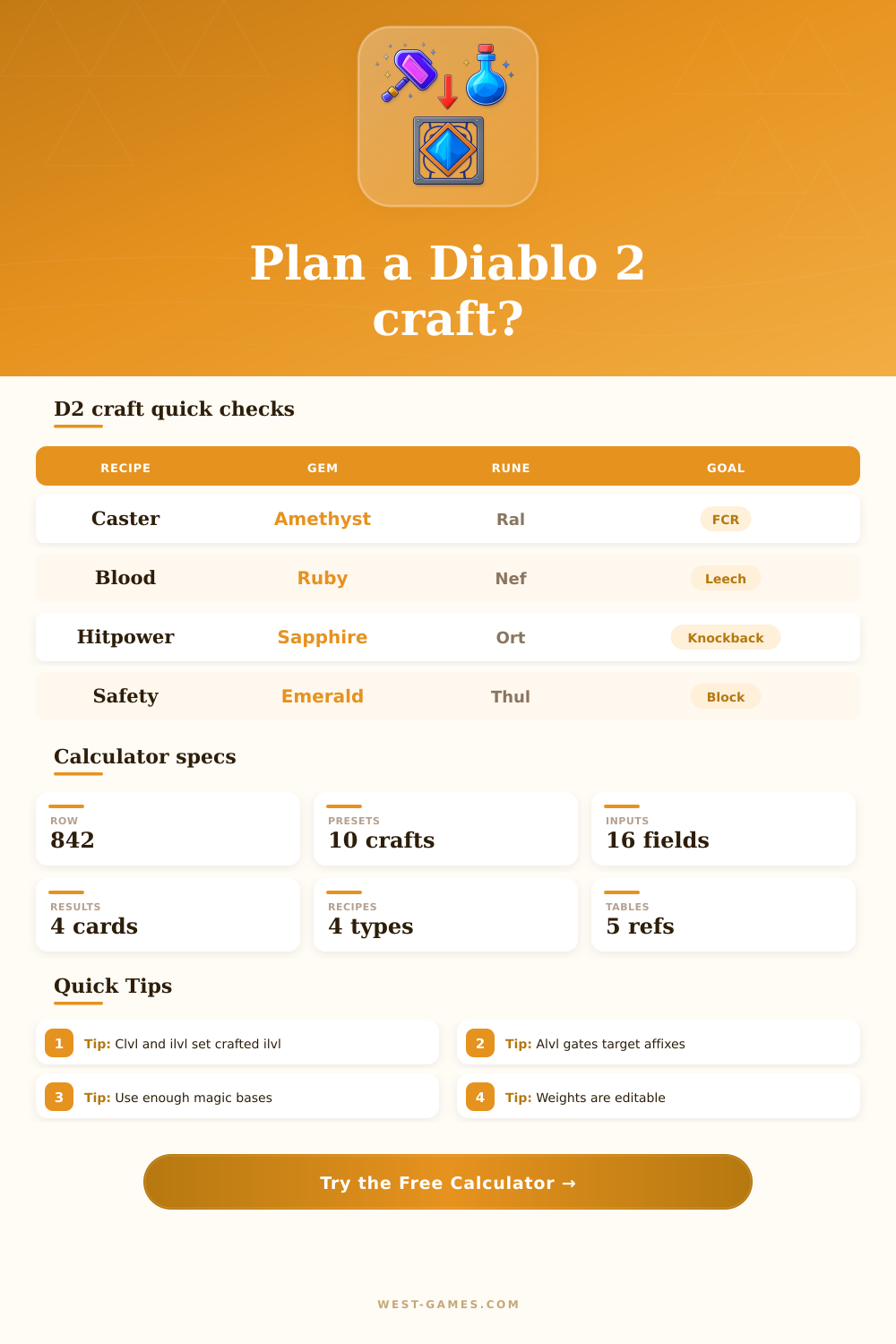
| Family | Theme | Common gem | Example rune |
|---|---|---|---|
| Caster | Mana and cast stats | Perfect Amethyst | Ral on amulet |
| Blood | Life, leech, damage | Perfect Ruby | Nef on gloves |
| Hitpower | Knockback, thorns, control | Perfect Sapphire | Ort on gloves |
| Safety | Block, resist, damage reduce | Perfect Emerald | Thul on amulet |
| Crafted ilvl | 1 affix | 2 affixes | 3-4 affixes |
|---|---|---|---|
| 1 to 30 | 40% | 20% | 40% total |
| 31 to 50 | 0% | 60% | 40% total |
| 51 to 70 | 0% | 0% | 80% three, 20% four |
| 71+ | 0% | 0% | 100% four |
| Step | Rule | Effect | Why it matters |
|---|---|---|---|
| Craft ilvl | floor clvl/2 + floor ilvl/2 | Caps at 99 | Main craft level |
| Base check | If qlvl is higher, use qlvl | Raises floor | High bases matter |
| Magic level | alvl = ilvl + magic lvl | Amulet boost | Unlocks high affixes |
| No magic level | Use qlvl threshold formula | May lower alvl | Common gear case |
| Target group | Typical alvl gate | Weight style | Use case |
|---|---|---|---|
| +2 class skills | 90 | Low weight | Caster amulet chase |
| Faster Cast Rate | 5 to 30 | Medium weight | Caster belt or ring |
| IAS | 35 to 60 | Medium weight | Glove damage builds |
| All resistances | 25 to 55 | Medium weight | Safety or amulet filler |
| Preset | Recipe | Base | Target group |
|---|---|---|---|
| Caster +2 Amulet | Caster | Magic Amulet | +2 class skills |
| Caster FCR Belt | Caster | Magic Belt | Faster Cast Rate |
| Caster Mana Ring | Caster | Magic Ring | Faster Cast Rate |
| Blood CB Gloves | Blood | Magic Gloves | IAS or stats |
| Blood Dual Leech Ring | Blood | Magic Ring | Life or mana leech |
| Blood FRW Boots | Blood | Magic Boots | Faster run walk |
| Hitpower Knockback | Hitpower | Magic Gloves | IAS or stats |
| Hitpower Bow Gloves | Hitpower | Magic Gloves | IAS |
| Safety Block Amulet | Safety | Magic Amulet | All resistances |
| Safety Resist Shield | Safety | Magic Shield | All resistances |
Crafting in Diablo 2 feel like a cross between inventory management and high-stakes gambling. If only I can use these perfect amethysts and rare Ral runes to get that +2 skill bonus on my gear, right? Or maybe I’ll end up with yet another piece of mediocre gear. When it go right, there’s a thrill in seeing those numbers tick over. But when it doesn’t, man does the frustration pile up fast.
In the long term, however, that’s where planning beat luck. Two hidden number, affix level and item level, are at the heart of game’s core mechanic. Affix level control which modifiers can be rolled. Item level controls how many random modifier you recieve. If you’re a high-level character trying to craft on low-tier bases, it’s a recipe for frustration: Powerful stats is gated by certain thresholds. Even with all the right gems in the world, the best ones will never show up in the pool if your crafted item level are not high enough.
How to Plan Your Crafting Better
By plugging in your base and character levels into the calculator above, you’ll remove the guesswork surrounding these critical numbers… And let math do the work for you. Most players obsess over guaranteed craft bonuses like crushing blow or mana and forget about the random affixes that actualy determine an item’s value. +2 skills on a caster amulet without any life or faster cast rate is pointless; you’re left with a attractive chunk of jewelry that will play badly.
The tool lets you model this situation by allowing you to specify target weights for various stat groups. This is essential because it shows your chances of getting the mods you want based off the affix level you’ve worked out. That’s going from vague hope to solid odds.
The other issue is materials availability. Many material, particularly runes used in runewords and high-end crafting recipes, will use up a lot of runes and other higher-tier components. Are you running a blood recipe on 50 pair of magic gloves? Make sure you know how much in runes/jewels/etc you have compared to how much you’ll need before starting a huge stack. This prevents you from running out of good materials while chasing unlikely odds after the forty-eighth try. Better to make ten in one go instead of burning through every rune trying to craft something you’re not guaranteed to succeed at.
Each of these recipe family has its own philosophy towards builds. Caster recipes are all about spells and mana, a good fit for necros and sorcs that requires maximum damage output and cooldowns; blood recipes emphasize life leech and crushing blow to keep physical melee alive during prolonged fights; hitpower recipes feature thorns and knockback for keeping enemies at bay; safety recipes maximize blocking/resistances for surviving sudden attacks. In the end, the correct family are determined by your character’s shortcomings, i.e., it should of not be based solely on the “coolest” one.
Because the affix level formula takes into account both your own character level as well as the base’s item level, this can get a bit complicated. For example, if you’re using a lower-level magic amulet (with some built-in stats), no matter what your character level is, those stats will limit what the end result could looks like. That’s one reason that hardcore players love to gamble for their base items at Act 5 vendor: You can guarantee they’ll start with an adequate enough item level to back up whatever gates you want them to open.
In the end, crafting is a game of resource management and expectation management. Most times, it’s not going to work out exactly as planned (or even remotely close different than after several attempts). Once you learn how affix pools interacts with item levels, you’ll be able to better determine which items is worth crafting and which ones are worth waiting for that perfect drop.
Preparation realy makes all the difference between satisfaction and frustration. Respect the odds, know your gates, and squirrel away those perfect gems until they actualy matter.