OSRS XP Per Hour Session Comparator
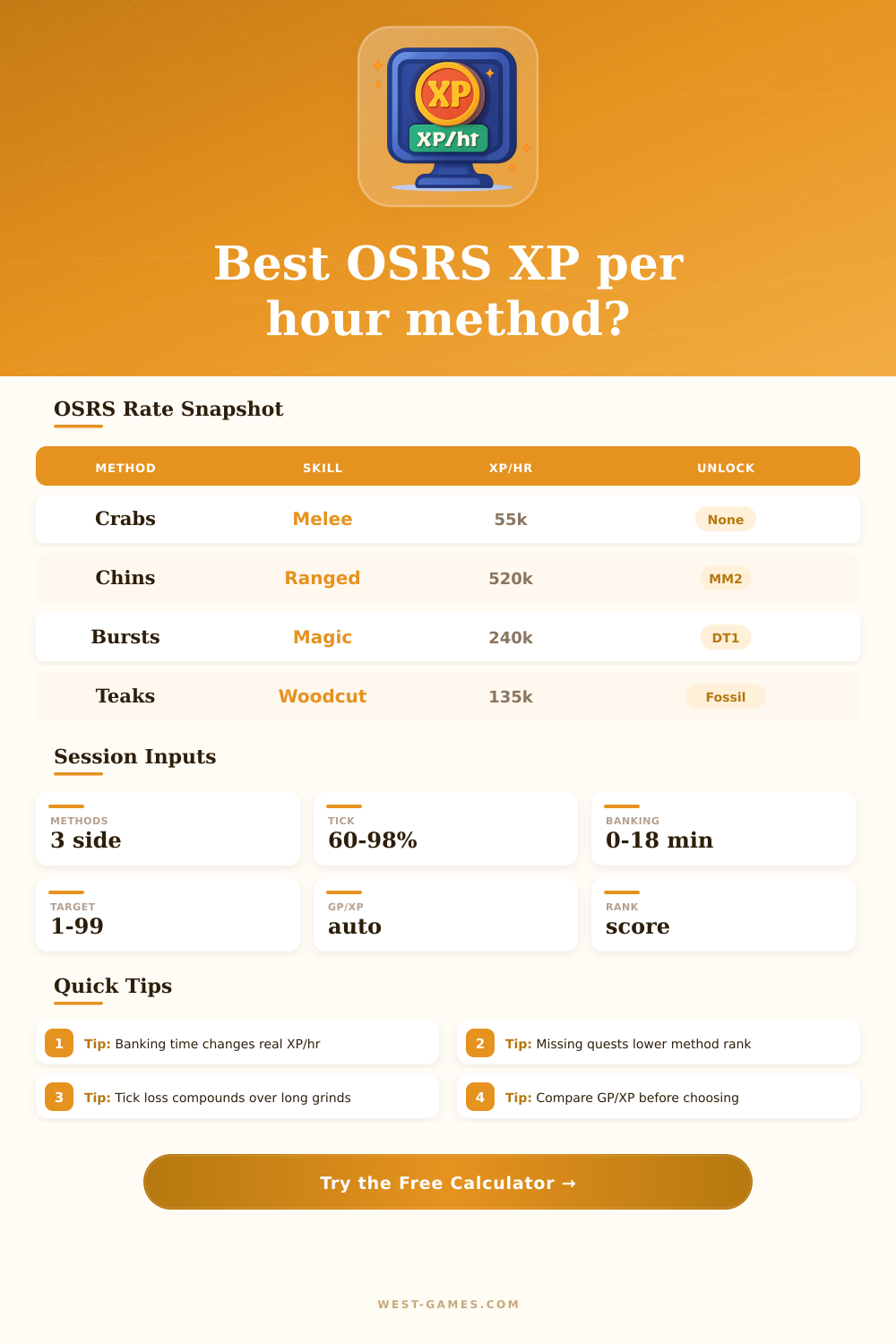
Compare multiple Old School RuneScape training methods by effective XP/hr, tick accuracy, idle time, banking drag, unlock requirements, GP per XP, and target level timeline.
⚡ Training scenario presets
🎯 Target, uptime, and unlock inputs
📊 Live comparison grid
🧮 Session rate summary
📘 Method base-rate reference
| Method | Skill | Base XP/hr | GP/hr | Unlock or requirement |
|---|---|---|---|---|
| Ammonite crabs | Combat | 55,000 | 0 | Fossil Island access |
| Nightmare Zone melee | Combat | 82,000 | -25,000 | Boss quest points |
| Maniacal monkeys chinning | Ranged | 520,000 | -4,800,000 | Monkey Madness II |
| Dust devil bursting | Magic | 240,000 | -950,000 | Desert Treasure I |
| Wintertodt solos | Firemaking | 210,000 | 180,000 | Minigame access |
| 1.5-tick teak trees | Woodcutting | 135,000 | -35,000 | Fossil Island or hardwood grove |
| Motherlode Mine | Mining | 42,000 | 210,000 | 30 Mining |
| Seers rooftop agility | Agility | 55,000 | 0 | Kandarin diary improves laps |
| Blast Furnace gold | Smithing | 330,000 | -2,200,000 | Blast Furnace access |
| Saradomin brew batching | Herblore | 285,000 | -1,650,000 | 81 Herblore supply route |
🔒 Quest and diary unlock reference
| Unlock flag | Affects methods | Calculator effect | Common reason |
|---|---|---|---|
| Monkey Madness II | Maniacal monkeys | Removes locked penalty | Chinning and bursting caves |
| Desert Treasure I | Bursting methods | Removes spellbook penalty | Ancient Magicks access |
| Key diary boosts | Rooftops and Blast Furnace | Adds small rate bonus | Shorter laps or better logistics |
| Minigame access | Wintertodt, Blast Furnace | Controls availability | Account route and world access |
⏱ Tick efficiency guide
| Play pattern | Typical tick efficiency | Best suited methods | Rate warning |
|---|---|---|---|
| AFK reset loop | 55% to 70% | Crabs, Motherlode, Wintertodt | Idle minutes matter most |
| Casual active | 70% to 84% | Rooftops, NMZ, Herblore | Banking drag is visible |
| Focused manual | 84% to 93% | Blast Furnace, bursting | Supply delays become costly |
| Tick manipulation | 93% to 99% | Teaks and high-effort skilling | Small mistakes compound fast |
⭐ Target XP reference
| Level target | Total XP needed | Why players compare here | Timeline note |
|---|---|---|---|
| 70 | 737,627 | Mid-game unlock planning | Rates start to diverge |
| 80 | 1,986,068 | Elite method preparation | GP/XP matters more |
| 90 | 5,346,332 | Long grind checkpoint | Idle assumptions dominate |
| 99 | 13,034,431 | Skill cape finish line | Choose sustainable methods |
💡 Comparator tips
Old School RuneScape boils down to one question when it comes to training: How quickly can I get experience? You want biggest number on top line, so you run headlong towards it, only to discover after an hour of grinding that you’re growing increasingly frustrated. The raw experience rate isn’t everything.
There’s the gold you need in order to fill your inventory, the mental toll of remaining alert, and the friction generated by having to constanty bank. A small detail, sure, but when you’re spending three hours glued to a screen, those little things matter. Plug your habits for each session into calculator above. It does all the work for you, so you don’t have to guess how much time you are wasting on idle loops in ticks.
Why Fast Training Is Not Always Best
You input what percent of your time is active versus idle or banking time in each hour. This difference matter because most people think eight hundred XP per minute works out to forty thousand hours. They don’t account for their average being lowered by standing there doing nothing while a bank chest empties. When you add in four minutes of supply management every hour, that number gets a lot lower then it looks. It also considers how efficient you kill ticks, meaning whether you click them at the right moment in the game’s update cycle. A slight decrease in precision for a higher level method can undo the benefit of a slightly faster but less strenuous method, which is where most people goes wrong.
There’s also the hidden level of unlock requirements. Does a method claim to give five hundred thousand experience per hour? Does that require Monkey Madness II? Is it worth grinding through the quests just to get access to that faster method? Flagging your current unlocks in the calculator means that it will mark down any methods which aren’t currently achievable by you, preventing you from falling into a fantasy where you think you’re doing something faster than you really are.
Diary completions and things like Desert Treasure serves this purpose too. Planning time is precious; waste it on ignoring those and you’ll end up with nothing to show for it. Recognise them, and you’ll be able to build a realistic roadmap: work toward a better method, or take the longer road which is open to you right here and now.
Gold efficiency often gets ignored until your wallet runs dry: when it’s too late and you’ve spent way too much on potions or ammo. There are certain activities that is nothing more than money holes. You spend millions of gold per hour on potions and ammo. These are some of the quickest routes to experience. It’ll tell you exactly how much money they eat versus amount of experience gained so you’re not wasting gold to get a small increase in speed.
Take bursts of magic for instance. They’re fast, sure, but they burn through runes like there’s no tomorrow. If you compare that to something cheaper and slower, you can see if it’s worth it to spend all that money for the increased speed. That’s smart training. You want to make efficient use of your time but not waste all your gold doing it.
This is based off reality through target timelines. There’s no longer the stress of open-ended grinding when you know exactly how much time it takes to get from here to level ninety-nine. With your adjusted hourly rate as input, the calculator can project a timeline for you. This gives you a clear goal and something to work towards. This brings abstract ambition down to earth and schedules it into your life. If you want a cape or just need one more thing unlocked to beat a boss, having a date helps keep motivation up.
The bottom line is: fastest doesn’t mean best. Best means something sustainable, both financially and physically/emotionally. You should of looked at the numbers first. That’s why the page has these reference tables, which show the tradeoff between accessibility, cost, and speed. Plug in your own playstyle instead of what you think it should be, tweak the inputs, and let the numbers tell you how to make it work for your lifestyle.