OSRS XP Per Hour Calculator
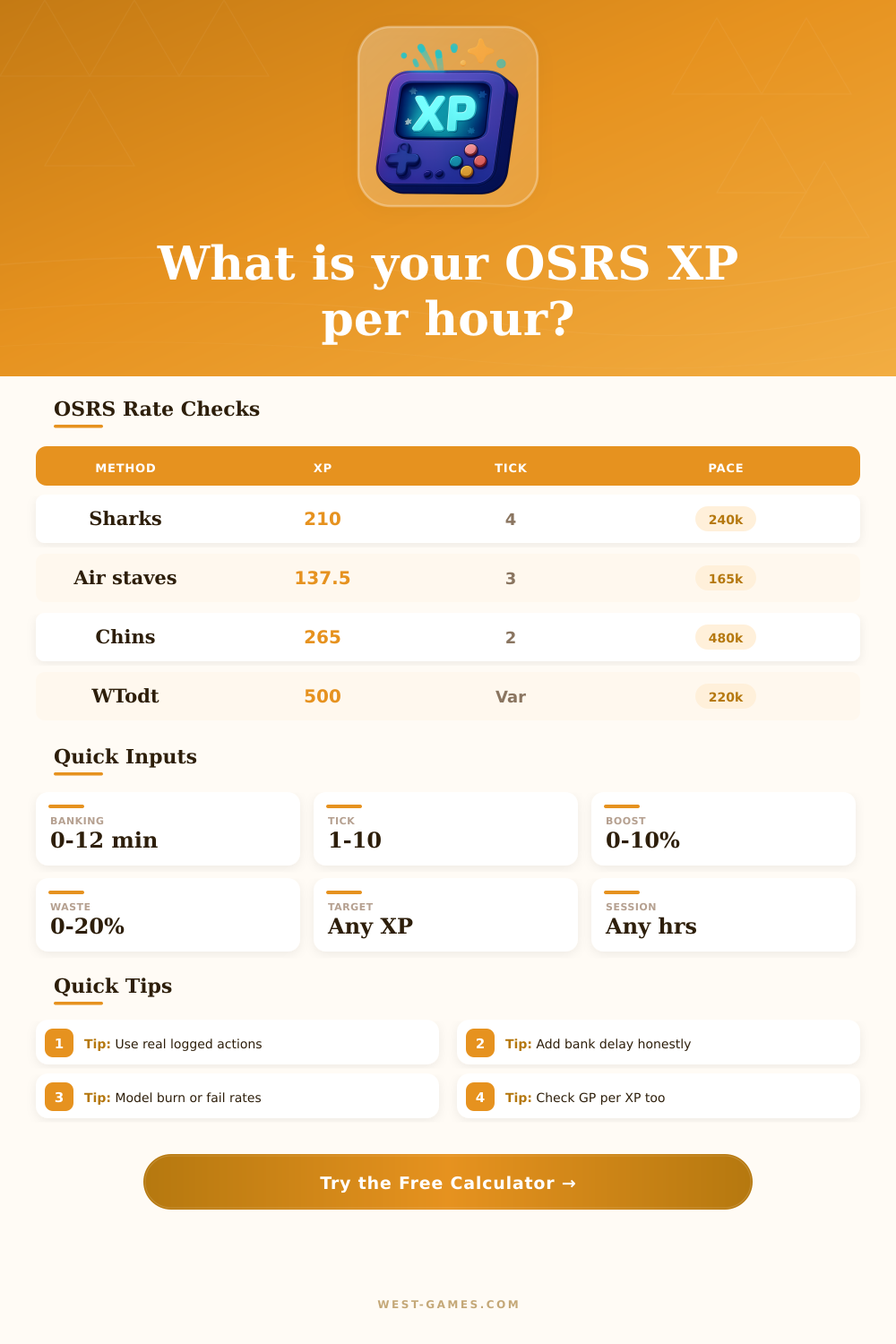
Model Old School RuneScape training rates with action XP, tick speed, downtime, boosts, fail rates, supplies, GP flow, target XP, and session length.
Current Setup
Calculate to see the active rate.
No Downtime
Shows the rate if banking and resets were perfect.
Boosted Check
Adds five extra boost points for outfit math.
Clean Actions
Removes fail or burn rate for ceiling planning.
| Preset Method | Skill | Typical XP Unit | Common Pace Note |
|---|---|---|---|
| Cooking sharks | Cooking | 210 per fish | Banking and burn rate decide real pace |
| Air battlestaves | Crafting | 137.5 per staff | Inventory banking dominates the session |
| String magic longbows | Fletching | 91.5 per bow | Fast bank standing action with supply flow |
| Adamant dart tips | Smithing | 62.5 per bar | One bar produces ten dart tips |
| Red chinchompas | Hunter | 265 per catch | Failed trap checks reduce effective XP |
| Ardougne rooftop | Agility | 793 per lap | Lap time is better than click count |
| Wintertodt solo | Firemaking | Variable per game | Use average XP per kill or game |
| Superglass Make | Magic | 78 per cast | Banking and molten glass yield both matter |
| Tick Cycle | Seconds | Theoretical Actions/Hr | Useful For |
|---|---|---|---|
| 1 tick | 0.6 sec | 6,000 | Game tick ceiling checks |
| 2 ticks | 1.2 sec | 3,000 | Very fast bank or combat loops |
| 3 ticks | 1.8 sec | 2,000 | Many production actions |
| 4 ticks | 2.4 sec | 1,500 | Cooking, fletching, steady skilling |
| 5 ticks | 3.0 sec | 1,200 | Gathering and slower processing |
| 10 ticks | 6.0 sec | 600 | Laps, casts, kills, or minigame events |
| Boost Source | Skill Area | Typical Entry | Calculator Use |
|---|---|---|---|
| Pyromancer outfit | Firemaking | 2.5% | Add to XP boost percentage |
| Graceful impact | Agility travel | Time save | Lower downtime or lap seconds |
| Cooking gauntlets | Cooking | Burn reduction | Lower fail or burn percentage |
| Skill cape perk | Selected skills | Method dependent | Adjust action XP or fail rate |
| Clan or event bonus | Custom | Variable | Add exact boost if active |
| Level Goal | Total XP Needed | From Previous Row | Planning Note |
|---|---|---|---|
| Level 70 | 737,627 | Midgame marker | Use target XP after checking current XP |
| Level 80 | 1,986,068 | 1,248,441 more than 70 | Good target for many unlocks |
| Level 90 | 5,346,332 | 3,360,264 more than 80 | Rates matter heavily here |
| Level 99 | 13,034,431 | 7,688,099 more than 90 | Check total hours and supplies |
| 200M XP | 200,000,000 | 186,965,569 more than 99 | Use long-session GP flow carefully |
| GP Field | Positive Means | Negative Means | Best Input Habit |
|---|---|---|---|
| Supply GP per action | Item is consumed or charged | Use zero for free gathering | Include runes, ammo, and food |
| Output GP per success | Product or loot has value | Use zero for pure XP methods | Use an average, not a lucky drop |
| Fail percentage | Actions lose XP | Some inputs may still be used | Track a sample of 100 actions |
| Net GP per hour | Method profits overall | Method costs GP overall | Compare with GP per XP |
The core mechanic is easy: Log in, do something, get experience. But that’s where simplicity ends. Making real progress depend more on how well you use your time during those actions than on the game itself. People tend to obsess over raw numbers of XP while ignoring all the “costs” behind each number, the time spent on banking delays, supply runs, re-failing tasks, etc. This disconnect is where most training plan fail.
Once you input your downtime and tick speed, calculator above crunches the numbers so you don’t have to guess at amount of time you’re wasting fumbling around with inventory. Theoretical guide quotes are a fantasy world, it’s a guide, not reality! If you’re in perfect conditions where your traps always work, food doesn’t burn and you never have to spend any time banking, great. Otherwise, every second you spend out-of-the-action lower your actual hourly rate.
Why You Should Track Your Real Game Time
For example, maybe a cooking method only takes a few seconds of clicking on fish. That could make it seem quick. However, if each hour add up to 6 minutes of downtime, that severely decrease your rate. By entering your precise minutes of downtime, the tool will account for this. It does matter. Saving even one or two extra second by using different bank interface or optimizing your route can be enough to offset completely swapping methods. Sometimes you’ll realize that your current comfortabley loop with fewer bank trips perform better than switching to a higher XP activity with poor logistics.
There’s another kind of training: the economic one. Some methods requires expensive raw materials, some burn through food, others consume runes. A few make money by dropping good loot or creating marketable items. You’d be surprised how much running around doing things will cost you GP, particularly during marathon playthroughs. Inputting output values and input costs lets you determine whether what you’re doing is helping your GP reserves or emptying them out. Is getting five thousand XP for every ten thousand GP burned worth the monetary loss? Maybe your goal is to break even with supplies rather then go as fast as possible, something you have to consider if you’re playing game on a budget. That way, you’ll learn to balance treasure with time, two limited resources in RuneScape.
The effects of boosts and fail rates are more significant than most players think as well. A single boost like an outfit bonus or diary perk can feel insignificant on its own. However, when they adds up together (and with every action) over hundreds of times, it becomes significant pretty fast. On the flip side, burning something you cooked or missing a hunter trap not only cost you experience but also your time. Knowing those factors accurately lets you avoid overestimating your pace. Instead, it allows you to establish reasonable expectations for reaching some milestone or leveling up to level 99.
On that page, there’s a table of references which show the normal paces at which certain tasks is done. That way you have a baseline to measure yourself against. The bottom line: While wiki numbers are useful for comparison, you should of been logging your own in-game actions so that they can better inform what’s realistic for you. We are all different, with our own pace and rhythm for play.
Once you have those inputs feeding into an estimate of your session duration, training becomes less of a blind grind, and instead something you control as a project. Instead of wondering “how long until I’m done?”, you’ll know precisely how many hours it take to accomplish your goal. And that change of mindset completely alters your perception of the game. What was boring repetition become purposeful forward movement.
Feed the numbers honest data and they won’t steers you wrong. Honest self-logging is the key to mastering this game’s pace.