🎮 Loot Calculator OSRS
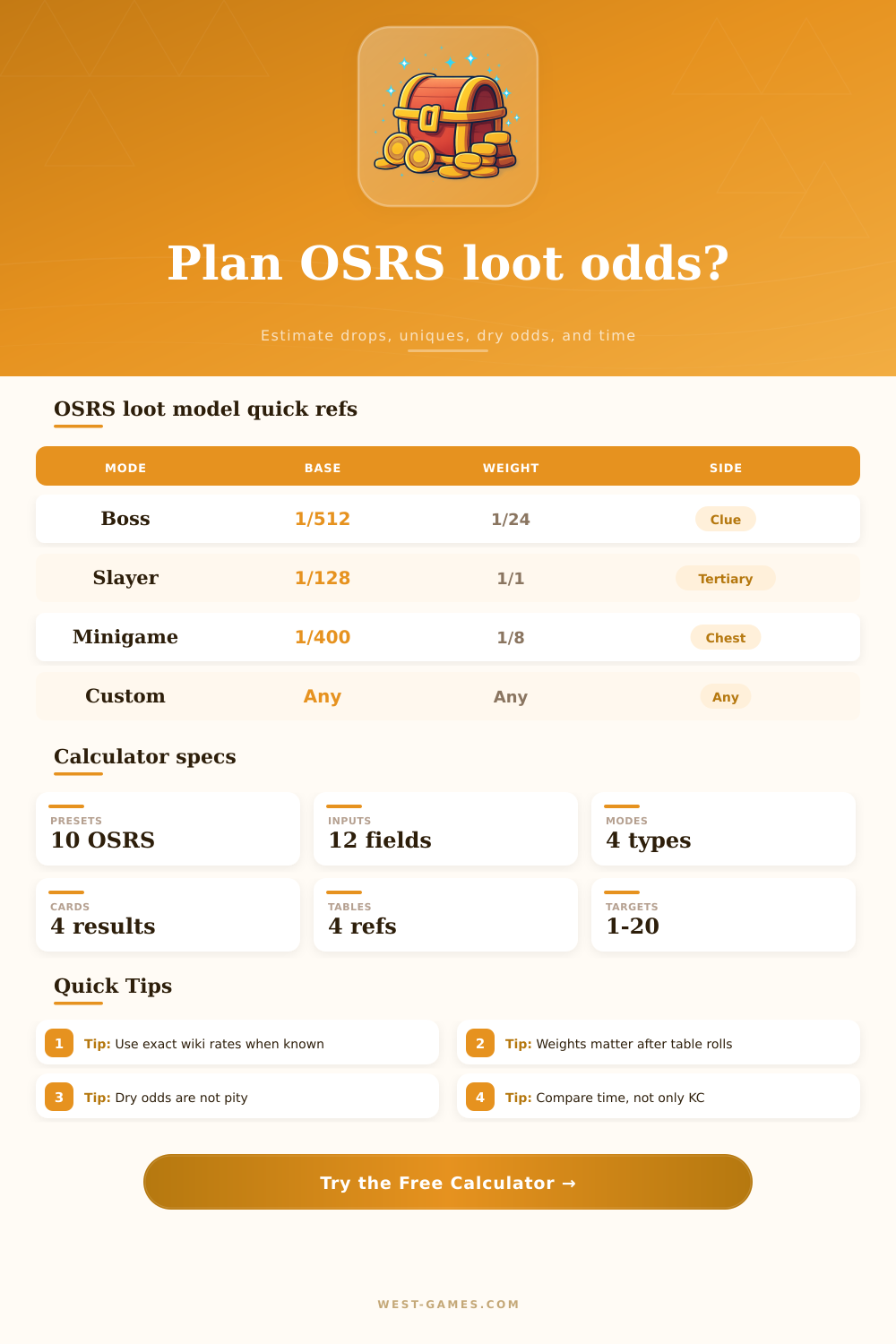
Estimate general OSRS boss, slayer, and minigame loot odds from base drop denominators, weighted unique tables, clue rolls, secondary rolls, target quantity, dry streaks, expected KC, and time.
| Preset | Mode | Base table | Weight model |
|---|---|---|---|
| Zulrah unique table | Boss | 1 in 512 | 1 of 4 equal uniques |
| Vorkath visage hunt | Boss | 1 in 5000 | Exact target rate |
| Alchemical Hydra claw | Slayer boss | 1 in 1001 | Exact target rate |
| Cerberus crystal | Slayer boss | 1 in 512 | One crystal group target |
| Gauntlet enhanced seed | Minigame | 1 in 400 | Exact chest target |
| Hard clue unique | Clue | 1 in 1625 | Editable unique group |
Presets are calculator defaults for general planning. Replace denominators and weights with exact current OSRS table values when precision matters.
| Drop structure | Base denominator | Target weight | Total weight |
|---|---|---|---|
| Exact item rate | Published item rate | 1 | 1 |
| Equal unique table | Rare table rate | 1 | Number of uniques |
| Weighted unique table | Rare table rate | Item weight | Total table weight |
| Any of several targets | Rare table rate | Sum of target weights | Total table weight |
| Reward chest pulls | Per pull rate | Target weight | Total weight |
The calculator first rolls the base table, then applies target weight divided by total weight, then repeats that chance for eligible rolls per attempt.
| KC vs rate | Hit chance | Still dry | How to read it |
|---|---|---|---|
| 0.5x rate | 39.3% | 60.7% | Very normal |
| 1.0x rate | 63.2% | 36.8% | Expected-rate mark |
| 2.0x rate | 86.5% | 13.5% | Unlucky but common |
| 3.0x rate | 95.0% | 5.0% | Rare dry streak |
| 4.6x rate | 99.0% | 1.0% | Extreme sample |
These benchmarks assume one-copy independent rolls. Multiple target copies or weighted groups change the effective rate.
| Input | Use for | Formula role | Result shown |
|---|---|---|---|
| Secondary roll | Pet, jar, head, shard | Independent chance per attempt | Expected count and hit odds |
| Clue side roll | Clues, caskets, keys | Independent chance per attempt | Expected side rewards |
| Rolls per kill | Multiple pulls or credits | Repeats target chance | Higher effective chance |
| Target quantity | Copies or log goals | Binomial copy target | Expected KC and confidence |
Side rolls do not increase the selected unique chance unless the activity's actual loot table says they share the same roll path.
| Mode | Best fit | Important input | Common mistake |
|---|---|---|---|
| Boss | Repeatable kills with one main drop table | Kills per hour and exact denominator | Forgetting target table weights |
| Slayer | Task-gated drops and unlocks | Attempts per task hour | Counting travel as zero time |
| Minigame | Reward chests, permits, pulls, or rolls | Rolls per completion | Using games instead of reward rolls |
| Clue | Caskets, side rolls, keys, and token rewards | Clue chance or casket rate | Mixing clue odds with kill odds |
This is intentionally a general OSRS loot calculator, separate from Barrows, Tombs of Amascut, Chambers of Xeric, and other special-formula calculators.
After grinding for three hours, only to realize they’ve collected absolutely nothing of value in their inventory, Old School RuneScape player know what despair feels like. You run through the cave, kill boss, and walk away. Yet there’s no new money in your bank account. Your patience has worn thin. When luck doesn’t even out, human intuition fails at big-number probabilities. Your emotions crash when you realize that luck won’t balance out anytime soon.
If you use a calculator before grinding for ten hours, though, it will remove emotion and replace it with risk management. Compare unique item weight against base table roll. Many players look at the drop rate of 1 in 512 and think all items has an equal chance of rolling. They aren’t. First, the game determines whether or not there’s a rare drop, and then it will roll for what item appears. So with four uniques with equal weight, you’re actualy more likely to get it like 1 in 2048. The calculator does this for you once you input weights and denominator. This saves you from doing math yourself on complicated tables where some items has higher rarity multipliers.
Why Use a Drop Rate Calculator
The presets aren’t as important as getting the input numbers correct. When you’re looking for faces from Vorkath or Zulrah‘s artifacts, you need to know exactly how many rolls you get per kill. Some thing give you several opportunities on one kill, like secondary pet tables or dual reward pulls. Not accounting for those bonus rolls results in incorrect expected time estimates, where you believe that a hunt should of take five hundred hours but really just takes three hundred. The tool allows you to tweak the variables until result matches what you do in-game instead of a theoretical minimum.
Most players give up on a kill-streak during a dry spell, but it’s normal to go double your average expected and not see anything. It’s actualy common for people to get no drops until half their expected kills (which occurs about forty percent of the time) due to random chance. Knowing that makes you less likely to quit just as the drop arrives. The interface has a probability guide which give you a sanity check if the randomness feels too unforgiving.
In reality, it’s typically not kills per hour that constrain you, but the amount of time spent doing them. A boss you can kill quickly that drops rare items might be more efficient per hour than slow boss with the same drop rate. Travel time between spots, respawns, and the time taken to bank all need to be considered. The time estimate is useful when planning your schedule and using realistic attempts per hour instead of idealized “speed running” numbers. This way you can determine if you want to do this grind or perhaps focus on something else with higher probability.
The secondary chance from side rolls also has nothing to do with the main unique drop rate, which is why it is often overlooked. Other things like brimstone keys, caskets, clue scrolls all contribute their own opportunities but are still part of your bottom line. Add those to your thoughts when calculating how valuable this activity will be. Maybe you’re after a particular weapon, but you’ll snag some accessories on the way there that keep the run worth pursuing.
Don’t fight randomness; embrace the odds. Your loot hunt isn’t about overcoming the odds, it’s about planning for them. That’s why I don’t think the calculator take away from the fact that Old School RuneScape is random. It just removes the uncertainty from what you should expect. Dry runs suddenly feel less like personal failures and more like something every player has to do. This change in perspective is invaluable, regardless of whether or not it help you find a specific item. You’re still grinding as hard as ever, but at least now you know how much longer it’ll be before you reach reasonable expectations.