⚰ Barrows Loot Calculator
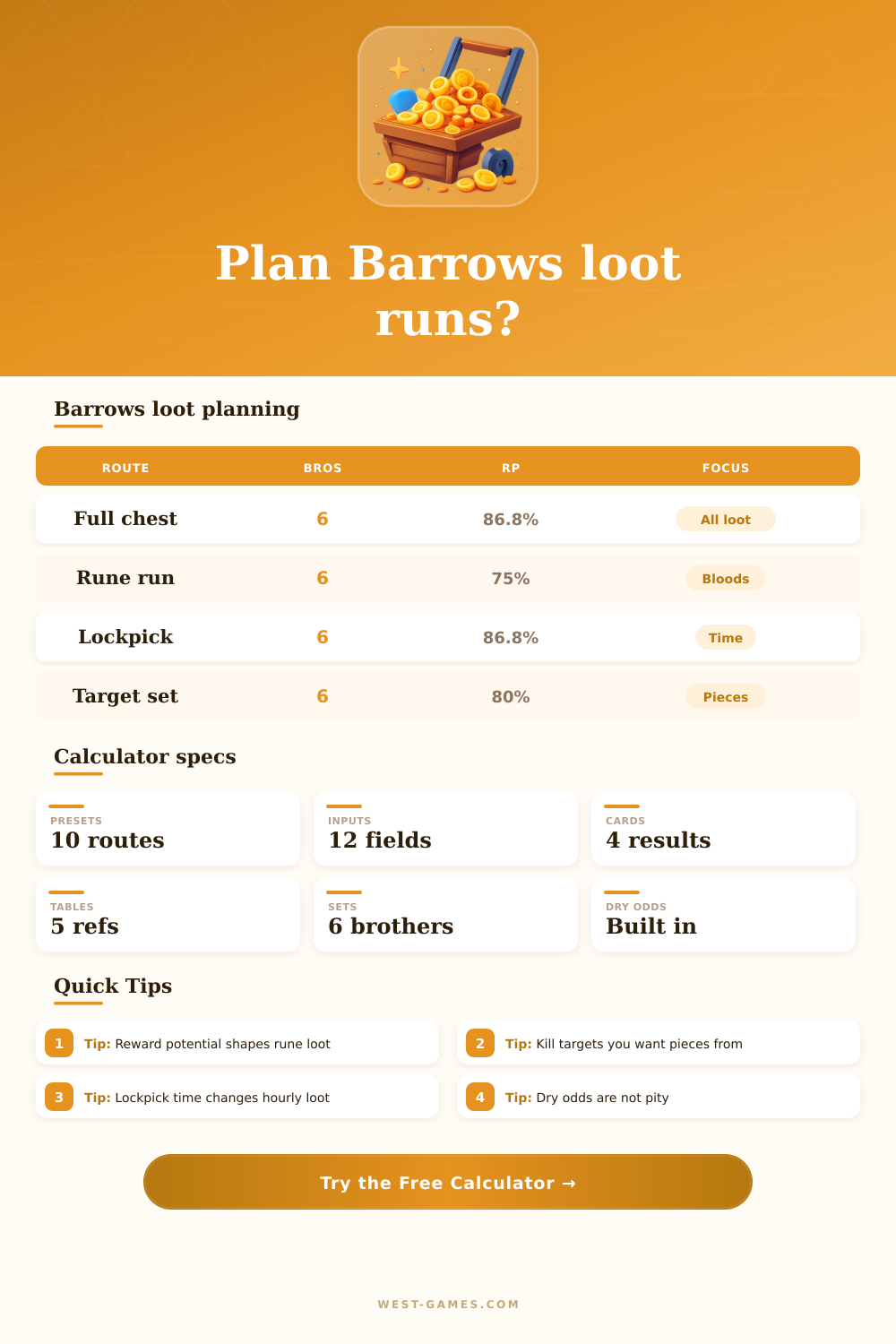
Plan OSRS Barrows loot around reward potential, brothers killed, target set pieces, rune reward assumptions, Strange old lockpick time, dry odds, and expected completions.
| Potential band | Calculator label | Secondary loot read | Typical use |
|---|---|---|---|
| 0% to 49.9% | Low potential | Weak rune index | Testing or diary runs |
| 50% to 62.3% | Chaos tier | Basic runes | Fast learner route |
| 62.4% to 74.6% | Death tier | Death rune lean | Time-save route |
| 74.7% to 86.9% | Blood tier | Blood rune focus | Common rune target |
| 87% to 100% | Bolt rack tier | More high-potential loot | Completion or max route |
Reward potential changes secondary reward expectations in this calculator; it does not increase equipment unique odds.
| Brothers killed | Reward rolls | Eligible pieces | Loot planning effect |
|---|---|---|---|
| 3 brothers | 4 rolls | 12 pieces | Low unique flow, narrow pool |
| 4 brothers | 5 rolls | 16 pieces | Learner route or quick tunnels |
| 5 brothers | 6 rolls | 20 pieces | Time save with one set removed |
| 6 brothers | 7 rolls | 24 pieces | Full loot table and best coverage |
The reward-roll model is simplified for planning. Use your selected brother count to compare routes consistently.
| Assumption | Default modifier | Best with | Calculator meaning |
|---|---|---|---|
| Balanced rune mix | 1.00x | Full chest | Neutral secondary loot index |
| Chaos and death lean | 0.92x | Lower potential | Conservative rune parcels |
| Blood rune focus | 1.08x | 75% to 86.9% | Rewards blood tier preference |
| Bolt rack tier | 0.86x | 87% and up | Discounts rune purity |
| Manual index | Editable | Loot tracker data | Uses your own parcel number |
The rune index is a normalized planning value, not a guaranteed item count from a single chest.
| Owned in set | Missing | Goal mode | Best result to watch |
|---|---|---|---|
| 0 pieces | 4 | Finish selected set | Expected completion chests |
| 1 piece | 3 | Missing-piece hunt | Any missing chance |
| 2 pieces | 2 | Two-piece finish | Dry odds after sample |
| 3 pieces | 1 | Specific piece | Exact piece chance |
Finishing a set behaves like collecting multiple distinct pieces, so it often takes longer than a simple one-drop target.
| Lockpick setting | Modeled effect | What improves | What does not change |
|---|---|---|---|
| 0 seconds saved | Normal tunnel pace | No charge usage | Equipment chance per chest |
| 20 seconds saved | Small reset gain | Chests per hour | Reward potential band |
| 35 seconds saved | Common sprint default | Hourly rune index | Target chance per chest |
| 60 seconds saved | Strong route shortcut | Time to completion | Which brother pieces are eligible |
| Charge input | Tracks sample usage | Supply planning count | Loot formula itself |
Lockpick time matters because more chests per hour means more chances per hour, even when per-chest loot odds stay the same.
If you run Barrows for many hours, you might get nothing but basic runes. That’s frustrating! It feels like a cruel and random system… until you realize that it is just math. When you see probability as math rather than cruel chance, you can use the calculator on this page to find those odds so you can stop guessing and start planning.
Knowing what you can win will change the route you choose. It transforms it from a lottery to an inventory management problem. You’re not relying on luck; you’re engineering a situation in which luck will arrive eventually.
How to Use Math to Win Better Loot
The tradeoff is that skipping a brother reduces pool of eligible equipment pieces. You save three minutes per brother skipped, but you kill off additional portion of potential gear drops. The calculator allows you to flip that switch and show precisely how many brothers you’re killing off. It’s a question of speed vs quality (and also what you give up).
If you know you need a certain piece of gear, skipping a brother ensures you won’t find it. The gear drop rate isn’t great so skipping one or two make sense on a learning route. But what happens if you’re targeting a single piece and you skip that brother? Well, now you get no loot at all, so going fast doesn’t matter if your target doesn’t exist in the pool.
The potential field often trips people up, as it seems like a score, but it’s actualy only a way to determine what tier of secondary loot is most probable. This is laid out in detail in the reference table on the page, breaking down bands from low to bolt rack tier. Higher potential means higher value will be more common (such as better rune combinations and bolt racks).
This is important because runes can last weeks to help cover cost of prayer restoration. Setting yourself to run with an appropriate potential % gives you a good idea of how worthwhile a run is. If it doesn’t look profitable, then adjust and go another direction that takes less time. (i.e. Change routes to lower potential.) It’ll automatically adapt those expectations based off recent runs, so there won’t be any reliance on average values from the community that may be old.
For example, a Strange old lockpick doesn’t just speed me up inside the vault. It also lets me get into more chests per hour, which translates directly to more chances at rare items. Over time, that compounds. The calculator will factor in these seconds you’ve saved, and translate it into an effective hourly pace.
This is important if you’re going for a longer play session, because little gains like this save you tons of time which equates to far greater volume of loots. Thirty seconds each run? Over twenty runs, now you have two extra chests done or ten minutes back in your pocket. It’s a compounding benefit that linear thinking tends to overlook.
The math gets complicated when targeting an entire armor set. You aren’t just hunting for one piece; you’re tracking down several missing pieces. Completing a set seems more difficult since each of those rare drops need to occur in succession. By allowing you to plug in your existing piece count, the tool visualizes this process.
It will estimate your odds of filling in the blanks and provide a completion confidence target. When you hit this number, you know you’ve run enough times to reasonably expect to finish. Otherwise, you could of given up at 50 runs believing yourself unlucky, while in fact you were only a few runs from statistically expected success.
In the end it’s all about variance and volume. You face volume issues because you don’t know which item will drop, and variance issues because you don’t know how many runes you’ll need to get it. Barrows is tuned, so that if you tune in your strategy to their tune (i.e. Assuming runes per drop, number of brothers, lockpicking) then you’re playing the game on its terms.
The numbers are given by the tool above, but it’s up to you to understand what they mean and apply them to your week-to-week run. Run with intent, not blindly. Your loot log will remember if you planned correctly.