New World Trading Post Fee Calculator
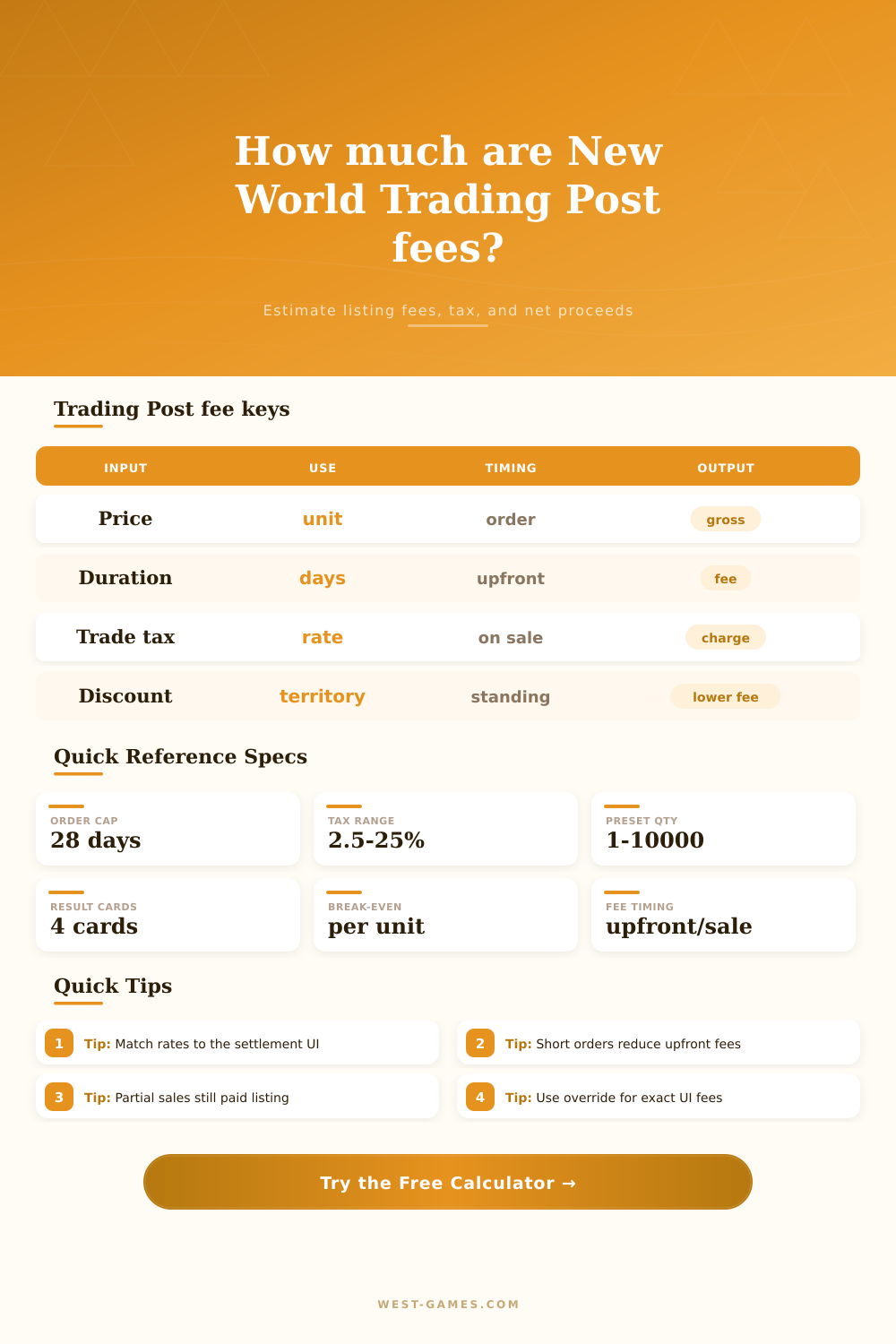
Estimate New World Trading Post listing fees, transaction tax, stack value, net coin received, and break-even unit price from listing duration, territory tax, standing reductions, and sale completion.
Fee Breakdown
| Duration | Calculator Factor | Best For | Risk Note | Editable Assumption |
|---|---|---|---|---|
| 1 day | 1.0x base listing rate | High-turnover ore, fiber, motes, food, and common reagents | Lowest upfront fee, but more relist risk if the stack moves slowly. | Change the 1-day base rate to match the Trading Post preview. |
| 3 days | 2.0x base listing rate | Fast materials with enough market depth to avoid constant reposting | Balanced for stack goods where undercuts are common. | Preset default for common material stacks. |
| 7 days | 4.0x base listing rate | Consumables, trophies, gems, and refined mats with steady demand | Higher upfront fee makes partial sale modeling more important. | Adjust if your server preview shows a different curve. |
| 14 days | 7.0x base listing rate | Rare components and gear that need longer buyer discovery | Can be expensive when price is high and the item does not sell. | Use exact fee override for high-value listings. |
| 28 days | 11.0x base listing rate | Very slow items where avoiding reposts matters more than fee size | Maximum exposure also creates the largest modeled listing fee. | Shacknews references the Trading Post order window up to 28 days. |
| Field | What It Represents | Formula Role | Timing | Calculator Output |
|---|---|---|---|---|
| Listing price per unit | The coin amount entered on the order panel for one unit | Gross listed value = unit price × order quantity | Before posting | Stack value and break-even comparison |
| Quantity | How many items are in the order stack | Scales listing value, sold quantity, and transaction charge | Before posting | Listed stack, sold units, unsold units |
| Base listing fee rate | Editable 1-day listing percentage for the current market view | Listing fee = stack value × rate × duration factor | Paid upfront | Listing fee and total fees |
| Trading tax rate | The territory transaction tax used for the sale charge | Transaction charge = sold value × effective trading tax | When sold | Transaction fee and net proceeds |
| Standing discount | Territory standing Trading Tax reduction shown by the settlement | Reduces modeled fee rates depending on the selected scope | Before posting | Effective listing and tax rates |
| Sale completion | Expected percentage of the stack that actually sells | Sold units = quantity × sale completion percentage | Market outcome | Net proceeds and partial-sale warning |
| Unit basis | Coin value you want each sold unit to recover before profit | Break-even price solves for unit basis after all modeled fees | Planning | Break-even price and profit after basis |
| Manual listing override | Exact listing fee copied from the New World order panel | Replaces formula listing fee for one posting cycle | Paid upfront | More exact net and break-even estimates |
| Preset | Item Pattern | Duration | Fee Focus | Why It Matters |
|---|---|---|---|---|
| Iron Ore bulk stack | Raw resource, 1000 units at low unit value | 3 days | Listing fee versus thin per-unit margin | Bulk materials can look profitable before fees but shrink fast after tax. |
| Mythril Ingot fast sale | Refined material with strong market movement | 1 day | Fast liquidity and low upfront fee | Short windows suit high-turnover crafting mats. |
| Raid food 7-day order | Consumable stack with weekly demand swings | 7 days | Stack value and partial sale risk | Buff food may sell around wars, raids, or mutation cycles. |
| Matrix high-value craft | Rare component or matrix-style craft | 14 days | Manual override and break-even price | High-value items justify copying exact UI fees before posting. |
| Named gear long listing | Single gear item with slower buyer discovery | 28 days | Large listing exposure against one sale | Long orders can be right for gear, but the upfront fee is painful if undercut. |
| Buy order material fill | Demand order for a large stack | 7 days | Coin tied up plus posting fee | Buy orders can lock significant coin before a full fill occurs. |
| Low-standing town sale | Normal market with almost no tax reduction | 3 days | Effective tax rate | Shows why posting territory and standing choices matter. |
| Company-owner discount | Listing with extra local reduction | 7 days | Discount comparison | Useful when your company, faction, or event grants a visible fee reduction. |
| Reference Point | Observed Rule | Calculator Setting | Common Mistake | Check Before Posting |
|---|---|---|---|---|
| Trading Post screen | Sell order panel shows listing price, quantity, duration, listing fee, and transaction charge. | Use all visible values as inputs. | Looking only at gross stack value. | Compare calculator listing fee with the preview. |
| Settlement tax | Trading tax is defined by the territory where the order is posted. | Enter the current territory trading tax rate. | Assuming all settlements are identical after travel. | Open map settlement taxes before posting. |
| Territory standing | Trading Tax standing cards reduce trading fees in that territory. | Enter your visible standing reduction. | Applying one town standing bonus everywhere. | Use the territory where the order is made. |
| Order duration | Longer orders create larger upfront listing exposure. | Select 1, 3, 7, 14, or 28 days. | Using maximum duration on fast stacks. | Model one relist versus a longer order. |
| Partial sale | Transaction charge only follows sold value in this estimate. | Set expected quantity sold percentage. | Forgetting the upfront fee if the stack only partly sells. | Stress-test 50% and 75% sale completion. |
In practice, the Trading Post fee cut into profits when selling something. Casual sellers will be impacted as well because listing fee is paid upfront regardless of whether a sale occurs.
Players typically consider market price and determine if it’s worth doing so. What they neglect is fact that they pay this fee regardless of whether or not someone purchase their item. There is an additional transaction tax on top of that which kicks in upon completion of a sale.
How to Save Money on Trading Post Fees
Combined with that 2-step cost, thin margins mean you might make nothing on full sellout. That’s where calculator here takes out the guesswork, accounting for both steps and giving you an actual look at what you’ll pocket before spending money.
First, length of time matters. If something move quickly (like fiber) then the lower upfront fee for only one day makes sense. But if your item doesn’t sell, you’ll need to rebuy that listing space, and pay another listing fee. For rarer equipment, twenty-eight days is way to go: it’s higher up-front but ensures that the item will only incur the compounded listing fees if it take a while to sell.
In other words, it’s a tradeoff between immediate cash flow and long-term exposure. When you toggle on different lengths, you can see how this affects the fee, helping you determine if extra is worth it.
After taxes, depending on which territory you post to, there is also a territory tax. There is a different trading tax rate for each settlement. That rate can be reduced based off your standing in that territory. If you have max standing in Veerstone, you may end up paying less as a percentage. This variable is often ignored, yet it can shift your break-even point by several coins per unit. Before you post an order, look at what the tax rate are in that settlement. Posting to a high tax zone could make a profitable sale unprofittable.
The territory standing discount is applied to the input field so your estimate shows what you actualy receive in game.
Another potential danger is partial fills. With a thousand units listed and only half go to new homes, you’re still on the hook for entire listing cost. Adjusting the number of units you expect to sell lets you model this risk in the calculator. This is useful when you have slow-movers or when each item is high value. And it illustrates that if you don’t sell some units, they become overhead and not merely “lost” sales.
Maybe you discover that if you set a slightly lower price, you’d sell more at a better profit. Fifty percent odds of shifting inventory might not work against a high price point. That shifts you from being a passive vendor to an active trader who understands how it all works. Instead of just putting things up there, you begin to improve your sales for net yield.
Whether you’re flipping named gear or bulk materials, the number matter more then the headline price. If it’s a tool that does the arithmetic for you. You adjust your standing discounts. Adjust your duration. Check where you stand. Focus on strategy. Make it a calculated business decision instead of a costly mistake.
You should of used this sooner. The Trading Post isn’t a giveaway. It’s a marketplace. And fees are the price of doing business. Few of us can afford to ignore them. Running the numbers isn’t just for our coin, it’s an investment that keeps you moving forward on every sale. A broken vendor doesn’t always sell something different than a successful vendor. They simply don’t understand the cost of selling what they do.
Master the fees. Follow the coin.