🛡 PoE Resistance Cap Calculator
Audit fire, cold, lightning, and chaos resistance against Path of Exile caps, Kitava penalties, map curses, exposure, maximum-resistance changes, penetration, and incoming hit damage.
| Value | Fire | Cold | Lightning | Chaos | Calculator meaning |
|---|---|---|---|---|---|
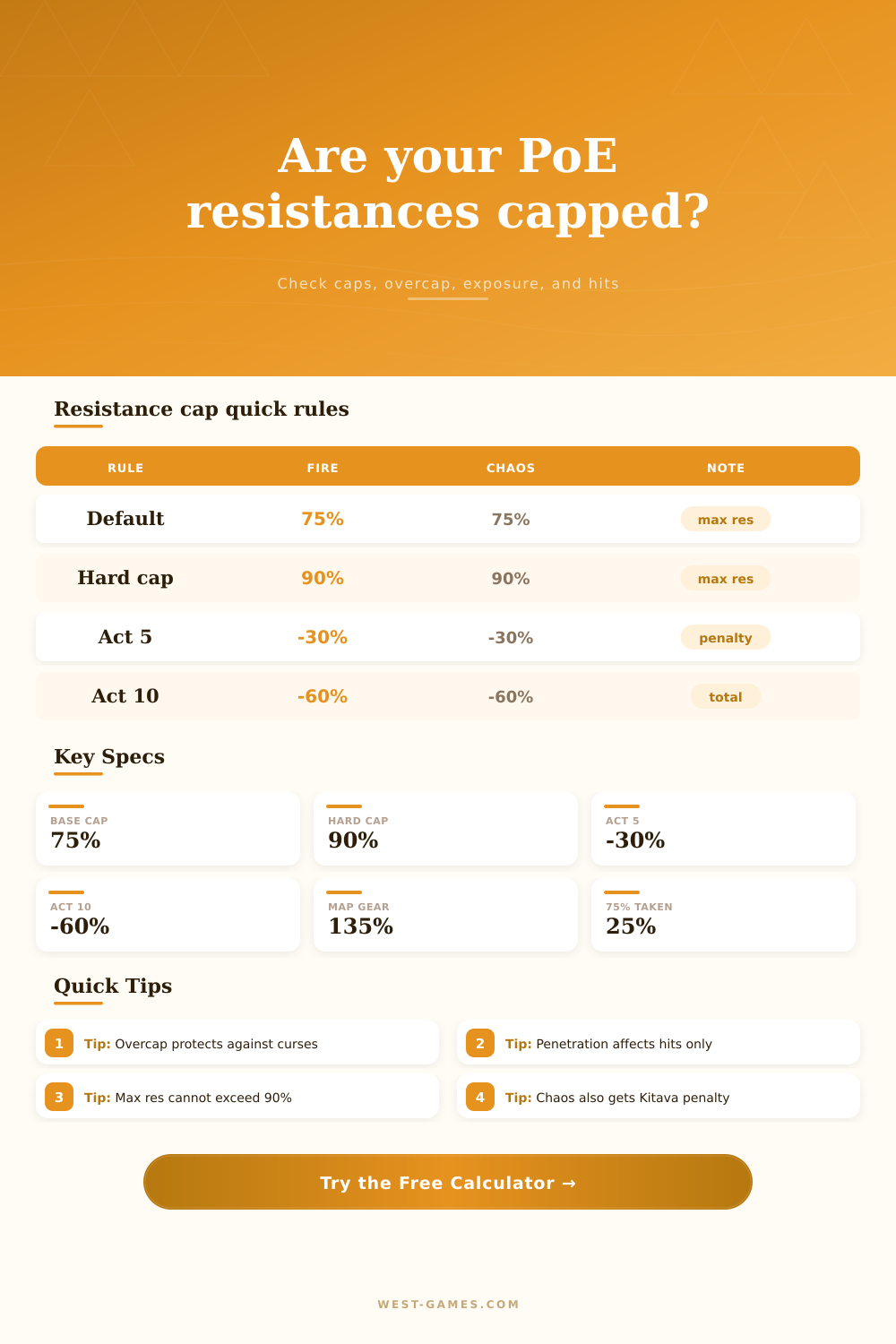
| Base maximum | 75% | 75% | 75% | 75% | Default cap before maximum-resistance modifiers. |
| Hard maximum | 90% | 90% | 90% | 90% | Maximum resistance cannot be raised above this value. |
| Before Act 5 | 0 penalty | 0 penalty | 0 penalty | 0 penalty | Entered gear/tree values are not campaign-reduced. |
| After Act 5 | -30% | -30% | -30% | -30% | First Kitava penalty to all four resistance types. |
| After Act 10 | -60% | -60% | -60% | -60% | Final mapping baseline after both Kitava penalties. |
| Mechanic | Where it applies | Changes sheet value? | Affects ailments? | Calculator step |
|---|---|---|---|---|
| Resistance total | Character stats, gear, passives, penalties | Yes | Yes, through actual resistance | Start from entered uncapped value. |
| Curse or reduction | Uncapped resistance | Yes while active | Yes if the ailment uses that resistance | Subtract before applying maximum resistance cap. |
| Exposure | Uncapped elemental resistance | Yes while active | Yes if active during damage over time | Modeled with the elemental reduction input. |
| Maximum resistance | Cap on actual resistance | Yes | Yes | Clamp actual resistance to max, never above 90%. |
| Penetration | Specific incoming or outgoing hit | No | No for ailments | Subtract from actual resistance for hit damage only. |
| Goal | Penalty mode | Hostile reduction | Needed entered value | Why it matters |
|---|---|---|---|---|
| Basic map cap | Stat page | 0% | 75% | Enough to display 75% with default maximum resistance. |
| Gear/tree map cap | Before Kitava | 0% | 135% | 135% minus the -60% penalty reaches 75%. |
| Elemental Weakness buffer | Stat page | 30% | 105% | 105% reduced by 30% still reaches the 75% cap. |
| Exposure buffer | Stat page | 25% | 100% | 100% reduced by 25% still reaches the 75% cap. |
| 80% max setup | Stat page | 30% | 110% | Higher maximum resistance needs a higher uncapped total. |
| 90% max setup | Stat page | 30% | 120% | Hard-capped maximum resistance still needs enough uncapped res. |
| Effective resistance | Damage taken | 5,000 hit result | Compared with 75% | Typical situation |
|---|---|---|---|---|
| 90% | 10% | 500 | 60% less damage | High maximum-resistance defense. |
| 80% | 20% | 1,000 | 20% less damage | Small max-res investment. |
| 75% | 25% | 1,250 | Baseline capped map character. | Default cap reached. |
| 50% | 50% | 2,500 | 100% more damage | Badly undercapped or penetrated. |
| 0% | 100% | 5,000 | 300% more damage | No mitigation from that resistance. |
| -30% | 130% | 6,500 | 420% more damage | Negative resistance after penalties. |
You enter an arena with a boss on the map, see your armor glow red, take the damage and boom. Gone. Life bar fades out of existence. A minor hit kills you because you dont understand what resistance caps are.
Resistance caps is more than just big numbers on your screen. Resistance caps is there to provide you some breathing room against game’s attempts to reduce them. That’s why they’re called buffers.
Why Your Resistance Is Not Enough
Plug in your gear stats into the calculator above, and it does all the math for you. You won’t have to guess about conversions and coefficients that typicaly mess people up.
It’s simple on the surface; you need seventy-five percent resistance to minimize damage taken. That’s how you play most things, right? But there is more then meets the eye.
Your character sheet isn’t always whole story. While it tells you what you have in terms of resistance right now, it doesn’t tell you about curses which remove 30% off that value, or exposure mechanics that halve your mitigation. You could appear capped but be dangerously undercapped at the same time.
Before walking into a room, this tool will let you try out these debuffs to see how they would affects you. What was a possible wipe becomes manageable risk.
This is where most players will stop because they look at the number. They look down and see “seventy-five percent fire resistance” and breathe a sigh of relief. Except they fail to remember that act 10 and act 5 story penalties remove sixty percent from your overall resistance pool.
So if you’re sitting there with seventy-five percent listed on the sheet, odds are you’re actualy rolling around in map with fifteen percent effective resistance. And that’s what people miss about it.
You should stack way over the cap so that after you account for penalty, you still end up at seventy-five percent. The table on the page spells it out nicely. It illustrates how frequently you’ll need one hundred thirty-five percent raw resistance just to hit normal cap in endgame play.
Another element that doesn’t quite scale like elemental bonuses are Chaos resistance. It’s a stat unto itself, and rarely given thought until you’re one-shot by a chaotic boss. The chaos stat is handled differently by the calculator.
You can see how many percentage points of chaos resistance is being eaten through certain reductions. This allows you to check if your 20% chaos resistance holds up against whatever hits you. Little things matter, and this is a little thing that makes it easier to spot if chaos is going to kill you before you have time to react.
Then we get to the meat of it: penetration. This is where theory becomes practical.
A chunk of your resistance gets ignored from a particular hit. That doesn’t change on your character sheet, it doesn’t reduce your displayed resistance. Rather, it reduces amount of damage you’d expect to get taken.
So, if you’re at 75% fire resistance and the enemy has 25% fire penetration, the game will figure out the damage like you were at 50% resistance. You’ll take double what you thought you would. Because the tool applies penetration after deciding the cap, it provides a real world view of the damage multiplier.
Remember that high resistance only matters if nobody can punch through.
And don’t get me started on the preset buttons. These buttons is for those times when you simply want to see what happens in a certain scenario without having to input each variable yourself. It is a time saver.
Hit the exposure boss button and it’ll load up its own version of a worst-case scenario. How many hits could you take before dying? It’s like a stress test for your build. Pass it and you probably won’t die during the real encounter, fail and you’ll know immediately where you need to improve.
If you’re overcapped, that’s fine because you gain protection against those variables. A hundred percent resistance may seem wasteful in terms of numbers on paper, but what about when you get exposed or cursed? Now you’re at 100 percent and might still be below the cap. This is insurance.
It costs you some passive tree points or inventory space, sure, but it buys you survival. Your safety buffer will be represented by a number in the calculator, telling you exactly how far away from danger you are. Is it five percent? Or is it fifty percent? This matters when determining where you’ll spend your next gear swap.
So Path of Exile isn’t as much about building up to a number; it’s about holding that number. Under pressure, you’re trying to retain an effective resistance of over seventy-five percent.
This means the numbers on your stat sheet aren’t the numbers you want to pay attention to: they’re your starting point. It’s the modifiers that matter, and that’s where the real test occurs. If you don’t understand your effective versus base values, you won’t last long.
That’s when you plug into a sim and realize how quickly those numbers drops. Suddenly, you look at your gear differently: not chasing the cap on paper but chasing the buffer in practice. That mindshift is what makes veteran players different than casual players.
You step out onto the field, you take the hit, and you live through it.