🎮 Marvel Rivals Win Rate Calculator
Estimate current win rate, target games needed, role and hero pace, rank pressure, party size effect, map-mode fit, streak momentum, and short-session forecast.
| Hero | Role | Win pace | Signal to watch |
|---|---|---|---|
| Doctor Strange | Vanguard | 49-54% | Portal and shield tempo |
| Venom | Vanguard | 48-53% | Backline disruption |
| Hela | Duelist | 50-55% | Opening pick rate |
| The Punisher | Duelist | 49-54% | Angle control and uptime |
| Luna Snow | Strategist | 50-55% | Fight-saving sustain |
| Mantis | Strategist | 50-56% | Utility and clutch saves |
| Rank band | Factor | Expected feel | Calculator effect |
|---|---|---|---|
| Bronze-Silver | 0.94-0.98 | Volatile basics | Small chance boost |
| Gold-Platinum | 1.00-1.07 | Team play tested | Neutral to firm |
| Diamond-GM | 1.16-1.30 | Errors punished | Chance dampened |
| Celestial+ | 1.42-1.62 | Elite consistency | High pressure |
| Input | Upside | Risk | Model effect |
|---|---|---|---|
| Solo queue | Clear signal | Team variance | Full personal read |
| Duo or trio | Better coordination | Shared signal | Small boost, some noise |
| Five or six | Set plays | Harder lobbies | Coordination boost, pressure |
| Win streak | Confidence | Regression risk | Chance nudge up |
| Loss streak | Reset clue | Tilt drag | Chance nudge down |
| Situation | Formula | Meaning | Use case |
|---|---|---|---|
| Current rate | Wins / matches | Raw sample rate | Baseline read |
| Below target | (T*M-W)/(1-T) | Perfect wins needed | Catch-up plan |
| Future window | Chance x games | Expected wins | Session forecast |
| Streak effect | Base x form | Momentum nudge | Reality check |
When you climb out of a losing streak only to immediately lose two more games in a row, it feel like matchmaking system is personally targeting you. And then you lose another couple of matches. It all feels very personal, but in reality, it’s almost always drier and not as personal than you feel.
Your win percentage are based off several factors: what rank you’re currently at, what position you play, and your sample size (the number of games played). These three thing affect each other, but most people don’t realize this till they start going on tilt after matches they could’ve easily won. The above calculator help translate those vague feelings into concrete targets per session, letting you know if you’re really making gains…or if you’re merely burning out.
How to Check Your Win Rate
The most important point to understand is that not all wins is equal when it comes to data quality. One type of win, say, with a Duelist such as Hela, is very different from another type of win, say, with a Vanguard hero such as Doctor Strange. One type of win depend heavily on mechanical execution and aggressive pick pressure; the other depends more heavily on utility and positioning.
Mix those types of wins together and what do you have? A useless average. Wondering if you’re actualy improving mechanically at diving? Playing Spider-Man 50% of the time and Luna Snow 50% of the time makes it impossible to tell. Play Spider-Man 50% of the time and Luna Snow 50% of the time. What does resulting average tell you about how you’re improving at tanking? Nothing. Separate them because that’s where the real signal lives. Use the tool to isolate specific hero profiles so it can filter out how your play change across different heroes, days, and roles.
Yes, rank is important. I know we all like to think otherwise. Sure, in Bronze and Silver it’s relaxed enough where you can get away with some mechanical slip-ups. But at Diamond or Grandmaster, any mistake will be paid for immediately. This is where the win chance calculator consider rank pressure and adjusts accordingly. You aren’t guaranteed a win, but it provides a reasonable expectation as to how difficult the climb really is. Playing ranked games in Gold at level of intensity required to reach Grandmaster? Don’t expect the same outcome. Half the fight is adjusting your mentality to the difficulty of current lobby.
There’s a trap of party size. You feel safer queuing up with five buddies versus going solo, but that masks how well you’re performing individually. By stacking, you decrease the variation on the team coordination part of the equation but increase the variation of lobby quality. Your team could be perfectly in sync, but if you get paired with another coordinated team, one slip-up and it’s game over. What happens here is the inputs view bigger party as noisier signals about your own skills, since you’re still winning but now it’s less clear whether you were carrying, or you were doing it yourself.
All decisions throughout the course of a match are made based off psychological phenomena called “streaks.” Winning 3 games provide confidence which teeters towards arrogance. Losing 5 will have you paranoid and being far too cautious. Momentum affect human performance. We’re including a streak modifier on the calculator because it knows your next game may go your way or against you, but it also acknowledges that tilt is real and recoverable. You’ll know when to step away from the game and reset for the night.
Reality meets planning with setting a target win rate. So let’s say you’re currently sitting on a 52% win rate and aim for a 55%. The math will tell you precisely how many perfect games you’d have to play to make up the difference. More often than not, it’s fewer then you expect. However, you can’t afford to slack off even one bit during those catch-up matches; you need to stay focused. That’s why the forecast window converts hours of gameplay into numbers of games so you know how much time you should of be spending, preventing you from wasting three hours only to discover that your win rate didn’t budge by more than a hair.
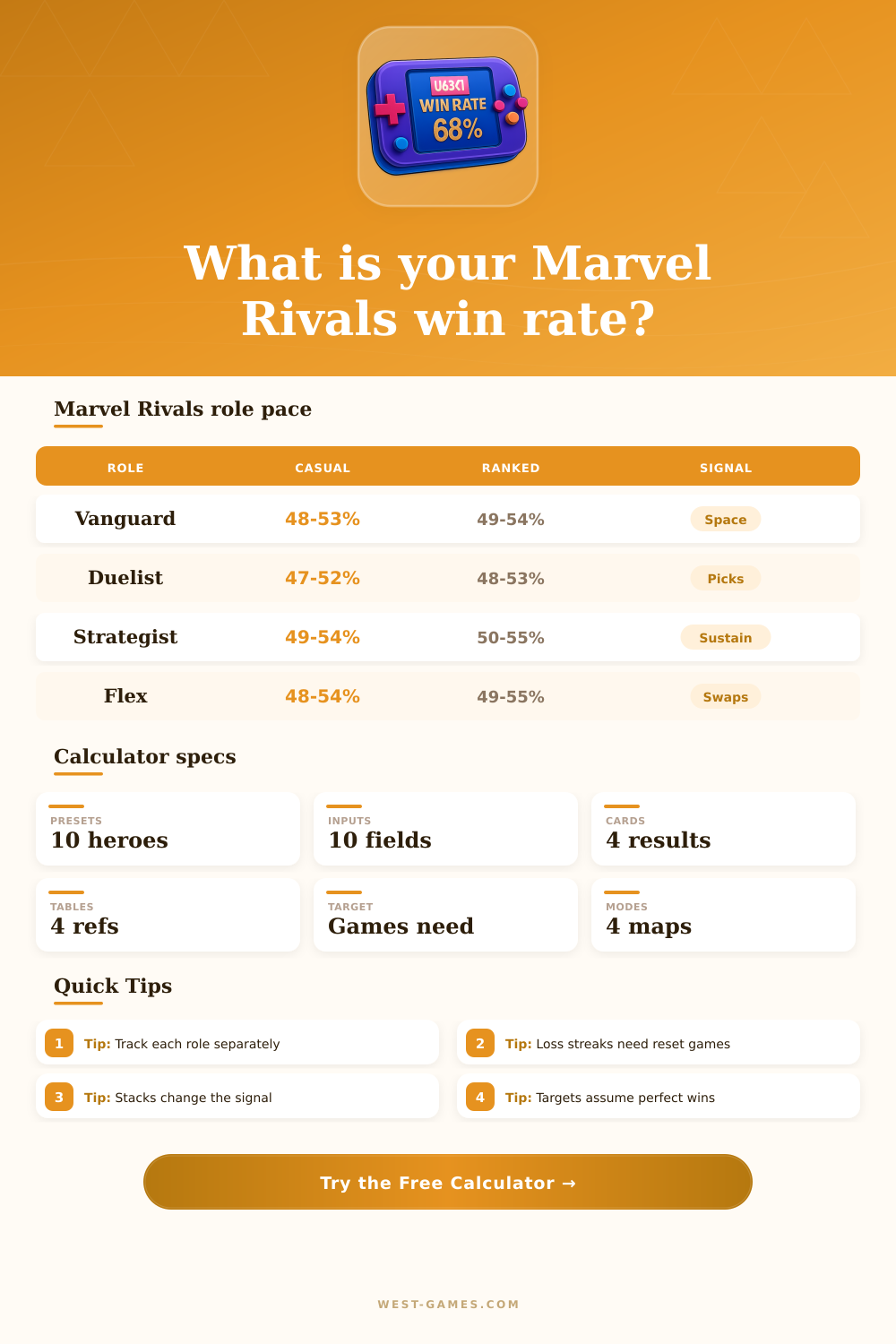
To determine whether your performance is normal or an outlier, you look at page’s reference tables. These tables contain baseline expectations per role so you can adjust your own goals. The trick here is understanding what you are actualy measuring. It’s not measuring consistency across a random sample. It’s measuring consistency across a controlled sample size. It’s not measuring luck. So you don’t need to chase perfection, and once you start to track consistent, specific hero performances in competitive queue, you see the way up. That five-loss slide that felt like it was about you yesterday? It is just data that needs to be processed.