🏆 Clash Royale Ultimate Champion Win Rate Calculator
Estimate Ultimate Champion medal pace from current UC rating, season record, deck matchup, Trophy Road context, target threshold, and expected games.
| Medal target | Planning label | Win rate feel | Session note |
|---|---|---|---|
| 1200-1499 | UC entry | 50-54% | Stabilize swings |
| 1500-1799 | Steady UC | 54-57% | Deck comfort matters |
| 1800-2099 | Strong push | 57-60% | Avoid cold queues |
| 2100-2399 | High UC | 60-63% | Small edges compound |
| 2400+ | Peak ladder | 63%+ | Variance control |
These are calculator planning bands. Use your actual medal gain and loss values for tighter expected-game math.
| Matchup state | Win chance mod | Medal effect | Use when |
|---|---|---|---|
| Very favorable | +7.5 pts | Fast climb | Meta pocket helps |
| Favorable | +3.5 pts | Good climb | Soft counters common |
| Even | 0 pts | True deck test | Mixed queue spread |
| Unfavorable | -5 pts | Target slows | Counters are frequent |
| Hard counters | -9.5 pts | Negative risk | Repeated bad pockets |
Do not overfit one battle. Choose the matchup profile from a real UC session sample.
| Win rate | Win gain | Loss drop | Expected medals/game |
|---|---|---|---|
| 54% | +27 | -25 | +3.1 |
| 57% | +27 | -25 | +4.6 |
| 60% | +26 | -26 | +5.2 |
| 63% | +25 | -27 | +5.8 |
| 50% | +25 | -25 | 0.0 |
Formula: win chance times win gain minus loss chance times loss drop, then adjusted for non-result risk.
| Current | Target | Net/game | Expected games |
|---|---|---|---|
| 1500 | 1800 | +4.0 | 75 |
| 1800 | 2000 | +5.0 | 40 |
| 1900 | 2200 | +4.6 | 66 |
| 2100 | 2400 | +5.8 | 52 |
| 2300 | 2500 | +3.5 | 58 |
Actual ladders are streaky. Treat expected games as a planning center, not a promise.
By the time you’ve reached two thousand Ultimate Champion medals, ladder turns from being a game of skill to a game of nerves. An hour of perfect play can be undone by a single bad pull and now you’re not just playing Clash Royale, but also managing variance and anxiety.
That is why it’s important to know what your actual win rate is at this point. It turns guesswork into a plan. Plug in your recent swings and your current rating and let the calculator do math for you. Don’t sit there staring at a blank screen deciding whether you should of log off or keep going.
How to Win at High Trophies
Not all Ultimate Champions are created equal. Winning streaks cause them to show up in clusters and losing streaks sees them go down in a free fall. These clusters appear as your chosen deck archetypes. If you play a cycle deck such as Goblin Drill or Hog Rider, your winrate will greatly depend on being able to take advantage of small errors instead of simply forcing down their towers through sheer volume of outplays. With beatdown decks like LavaLoon or Golem, you has slightly more wiggle room per trade, but if you get hit with a hard counter that can shut down your main push entirely, it’s lights out for you.
To account for this, the tool allows you to pick your deck archetype first, which then tweaks the starting winchance accordingly to reflect how well that type tend to perform against current meta spread.
This is something almost nobody looks at until it’s already too late. What happens in each of your games? How much do you go up or down on medals from that result? For example, maybe you’re gaining twenty-seven medals when you win, but losing thirty-five medals when you lose. That means, regardless of how well you perform, you’ll never climb.
That difference is your net medal pace. If your net medal pace is positive, then you can grind through the meta and still make some kind of progress. If your net medal pace is negative, then you lose ground whenever you get tilted or run into an unlucky match. It makes sense to check this number before playing so you know whether your goal is realistic or not, you might have to change decks to improve matchup spread.
Just like numbers, this isn’t everything. But it’s also a bit of context. This looks at the confidence a high-trophy count provides. Even with identical Ultimate Champion medal counts, a player who’s been at 9k trophies for a while will face more diverse opponents than another who hasn’t played for ages but is now returning.
This looks at your mental state going into an arena battle. You’ll do better playing when you’re feeling sharp and dialed-in versus when you’re tired/tilted and grinding out a few games before taking a break.
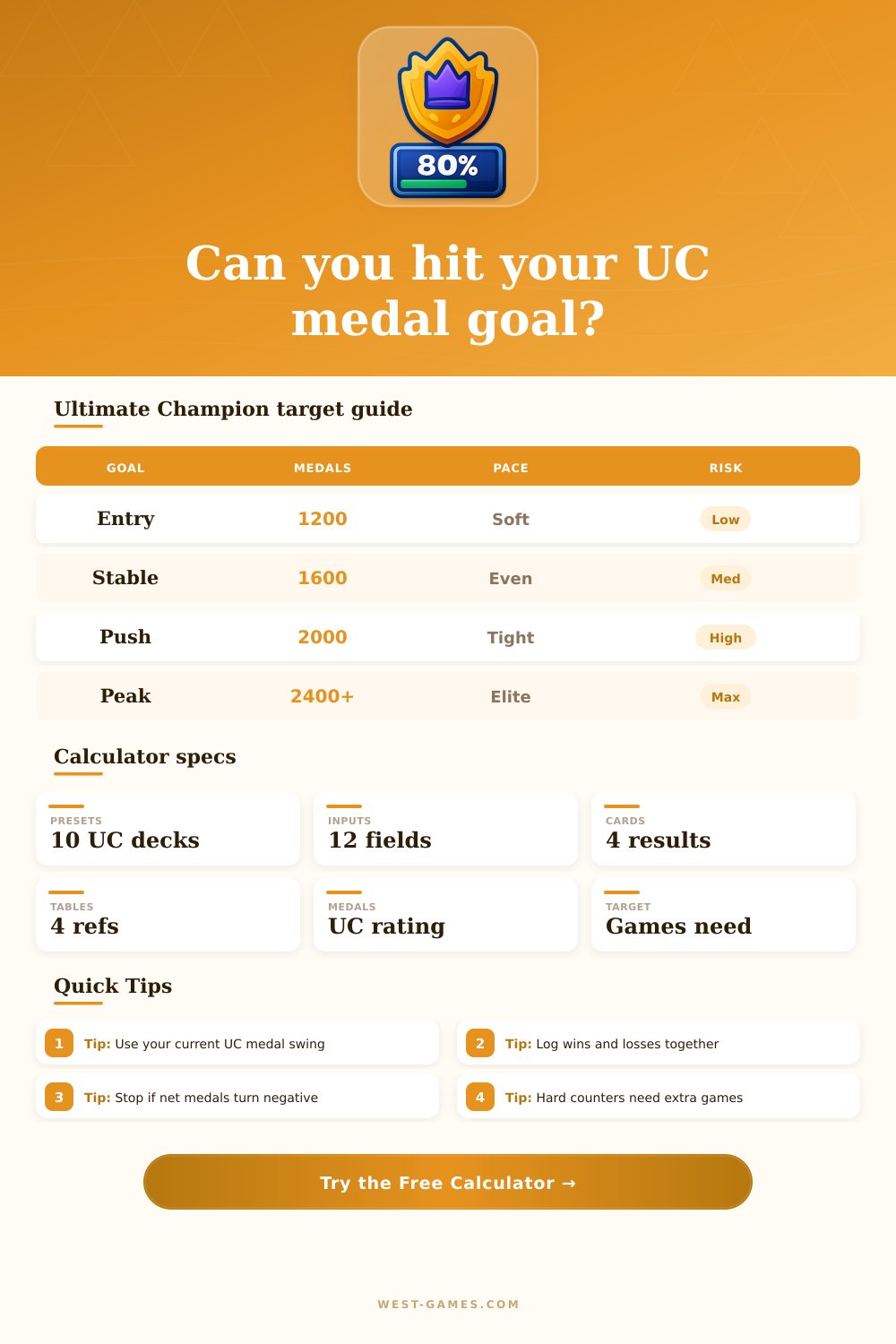
These tables is a good guide as to how many medals are needed to reach each range of medals. A thousand two hundred medals represents more or less a baseline level where you need stability above all else. Two thousand requires a solid win percentage, but also a well-managed session. Anything over two thousand four hundred is elite territory, and your ability to control variance will be your greatest asset. It’s not about playing the game anymore, it’s about riding out the inevitable swings without going crazy.
Things start to go wrong. Quit when the numbers don’t add up in your favor. Log out if you’re going into negative medal-per-game territory. Take a step back by switching to a deck that counters what’s been frustrating you lately, or wait out a long stretch of queues. It isn’t about how many games you need to play; rather, you want to play efficienty. Have an entry plan and an exit plan for every session.
While there’s no magic deck to climb the Ultimate Champion ladder, there are things you can control: When do I quit? How many games do I play? Do my cards fit my personal style of decision making? And do they work together? You can’t control whether your internet holds up at a critical moment. You can’t control who you face. You can’t control any of that stuff.
What you can control is discipline. You need discipline to stay the course. You must have the discipline to let the numbers point you in the right direction. Then, when you trust the process rather then the result, that knot in your stomach will loosen.