✨ Oblivion Enchantment Calculator
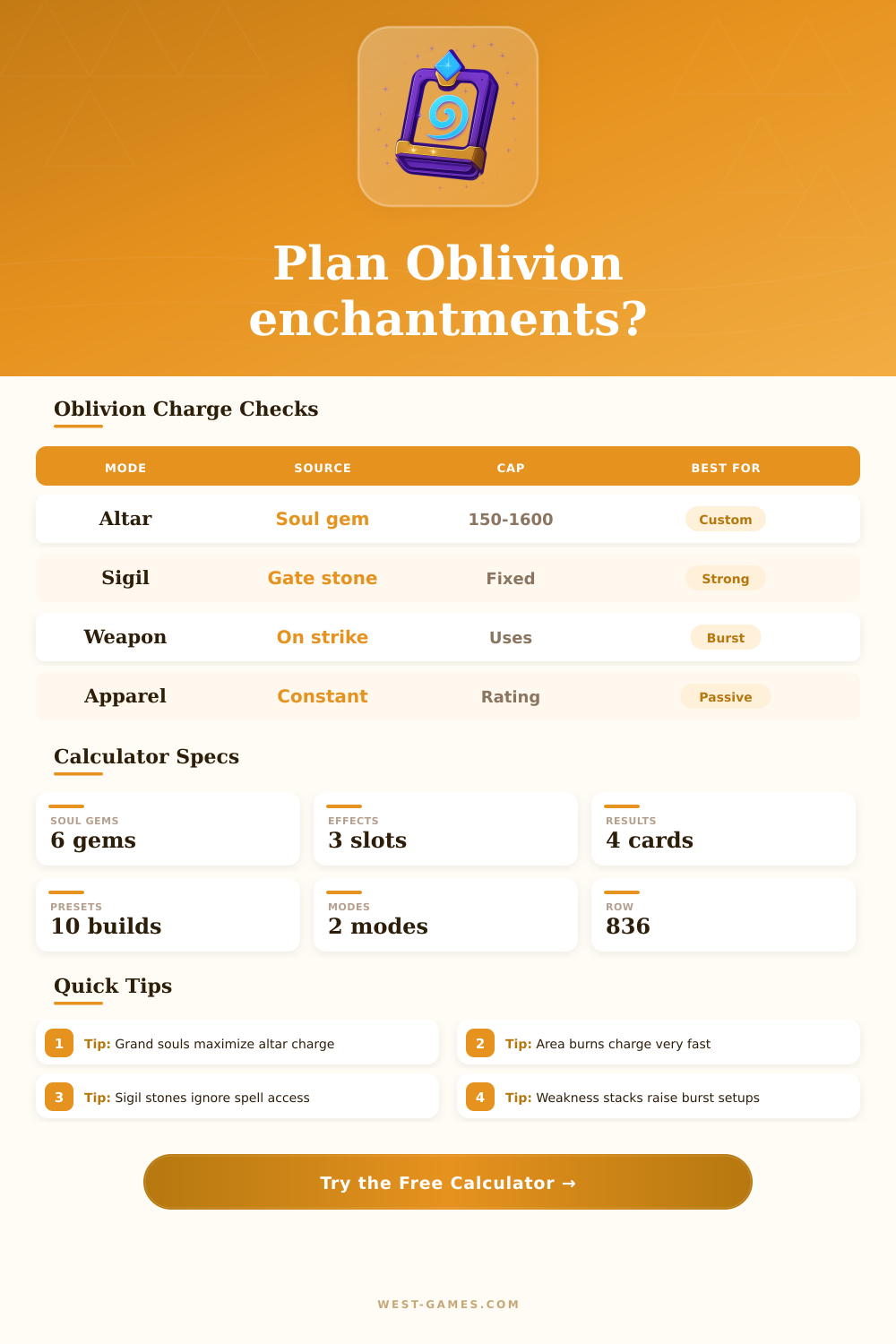
Plan The Elder Scrolls IV: Oblivion enchantments by soul gem charge, altar effect cost, sigil stone tier, magnitude, duration, area, and expected uses per full charge.
| Soul | Charge | Use | Note |
|---|---|---|---|
| Petty | 150 | Testing | Good for cheap Soul Trap tools. |
| Lesser | 300 | Low power | Works for short utility effects. |
| Common | 800 | Midgame | Enough for simple elemental weapons. |
| Greater | 1200 | Strong | Useful before grand souls are common. |
| Grand / Black | 1600 | Best altar | Top charge tier for custom enchantments. |
| Effect | Base | School | Behavior |
|---|---|---|---|
| Fire / Frost / Shock Damage | 2.5-3.0 | Destruction | Magnitude-heavy weapon burst. |
| Drain Health | 2.2 | Destruction | Efficient short-duration damage. |
| Absorb Health | 4.5 | Restoration | Costly, but adds sustain value. |
| Paralyze | 18.0 | Illusion | Very expensive per second. |
| Weakness / Silence / Soul Trap | 1.0-8.0 | Mixed | Duration matters more than magnitude. |
| Tier | Level Band | Weapon | Apparel |
|---|---|---|---|
| Descendent | Low | Small strike effect | Minor constant bonus |
| Subjacent | Mid | Moderate strike effect | Useful constant bonus |
| Ascendent | High | Strong strike effect | Strong passive bonus |
| Transcendent | 17+ | Top fixed strike effect | Top fixed passive bonus |
Sigil stones bypass soul gem selection and spell access but cannot be freely customized like altar enchantments.
| Pattern | Effects | Strength | Risk |
|---|---|---|---|
| Elemental blade | Damage only | Reliable burst | Low utility |
| Trap bow | Soul Trap + damage | Gem farming | Lower burst |
| Weakness stack | Weakness + element | High scaling | Costs more charge |
| Control weapon | Paralyze / Silence | Fight control | Few uses |
| Sigil apparel | Fixed passive | No recharge fuss | No custom mix |
| Step | Weapon Enchantments | Apparel Enchantments | Sigil Mode |
|---|---|---|---|
| Capacity | Filled soul charge from 150 to 1600. | Same soul rating, translated to passive budget. | Fixed by selected sigil tier. |
| Effect cost | Base cost x magnitude x duration x area factor. | Base cost x magnitude, with constant-effect scaling. | Fixed rating, shown against custom altar score. |
| Skill modifier | Higher spell skill lowers modeled drain. | Higher spell skill improves passive efficiency. | Does not require learned spell access. |
| Result | Capacity divided by cost per strike. | Passive rating and fit label. | Fixed strength and customization tradeoff. |
Oblivion’s enchanting is something to be taken serious and treated more like a mathematical equation than a crapshoot. Apply some effects at an altar, and get out whatever happens. It has to do with cost per effect vs. Charge capacity, and the higher the number the more times your thing hit before death. Luckily for us, the calculator above do the math for you. It lets you know exactly how many times a weapon’s gonna hit before they dies.
That’s where that ratio comes into play when creating item. First, there is the soul gem. With a max of 1600 charge (grand and black souls), a top-tier gem can hold much more than a commoner’s 150 (petty). Most players don’t pay attention to that, though; their eyes glaze over at how powerful an effect could be rather then thinking about its size. It can take a lot before realizing the gem can only sustain half a hit.
How to Make Strong Weapons in Oblivion
In fact, you may not check your gem’s capacity before maxing out your spell effects. The calculator takes your desired effect and compares it to what sort of soul tier you’re casting with. Lesser gems used for farming? Expect your charges-per-use to plummet. This is not necessarily a problem if you intend to recharge frequently, but it becomes a real liability once you get into those deep dungeon and resources start running low.
The cost of efficiency scales negatively with duration and area. Maybe you like your Fire Burst to go far? Increasing its range will grow much faster against charge. Don’t worry about guessing where your weapon will fall short. That’s what the penalty for expanded range is for; the calculator models it for you.
When combined with secondary effects, it’s easy to forget just how fast those numbers adds up. Want to paralyze enemies? Sure, sounds good. Paralyze is so power hungry though that it’ll kill your item halfway through combat. The tool has lists that show these base costs clearly. Don’t worry if you’re using pricey spells. You just have to accept they’re situational weapons and not something to rely on.
Sigil stones represent another approach altogether: they don’t require a soul gem and grant set-in-stone effects depending on your level band. Strong? Sure, the transcendent sigil sword is. But it’s also static. You can’t modify its duration or magnitude. This allows you to compare the fixed strength of the transcendent sigil sword to what you might get from a customized experience at an altar.
Specialized builds often find that flexibility of the altar carries the day; however, players who are less keen on managing recharge items can stick with sigils as a reliable fallback. Convenience versus control: take your pick.
The second type of effect worth a closer look is a weakness effect, which scales damage rather than adding raw numbers directly. This means as it increases effective burst, your subsequent spells will hit harder without increasing the charge cost of that initial setup. The calculator takes into account this bonus from chaining the weakness into an attack, so you know exactly how much extra it’s giving you. It is one of those mechanics where “planning” beats out “brute force”. A lot of people don’t notice this because they see the base amount it does and assume it sucks. Never mind that it makes the next spell do more because it set the table.
Recharge logistics and managing soul gems The tool will estimate how many gems you’ll need to keep your items topped-off given their capacity and how much they’re being used. For example: if you need to top off a weapon with five grand souls, that’s going to be pretty hefty on your inventory space. Maybe you should of shave some time off of the duration so it won’t have to get recharged as often.
Often, you’re better off having something moderately powerful that doesn’t need constant maintenance instead of something legendary but constantly in need of repair. In practice, it’s a question of balancing out your efficiency. Do you need enough power to win fights? Or are you willing to use up resources on diminishing returns? On effects which will be gone within seconds?
The UI comes with some pre-sets of popular enchants, such as a soul trap bow or fire daggers, to get an idea of how players set up their builds. Then you change the area and magnitude to match your own style of play. Not everything has to go boom. Boom is nice but it also needs to stick around.