Mage Talent Calculator TBC
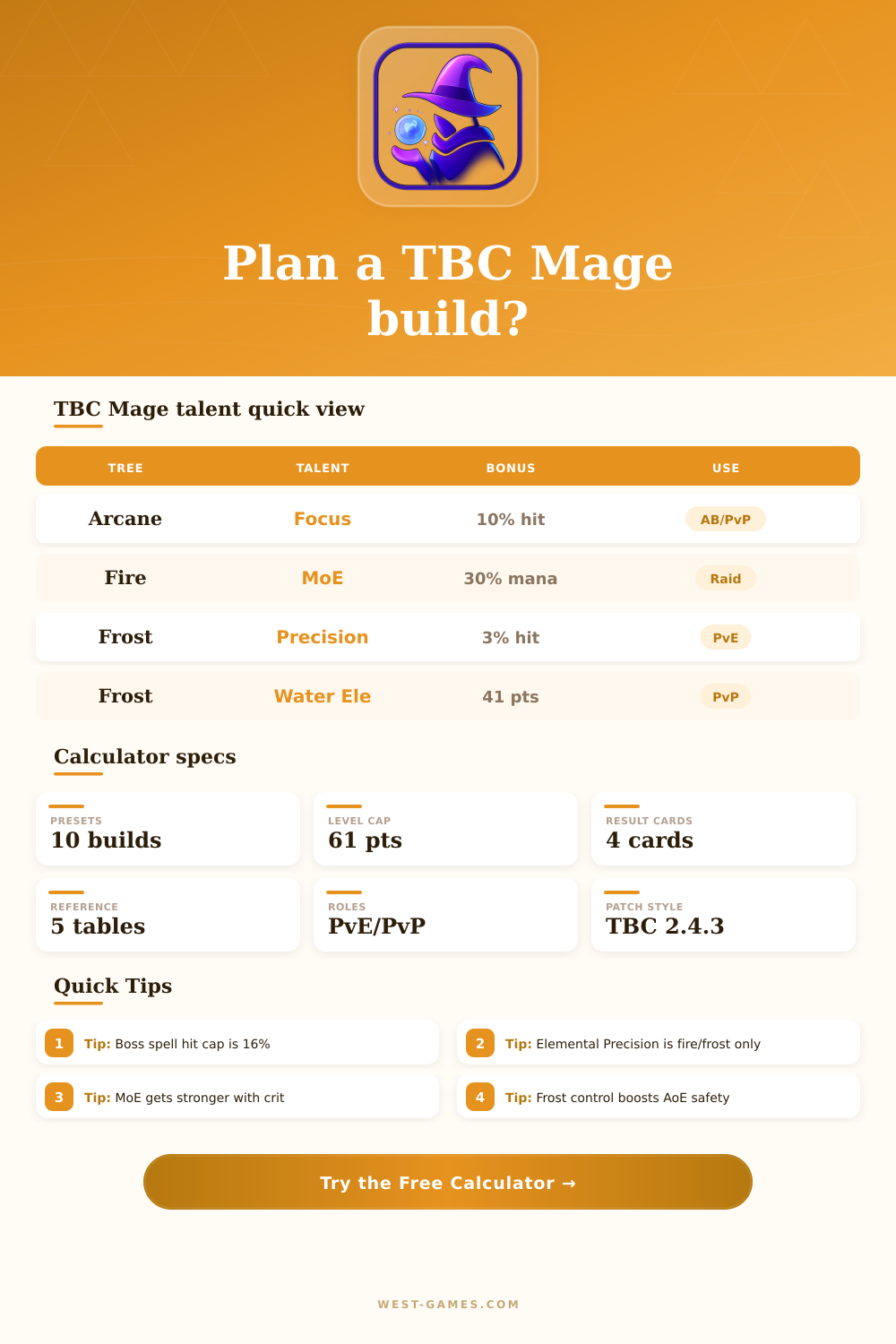
Plan Burning Crusade Mage Arcane, Fire, and Frost talent points with spell hit, mana efficiency, AoE farming, raid role, PvP control, spell coefficient, and breakpoint checks.
| Tree | Breakpoint | Talent check | Calculator use |
|---|---|---|---|
| Arcane | 20-21 points | Presence of Mind access | Burst and PvP tool score |
| Arcane | 30-31 points | Arcane Power access | Burst and Arcane spell weight |
| Arcane | 41 points | Slow access | PvP control score |
| Fire | 10-11 points | Pyroblast access | PoM Pyro and burst check |
| Fire | 30-31 points | Blast Wave access | PvP and AoE utility |
| Fire | 40-41 points | Combustion or Dragon's Breath | Raid crit or PvP control score |
| Frost | 20-21 points | Icy Veins or Cold Snap access | Raid speed and PvP reset score |
| Frost | 30-31 points | Ice Barrier access | Survival and farming safety |
| Frost | 41 points | Summon Water Elemental access | PvP pressure and control score |
| Spell | Family | Coefficient | Base mana model |
|---|---|---|---|
| Frostbolt | Frost | 0.814 | 330 mana |
| Fireball | Fire | 1.000 | 425 mana |
| Scorch | Fire | 0.429 | 180 mana |
| Arcane Blast | Arcane | 0.714 | 195 mana before stacks |
| Arcane Missiles | Arcane | 1.000 | 740 mana |
| Blizzard | Frost AoE | 0.952 total | 1640 mana |
| Flamestrike | Fire AoE | 0.571 total | 1175 mana |
| Cone of Cold | Frost AoE | 0.129 | 645 mana |
| Source | Value | Applies to | Planning note |
|---|---|---|---|
| Gear spell hit | Custom | All spells | Primary way to close boss cap |
| Arcane Focus | 2% per rank | Arcane spells | Up to 10% for Arcane Blast or Missiles |
| Elemental Precision | 1% per rank | Fire and Frost | Up to 3% plus mana discount |
| Misery or Improved Faerie Fire | 3% | Raid target | Requires reliable debuff uptime |
| Inspiring Presence | 1% | Party aura | Alliance Draenei support only |
| Role | Most valuable | Secondary | Weakness to watch |
|---|---|---|---|
| Raid DPS | Hit cap and cast value | Mana sustain | Overcapping hit wastes item budget |
| Heroic dungeon | Control and uptime | Efficient damage | Too little Frost control raises risk |
| Arena or battleground | Control and burst | Survival | Pure PvE hit stacking is less useful |
| AoE farming | Frost control | Mana per pull | Low sustain breaks pull rhythm |
| Solo leveling | Safety and efficiency | Damage per mana | Deep burst talents can drink often |
| Preset | Point split | Primary use | Typical strengths |
|---|---|---|---|
| Arcane Frost Raid | 40/0/21 | Boss DPS | Arcane burst with Icy Veins support |
| Deep Fire Raid | 2/48/11 | Fireball DPS | Strong Fire depth and Master of Elements |
| Icy Veins Fire | 0/40/21 | Hybrid raid | Fire damage with Frost cooldown utility |
| PoM Pyro | 21/40/0 | PvP burst | Presence of Mind plus Fire finishers |
| Deep Frost PvP | 0/5/56 | Arena control | Ice Barrier, Cold Snap, Water Elemental |
| AoE Frost Farm | 10/0/51 | Outdoor farming | Frost control, Ice Barrier, Blizzard safety |
| Elementalist PvP | 0/30/31 | Mixed PvP | Blast Wave plus Ice Barrier pressure |
| Arcane Blast | 46/15/0 | Arcane DPS | Arcane Focus, Arcane Power, high hit support |
| Dungeon Control | 18/0/43 | Heroics | Frost safety with Arcane utility |
| Leveling Fire | 10/41/10 | Solo questing | Fire depth with utility and basic precision |
In The Burning Crusade, building a mage means juggling several restrictions: How do I have enough mana to sustain myself? Do I want burst potential or control abilities? Damage is required too! It’s been a challenge that players has struggled with from the time raids got serious. After you figure out what you want to be as a Mage, plugging your stats into the calculator removes all but the math from your decision making process. Input your spec, select your role, and let it tell you what talents is worth considering based off your playstyle. At this point, most of the anxiety falls away.
Hit rating is your first consideration because missing spells realy hurts. Total spell hit required to land 100% of your casts on a level seventy-three raid boss is sixteen percent. This tool takes into account all raid buffs like Improved Faerie Fire or Misery and talent effects such as Elemental Precision or Arcane Focus. It will tell you exactly how many more points of gear hit you need.
How to Choose Your Mage Build
It’s tempting to overstack hit early on to be “safe” but you’ll find yourself wasting precious item budget on stats you don’t actualy require. With exact knowledge of the shortage, you can focus on spell power instead… A far superior use of those gems and sockets.
The other half of the equation, mana management, is just as important, particulary if you’re planning on some extended farming or fighting. By accounting for your current mana pool, regeneration rates, and talent refunds (such as Master of Elements), the calculator estimate how much sustain your character has. For Fire mages specifically, this talent is an absolute beast, since it refunds part of its base mana cost when you land a critical strike. Build some gear to boost your critical strike chance to make that refund stronger. This allows you to keep casting while draining your health bar instead of drinking mana pots all day. Weigh that against your cast rate and estimated fight time and it’ll spit out a sustainability score that lets you know whether your build will last through three or four minutes.
Deep Frost builds focus on defensive talents like Cold Snap and Ice Barrier. These give them safety net that is missing from pure damage trees. This makes Frost the clear winner for PvP survivability, AoE farming, and crowd control. If you’re farming outdoors at high volume, having Icy Veins remove Blizzard from the global cooldown is a huge plus. This can be factored into the calculator, which will increase your score based on what you expect to pull an hour.
If you’ll be running heroics instead, you may want to give up some of your AoE might for increased direct single target damage and some utility spells (like Polymorph or Slow). The page has some reference tables that show how point distribution affects your efficiency in different environments. That’s where the PvP component comes into play: Raw numbers aren’t always everything. Sometimes having more survivability trumps damage output. Even though a build may seem awful on paper, it could excel in arena due to its ability to avoid being locked down or interrupt an opposing caster. Having the right amount of hit rating for a well timed Pyroblast and Presence of Mind can be the difference maker. But that only works if you are able to land the spell in the first place.
The ability lets you switch between a raid lens and a PvP lens. This helps you see if your current build is too fragile or if you lack enough burst to get the kill. Obviously this isn’t a replacement for skill, but it helps ensure you’re not crippling yourself by making bad talent decisions prior to stepping foot in the battleground.
The right mage build for TBC isn’t one size fits all. It’s different than your encounters, your playstyle, and which members is in your guild. Some people like to roll with a pure Fire spec that revels in Combustion proc chains and critical strikes. Some people like a more moddern style. They use Arcane Blast for its lower mana cost and predictable damage output.
The important part is not just to parrot a meta build but instead to know what the talents actualy do in practice. When you get it down to how it feels in practice combined with your gear and role, things become very clear. You go from blind guessing to optimization. What makes this period so flexible is that whatever talents you choose should of fit your short-term objectives; whether that’s farming Shadcrovel in Shadowmoon Valley, or wiping on Kael’thas. Use the planner to experiment with different scenarios, change your hit rating targets to match, and imagine the tradeoffs. What it does is transform a scary spreadsheet into a clear discussion regarding who you’d like to be as a mage. Once you know that, the rest fills itself out.
Don’t forget to check for your hit cap first, though. It is always the first step.